Two things happened to Chinese micro-drama inside eighteen months, and most foreign brands have only heard about one of them.
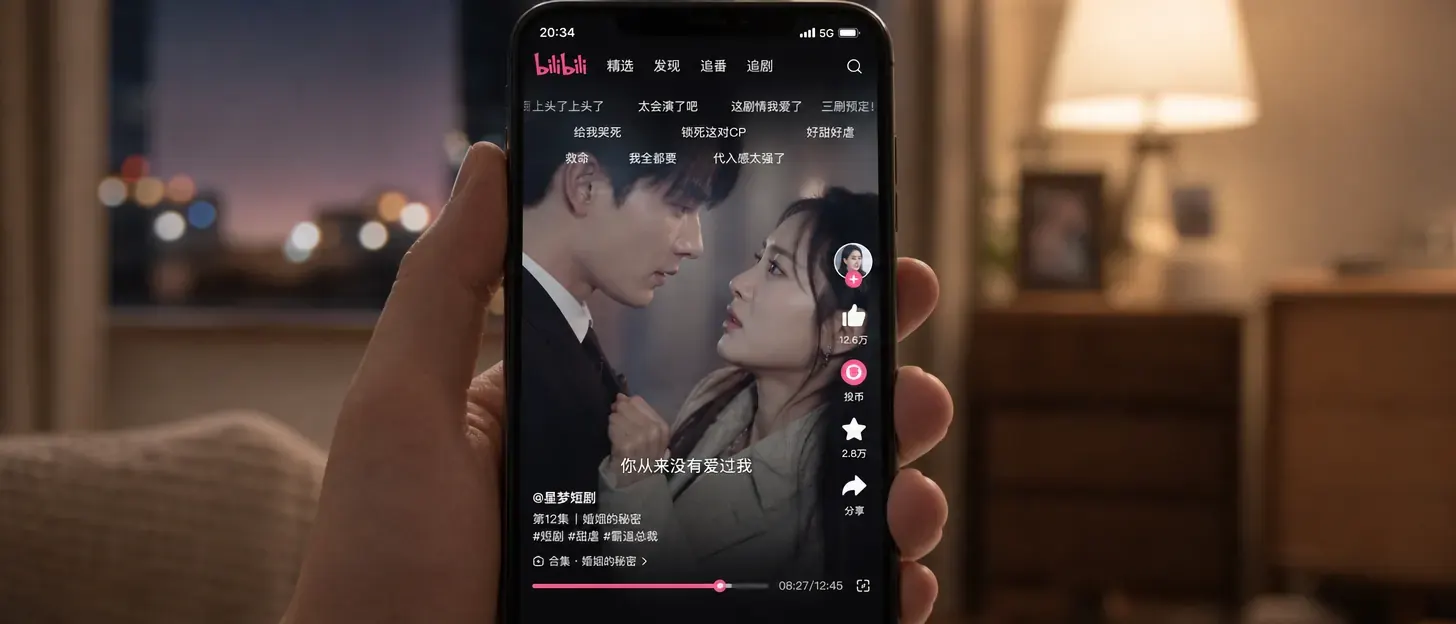
The first is the money. Micro-drama (微短剧) is the vertical, sixty-second serial format that runs on Douyin (抖音), Kuaishou (快手) and a handful of free apps. It stopped being a curiosity a while ago.
China’s micro-drama and animated-drama sector produced roughly RMB 100 billion in value in 2025, against total national box office receipts of RMB 51.8 billion. The two are not measured the same way, but the gap is wide enough that the direction is not in dispute. Source: DataEye Research (DataEye研究院), January 2026
The second thing is the cost curve. In December 2025, SenseTime (商汤科技) launched Seko 2.0, an agent that writes and produces multi-episode drama end to end. Kuaishou has Kling (可灵). ByteDance has Jimeng (即梦). The vendor names matter less than what they collectively did to a line item.
A professional team traditionally needed more than three months to finish a fifty-episode animated drama. SenseTime claims production cycles compress by 80 to 90 percent using Seko 2.0, with one creator running script, assets and compositing alone. Source: SenseTime, reported by Sina Finance (新浪财经), December 2025
For a brand, the interesting number isn’t the render speed. It’s what happens to a production quote when the floor drops out.
Rules in this area are moving quickly. Everything below reflects what was in force as of July 2026.
The four ways brands use it
| Route | What you get | Rough control | Where it fits |
|---|---|---|---|
| Single-episode placement | Product appears in someone else’s drama | Low | Cheap test, fast |
| KOL custom drama | Creator builds a short series around you | Medium | Category launch |
| Brand custom drama | You own the script, cast, IP | High | Flagship story |
| AI animated drama | Fully generated, no shoot | High | Young, male, gaming skew |
Custom is the mainstream now, not the exception.
Roughly 90 percent of brand micro-dramas on the market are brand-custom productions rather than one-off placements. Source: The Paper (澎湃新闻), 2025
Is the audience there
Yes. Although it is not the audience the format started with, and that gap is where most brand teams are still working from old information.
China’s micro-drama user base reached 718 million by February 2026, with first and second-tier city users rising as a share and average daily viewing above two hours. Source: Sina Finance (新浪财经), May 2026
That last clause deserves a second read. The early caricature of micro-drama was a lower-tier, low-income, low-attention audience, which made it easy for a European marketing director to file the whole format under “not our consumer.” Two hours a day of anything is a habit, and the demographic has drifted upmarket while nobody in Paris or Milan was looking. Beauty and personal care, health, and mother-and-baby are the categories buying in hardest, which is to say the categories most foreign consumer brands are already in.
The cases are real, not decks.
Jiumu (九牧) ran a six-episode branded drama built around a time-travel premise for its smart toilet range. First week: over 100 million views, topic views above 120 million, first place on Douyin’s brand drama chart. Source: The Paper (澎湃新闻), 2025
A time-travel comedy about a toilet. That is the register this format rewards, and it is usually the first thing a European brand team balks at. The AI route is pulling a different crowd, younger and more male, which suits categories that struggled with live-action drama.
OPPO chose a deeply customized AI animated drama for its K15 Pro launch. Day-one playback passed 10 million. Source: Sina Finance (新浪财经), May 2026
SK-II went another way, working with a Douyin creator on a custom series where the product claim and the show’s title echoed each other. Liangpin Puzi (良品铺子) did something cheaper still, attaching a spin-off episode to an existing hit around a gifting moment, which cleared 143 million impressions. The budgets are nowhere near each other. The bet underneath them is the same one.
What the tool demos leave out
Now the part the launch coverage skipped.
While the cost of making AI drama collapsed, the cost of publishing it went up.
Since September 1, 2025, all AI-generated or AI-assisted audio and video must carry a visible on-screen label that cannot be shrunk or blurred, plus hidden traceability data in the file’s metadata recording the generating party and the AI participation ratio. Source: Xinhua (新华网), September 2025
Then the filing regime arrived on top of it.
From April 1, 2026, AI-generated animated drama must be filed before release, with review tiered by budget: above RMB 3 million or sensitive subject matter goes to the national regulator, RMB 1 to 3 million to the provincial level, and below RMB 1 million to platform self-review with provincial filing. Source: Liumeiti (流媒体网), 2026
This is being enforced, not announced.
In a one-week campaign starting April 7, 2026, Hongguo (红果) removed 3,522 AI animated dramas that were unfiled or unlabeled. Kuaishou’s drama section screened over 8,000 AI titles and pulled more than 900. Source: Liumeiti (流媒体网), 2026
So production got roughly 90 percent cheaper while distribution got conditional. The saving is real but it moved rather than disappeared: money you no longer spend on a crew goes to filing and labeling, to clearing rights, and to a lawyer who reads the script before it ships. Brands that budget for the first half only end up with a good series that never reaches a feed. Or worse, one that reaches it and gets pulled at eight million views.
One more wrinkle, and it’s a softer one. The label says “AI generated” on every episode. Nobody in the market yet knows what that does to a luxury or premium positioning, or whether the algorithm quietly discounts labeled content in distribution. If your brand equity rests on craftsmanship, that stamp is a brand decision before it’s a production decision.
Where the budget actually goes
None of that makes the format a bad bet. It changes where the money sits.
Budgets are moving in two directions at once, which is what catches people out.
| Live-action brand custom | AI brand custom | |
|---|---|---|
| Cost direction | Rising | Falling |
| Typical shoot | 7 to 15 days | No shoot |
| Filing | Required | Required |
| AI labeling | No | Yes, every episode |
| What you own | Script and footage | Script, assets, model outputs |
| Main risk | Budget overrun | Takedown, or the label itself |
The live-action market moved while AI was moving too, and in the opposite direction.
Shooting budgets that used to sit at RMB 300,000 to 500,000 with a three to five day wrap have stretched to seven to fifteen day shoots, with premium productions approaching the million-RMB range. Source: Sina Finance (新浪财经), May 2026
So the two routes are pulling apart. Live-action is professionalizing and getting more expensive. AI is getting cheaper and more regulated. A brand picking between them in 2026 is really picking which risk it would rather carry, a budget that runs over or a series that gets pulled.
How to sequence it
Almost nobody should start with a custom series, whatever the agency pitching it says.
Start with a single-episode placement inside a drama that already has an audience. It costs little and tells you within two weeks whether your category lands in this format at all. Every brand we have taken through this wanted to open with the flagship series, and the ones who tested first are the ones who did not waste the flagship budget learning what their hook was. Watch what happens to brand search volume, not to views. Views are the vanity number here; search is the one that tells you a viewer went looking for you afterwards.
If the search moves, go to KOL custom. You get a creator’s existing audience, a shorter approval chain, and a producer who already knows where the review lines sit. Only after that does a brand custom series make sense. By then you’ll know your own hook and how much product visibility your category will actually tolerate before viewers swipe.
And the piece most brands forget: a drama that works sends people searching, and search has to land somewhere that can sell. If your Tmall Global (天猫国际) or Douyin store isn’t live and stocked when the series drops, you paid for someone else’s traffic. The content and the store go live together, or the content goes out alone. We work through that sequencing in social commerce and campaigns, and if the format itself is new to your team, it is one of the things we cover in the masterclass.
The format outgrew the fad label a while ago, and it was never really the discount channel people filed it as. It’s where roughly seven hundred million people now spend a serious slice of their evening. The tooling removed the old excuse that this was too expensive to try, so the question facing most brands now is a narrower one: whether they want to learn this format on a small placement in 2026, or on a flagship series in 2028 when the category is crowded and the cost of a miss is higher.
Working on China? Let's grab a coffee.
Tell us where you are now and where you want to get to.