Six new overseas brands opened a store and started selling in China every single day last year. Not applications, not pilots. Live stores, taking orders.
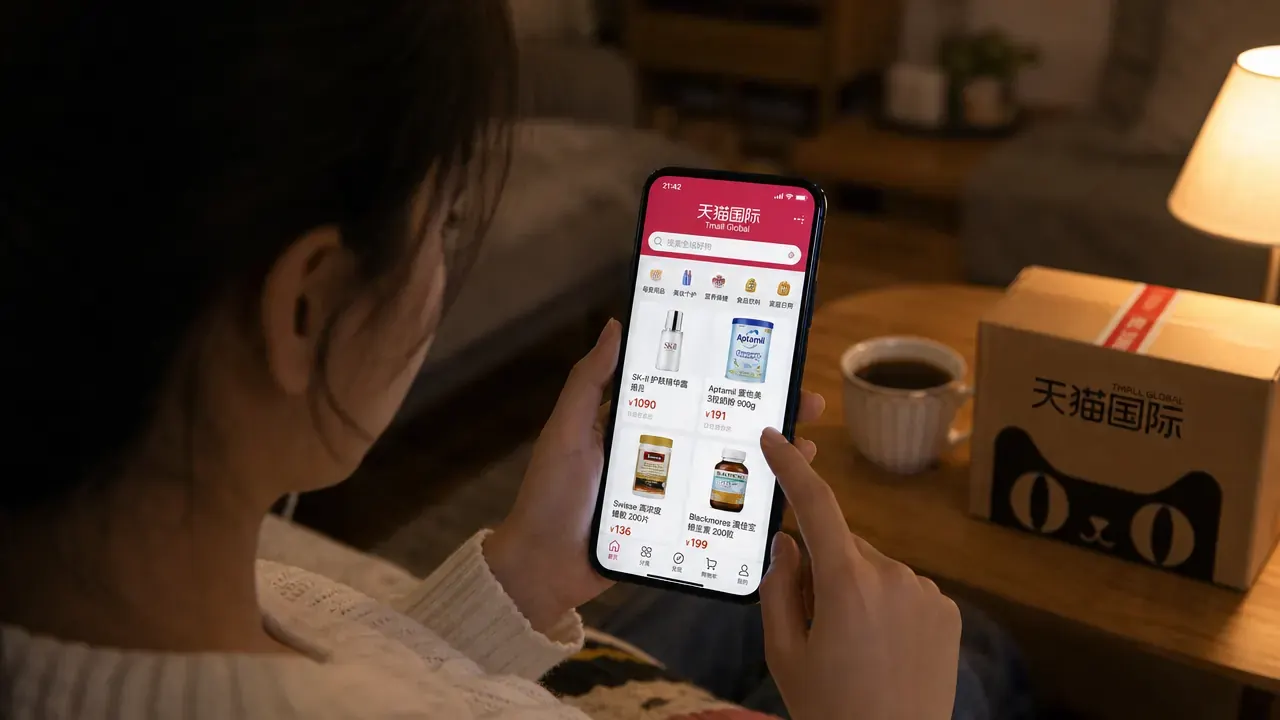
That is the headline from Tmall Global’s 2025 wrap-up, and it is worth sitting with for a second. Tmall Global (天猫国际) is Alibaba’s cross-border arm, the storefront that lets a brand sell to mainland consumers without registering a Chinese company or shipping inventory into the country first. Goods clear from a bonded warehouse or ship direct from overseas. For most foreign brands, it is the first real door into China.
In 2025, 2,415 overseas brands opened their first store on Tmall Global, a double-digit year-over-year increase in new flagship stores. That works out to more than six new brands a day. Source: China Economic Net (中国经济网), citing Tmall Global data
The fourth quarter was the busiest stretch of the year, with 691 new brands landing in those three months alone. You can see why. China is still the market global brands cannot afford to skip, and for most of them Tmall Global is where they test the water first.
The 2025 picture, at a glance
| What | The number |
|---|---|
| New overseas brands on Tmall Global | 2,415 |
| Average per day | 6+ |
| Peak quarter (Q4) | 691 new brands |
| Countries and regions represented | 52 |
| First-time countries | Cuba, Chile, Lithuania, Slovenia, San Marino |
| Total brands on platform to date | 40,000+ from 110+ countries |
The new cohort came from 52 countries and regions. The U.S., Japan and South Korea led on volume, while France, New Zealand and Australia grew fastest. Cuba, Chile, Lithuania, Slovenia and San Marino sent their first brands to the platform in 2025. Source: China Economic Net (中国经济网), citing Tmall Global data
Where they aimed matters more than how many showed up
If you are weighing a China move, this is the part to pay attention to. The brands showing up are not chasing the mass market anymore. They find a narrow, specific need and make it their own.
Health, beauty and personal care, and mother-and-baby drew the most new entrants. But inside those big categories, brands went hunting for the tight segments. Infant food was the hottest lane of all.
New infant food brands surged 128% in 2025. In personal care, where domestic Chinese brands have taken over the mainstream, new overseas brand numbers grew 37%, and more than half of those went straight into hair care. Source: China Economic Net (中国经济网), citing Tmall Global data
That last detail is the whole point. When the middle of a category fills up with strong local players, the foreign brands that win are the ones stepping sideways into a problem nobody else is solving well. Scalp sensitivity. Oral-care oils. Toothpaste made for people in braces. Single-use hair dye pens. The Tmall report lists these specific lanes as the fast movers.
This lines up with what we tell brands before they spend a yuan. The “1.4 billion consumers” pitch is a trap. A sharp answer to one real consumer problem beats a broad answer to a vague one, every time. If you want the longer version of that argument, our piece on why most foreign market tests fail walks through it.
Five categories that doubled
Opening a store is the easy part. What you sell once you are inside is the real test, and in 2025 five categories pulled away from everything else.
Tmall Global’s fastest-growing categories by sales in 2025 were collectible toys, outdoor gear, infant food, fashion cosmetics and pet wellness. All five doubled their annual sales year over year. Source: China Economic Net (中国经济网), citing Tmall Global data
Those five categories have one thing in common. Chinese shoppers are spending on themselves, and on the people and pets they love. Collectible toys rode the same wave that put LABUBU, the toothy little character from Chinese toymaker Pop Mart, on every other bag in Shanghai. Outdoor gear reflects a country that discovered camping and hiking a few years ago and has not put it down since. And pet wellness is pure “it economy,” with owners now buying supplements for their cats using the same care they give their own.
None of these are impulse buys. They are exactly the categories where a foreign brand with real quality and a clear point of view can still ask for a premium price and hold it.
The brands already winning, and how they did it
Category data tells you where the demand is. Individual brands tell you what to actually do about it. Numbers are easy to nod at, but names are harder to argue with, so here are real brands, real products, and real results from the last cycle, each one showing a different way in.
| Brand | Origin | What happened |
|---|---|---|
| BORJOMI | Georgia | Mineral water. GMV up 7x vs. launch; 500ml glass bottle a sell-out |
| brieye | Europe | Eye care. Grew 8x its home-market rate; 30M+ RMB cumulative |
| WHC | Australia | Supplements. From 2.6M RMB (2019) to 120M+ RMB (2025) |
| Nutrafol | USA | Hair-growth supplement (Unilever-owned). Monthly GMV past 1M RMB within 3 months |
| COVERNAT | South Korea | Streetwear. Winter down jackets sold out on launch |
| Weverse Shop | South Korea | Fan merch. Top-3 new brand by GMV; broke 3M RMB fast |
Take brieye, a European eye-care brand most people outside the category have never heard of. Being unknown in China turned out not to matter at all, because the niche was theirs to take.
European eye-care brand brieye grew at eight times its home-market rate after opening on Tmall Global, passing 30 million RMB in cumulative sales in a little over half a year. “The support and the dedicated service made entering China simple,” the brand said. Source: NetEase (网易), citing Tmall Global
Hair care was the wedge. That 37% jump in personal-care brands, with half of it going into hair, was not random. UK brand Xcare shows the play in miniature: find the specific pain point, solve it, say so plainly.
UK hair-growth brand Xcare targeted the “sensitive and oily scalp” shopper with a propylene-glycol-free formula, using an “effective but gentle” angle to break out of a crowded anti-hair-loss field. Source: China Economic Net (中国经济网), citing Tmall Global data
Livestream is what turns a slow entry into a fast one, and BORJOMI is the story I point to when a brand asks how it actually works day to day. The Georgian mineral water brand did not build slowly. It prepared, then spiked.
BORJOMI air-freighted hundreds of thousands of bottles into a bonded warehouse ahead of Double 11, then got onto Luo Yonghao’s livestream in about two weeks through Tmall Global’s team. Store GMV is now up roughly 7x versus opening. Source: Sina Finance (新浪财经), citing Tmall Global
Patience compounds. And then there is WHC, the Australian supplement brand, which is the long-game counterpoint to all the fast-spike stories.
WHC went from 2.6 million RMB in Double 11 sales in 2019 to more than 120 million RMB in 2025, its seventh year on Tmall Global. Its executive described the growth as exponential. Source: Sina Finance (新浪财经), citing Daily Economic News
Six brands from six different starting points, each using its own tactics to get there. The thing they share is that not one of them tried to be everything to everyone. Each found the narrow thing it could win, and then went all in on it.
What this means if you’re thinking about China
The door is genuinely open, wider than it has been in years. Tmall Global has now onboarded more than 40,000 overseas brands from over 110 countries, and the platform has been cutting entry costs to pull in more, including deposit reductions and commission rebates for new merchants.
But open doors are not the same as easy money. Every brand above did its homework first. They knew their category and their price point, and they knew exactly which consumer they were chasing, all before a single unit shipped. The ones who treated China as a side project, with a small budget and a one-year clock, are not in these numbers. They washed out.
Most of that homework happens before a store ever opens: the category read, the pricing model, the choice between cross-border setup and a domestic entity, the decision on who runs the store day to day. Get those calls right and the platform data starts working for you instead of against you.
A few things we would take from the 2025 data if we were in your seat. Pick a narrow segment you can genuinely win, not the mass middle where domestic brands now dominate. Run a focused Douyin (抖音) test to validate real demand before you commit to a full storefront. And open your cross-border store when you are ready to run it properly, not as a flag to plant.
One more, because it catches a lot of brands out. The festival calendar is not a nice-to-have. Days like 618 and Double 11 do a serious chunk of the whole year’s sales, so inventory and livestream plans need to be built around them from day one, not bolted on later.
The brands winning on Tmall Global right now got two things right. They showed up prepared, and they stayed long enough for the work to compound.
Working on China? Let's grab a coffee.
Tell us where you are now and where you want to get to.