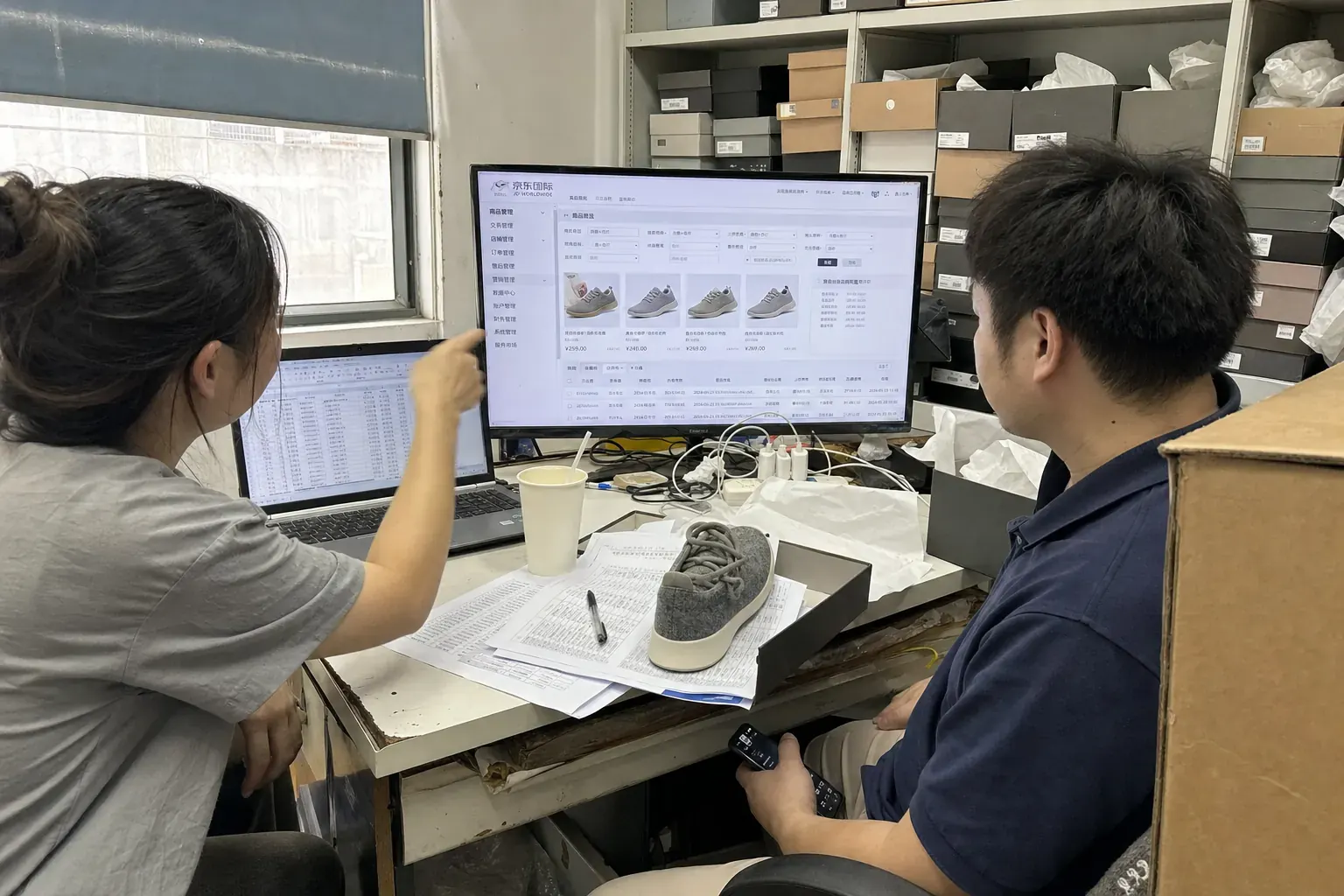
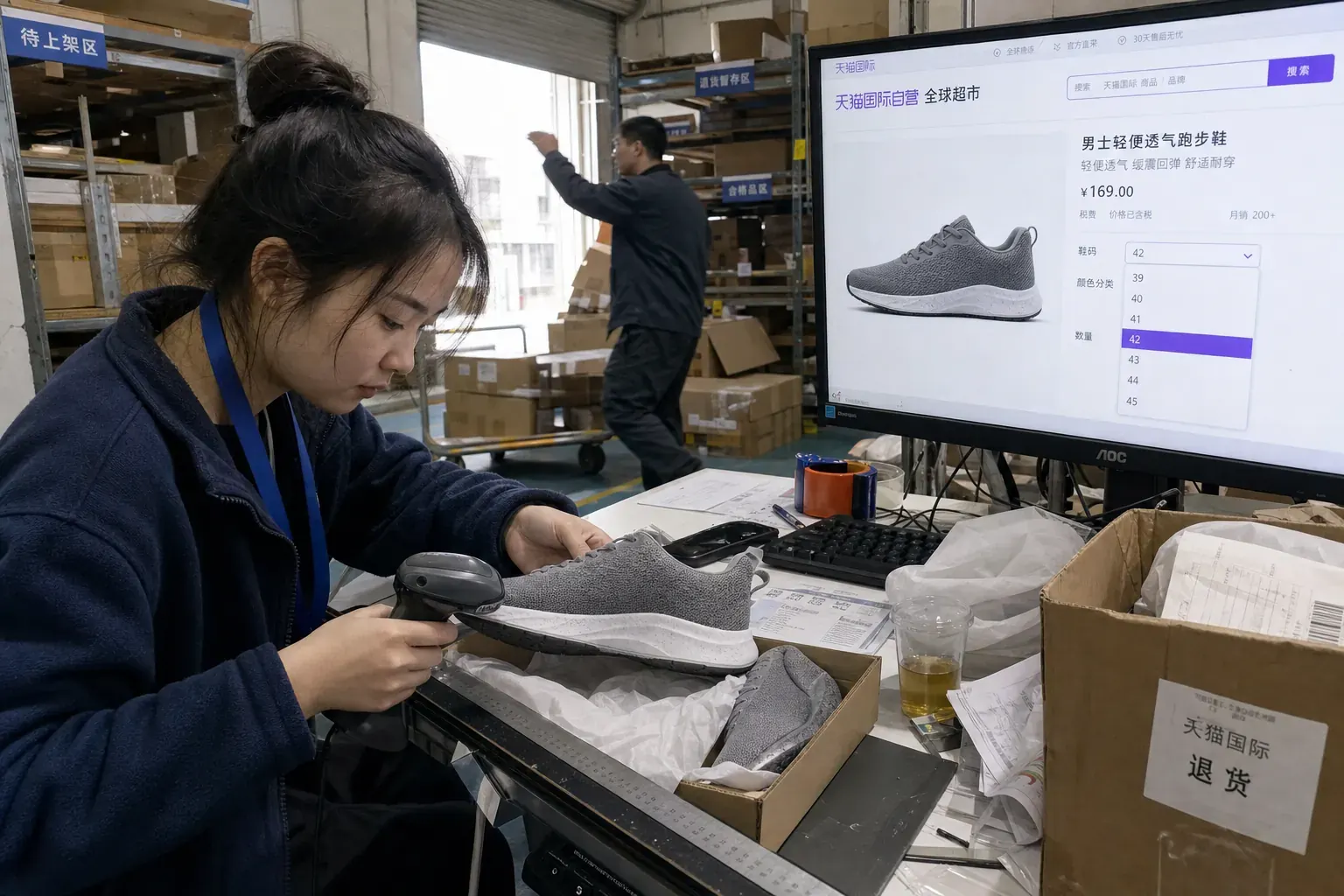
Start on Tmall Global. Footwear costs 110,000 RMB there before you sell a pair, against 35,500 RMB on JD Worldwide and 5,000 RMB on Douyin cross-border. Tmall takes 5% of every sale, JD and Douyin 6%. After that your return rate decides the year, and shoes come back often enough to eat a thin margin.
Footwear is one of the easier categories to bring into China. It sits on the cross-border positive list, needs no import license, and ships to the customer from a bonded warehouse inside China. The hard part starts after the sale. Fees first, though, because that is what brands ask.
What the three platforms charge for footwear
| Footwear, first year (RMB) | Tmall Global | JD Worldwide | Douyin cross-border |
|---|---|---|---|
| Security deposit, refundable | 50,000 | 35,500 (about US$5,000) | 5,000 |
| Annual platform fee | 60,000 | none | none |
| Commission on each sale | 5% | 6% | 6% |
| Cash in before the first sale | 110,000 | 35,500 | 5,000 |
Deposit, annual fee and commission by category for footwear on Tmall Global, JD Worldwide and Douyin cross-border. Source: TheChinaPath calculator data, October 2026.
Those are the published bands, checked October 2026. A TM trademark or a multi-brand store raises the Tmall deposit above the flagship figure, and your partner may quote differently. Argue from the row.
Douyin’s two figures moved recently. Its deposit stopped following category in June 2025 and now tracks last month’s sales: 500 RMB up to 50,000 RMB, 2,000 RMB up to 100,000, 5,000 RMB above that. We show the top tier. The 6% comes from the fee schedule Douyin published on July 15, 2026.
Douyin Global’s base deposit is set by the store’s paid GMV in the previous calendar month: 500 RMB from 0 to 50,000 RMB, 2,000 RMB above 50,000 to 100,000 RMB, and 5,000 RMB above 100,000 RMB. Source: Douyin E-commerce (抖音电商), 《【全球购】保证金管理规范》, latest revision effective June 5, 2025. https://school.jinritemai.com/doudian/web/articlev0/107821
Footwear (鞋靴) pays a 6% base technical service fee on Douyin Global. Source: Douyin E-commerce (抖音电商), 《【全球购】技术服务费费率标准》, July 15, 2026. https://school.jinritemai.com/doudian/web/articlev0/aHMYyFoqESKn
JD quotes its deposit in dollars. A brand flagship pays US$5,000 for footwear, converted above at 7.1, and other store types pay US$15,000. There is no annual fee, just a 0.9% transaction fee on each order.
Footwear (鞋靴) pays JD Worldwide a 6% operating support fee plus a 0.9% transaction fee, and a brand flagship deposits US$5,000. Source: JD Worldwide (京东全球购), category fee standard, revised September 24, 2026, effective October 1, 2026. https://jdw-rule.jd.hk/detail?ruleId=950583665543483392
Douyin has no annual fee either, which makes it look like the cheap door until you get to returns.
None of that includes stock, media, a Tmall Partner retainer or the bonded stack. Add the bonded warehouse deposit, the tax prepayment and the store build and a Tmall Global footwear flagship needs about 535,000 RMB wired before launch, roughly 150,000 of it refundable.
The route, and the trap inside it
Shoes are on the positive list, which decides what may enter this way at all.
The list runs to 1,142 eight-digit tariff lines and covers apparel and footwear among the consumer goods it admits. Source: Cyberspace Administration of China (中央网信办), carrying People’s Daily, April 2016. https://www.cac.gov.cn/2016-04/08/c_1118561924.htm
The edition in force is the 2019 list as adjusted by Announcement 2022 No. 7 (https://www.gov.cn/zhengce/zhengceku/2022-02/21/content_5674854.htm). Being on it comes with something most brands underrate.
Cross-border retail import goods are supervised as goods for personal use, and the first-import permit, registration and filing requirements do not apply to them. Source: MOFCOM and five other bodies, 商财发〔2018〕486号, effective January 2019. https://www.gov.cn/zhengce/zhengceku/2018-12/31/content_5437823.htm
No import license. No Chinese label glued to the box. The product page carries the Chinese information instead, and the customer buys as an importer of one. The same rule caps them at 5,000 RMB per order and 26,000 RMB a year (https://policy.mofcom.gov.cn/claw/clawContent.shtml?id=65769), a ceiling footwear rarely reaches.
Tax is light too.
Duty on cross-border retail imports is set at 0%, and import VAT and consumption tax are levied at 70% of the statutory amount. Source: Ministry of Finance (财政部), 财关税〔2016〕18号, March 2016. http://www.mof.gov.cn/gp/xxgkml/gss/201603/t20160324_2510682.htm
The general VAT rate has been 13% since April 2019 (https://www.gov.cn/gongbao/content/2019/content_5416183.htm), so a pair of shoes carries 9.1%. General trade pays the full 13% plus duty, needs a Chinese label, and falls under the mandatory standards, GB 30585-2024 for children’s shoes since June 1, 2025 (https://std.samr.gov.cn/gb/search/gbDetailed?id=19BBE2758DF1574AE06397BE0A0A5337).
Now the trap. China sizes shoes by foot length in millimeters.
GB/T 43293-2022 《鞋号》, a modified adoption of ISO 9407:2019, has applied since May 1, 2023. Source: National Standard Information Public Service Platform (全国标准信息公共服务平台), October 2022. https://std.samr.gov.cn/gb/search/gbDetailed?id=EB58F4DA9225B2A2E05397BE0A0A7D33
A European 41 is not a number a Chinese shopper carries around. They know 250, or 255. Paste a conversion chart onto the product page and move on, and your returns run hot by month two, because the half-size gap between a Spanish last and an Italian one does not survive a lookup table. Photograph the insole against a ruler. Publish the inner length per size, in millimeters. That work shows up in the returns column.
What one order actually costs
No reliable public figure exists for the average order value of imported footwear, so the 600 RMB below is an assumption, not a statistic. Change it in the calculator to your own basket. The rates are the calculator’s defaults: 4 RMB to pick and pack, 11 RMB of last-mile shipping, 15 RMB to handle a parcel that comes back, 1% to Alipay.
| Per 100 parcels shipped, 600 RMB order (RMB) | 5% returns | 30% returns | 50% returns |
|---|---|---|---|
| Orders kept | 95 | 70 | 50 |
| Platform commission at 5% | 2,850 | 2,100 | 1,500 |
| Payment fee at 1% | 570 | 420 | 300 |
| Pick, pack and last mile | 1,500 | 1,500 | 1,500 |
| Return handling and the leg back | 130 | 780 | 1,300 |
| Cost per kept order | 53 | 69 | 92 |
| Share of the 600 RMB order | 8.9% | 11.4% | 15.3% |
Cost per kept order for footwear at three return rates, on the per-order logistics defaults in the Tmall Global model. Source: TheChinaPath calculator data, September 2026.
The calculator ships with a 5% return rate. For shoes that is fiction. The only dated public number close to this category covers apparel:
During Double 11 2025 the overall e-commerce return rate was 61.5%, and in apparel livestream it ran above 80%. Source: Beijing Daily (京报网), carrying CCTV News, January 2026. https://news.bjd.com.cn/2026/01/11/11517038.shtml
Plan against that as a ceiling rather than adopting it as your number. Footwear sits in the same fit-driven bucket and behaves like it, ugly on the first purchase and better on the repeat.
Breakeven, then. At a 60% gross margin and a 30% return rate, each kept order contributes 291 RMB. The non-refundable floor on Tmall Global, counting only the annual fee and the store build, is 85,000 RMB. Call it 292 kept orders, roughly 417 parcels out the door. Add the retainer and the media budget and real breakeven sits several times higher.
Which platform first
Tmall Global, if the brand already has some search demand in China and can fund the bonded stack. In our experience a flagship there is still the page a Chinese buyer opens to decide whether a foreign shoe brand is real, and it outlives the campaign that launched it.
JD Worldwide flips it when you are testing whether China wants the brand at all. A point more in commission, about a third of the cash to get live, a shorter conversation with your CFO if the answer comes back no.
Douyin cross-border deserves more caution than its price tag suggests. No annual fee, a 5,000 RMB refundable deposit, the lowest paper cost of the three even at 6% commission, and the whole exposure sitting in the returns column. Go there once your size data is clean, not to collect it. The Douyin cost calculator prices that route the same way.
What the Camper page shows
One more thing, and it has nothing to do with fees. Camper’s China numbers are published on this site, and they point at the part of footwear no fee table reaches.
Over 18 months the brand’s combined following across WeChat, Weibo and Xiaohongshu (RedNote) went from 43,000 to 187,000. RedNote drove 38% of all ecommerce traffic while holding the smallest audience of the three. Same-store sales in tier-one cities rose 31% year over year. The rest is on the Camper case page.
Platform cost is knowable to the yuan before you start. Demand is not, and for shoes it gets built somewhere other than the store. Day-to-day social account operations and KOL seeding sit with TheRedScroll, the group’s China social media agency (https://www.theredscroll.com). We run the storefront and the commerce behind it, through cross-border ecommerce operations.
Run your own numbers
The Tmall Global setup and run calculator holds the category data behind the table above. Open it, pick Footwear in the category picker, and the deposit, the commission and the annual fee fill in from the same bands used here. Then override the return rate. That one field moves the year-one result more than anything else on the page, and if the store is not built yet, cross-border setup covers the sequence that comes first.
Questions we get asked
Does footwear need a license or a test report to enter China?
Not on the cross-border route. Goods sold this way are supervised as personal-use imports, so the first-import permit, registration and filing requirements do not apply. General trade is a different regime, with the Chinese label and the mandatory standards.
What tax does the shopper pay on a pair of imported shoes?
9.1% for general goods. Duty on the cross-border route is 0% and import VAT is charged at 70% of the statutory amount, so 70% of 13%. It holds within the 5,000 RMB and 26,000 RMB limits.
Do I have to convert my size chart to Chinese sizes?
Yes, and a conversion table is the weak version of doing it. The Chinese standard measures foot length in millimeters. Publish the inner length for every size you list, next to your own numbering, and write the fit note for the market rather than translating yours.
Send us your size chart and the last twelve months of returns, and we will price the footwear store both ways: talk to the cross-border ecommerce team.
Updated October 2, 2026
Working on China? Let's grab a coffee.
Tell us where you are now and where you want to get to.