Your site works everywhere except China.
Eight seconds to load from Shanghai, if it loads at all. Baidu has never indexed it. And someone on the China side has started saying "mini program" in meetings.
That's five separate problems arriving together, each with a different fix. This page explains what is actually breaking. The build itself belongs to ChinaWebFoundry, our web team in Shanghai.
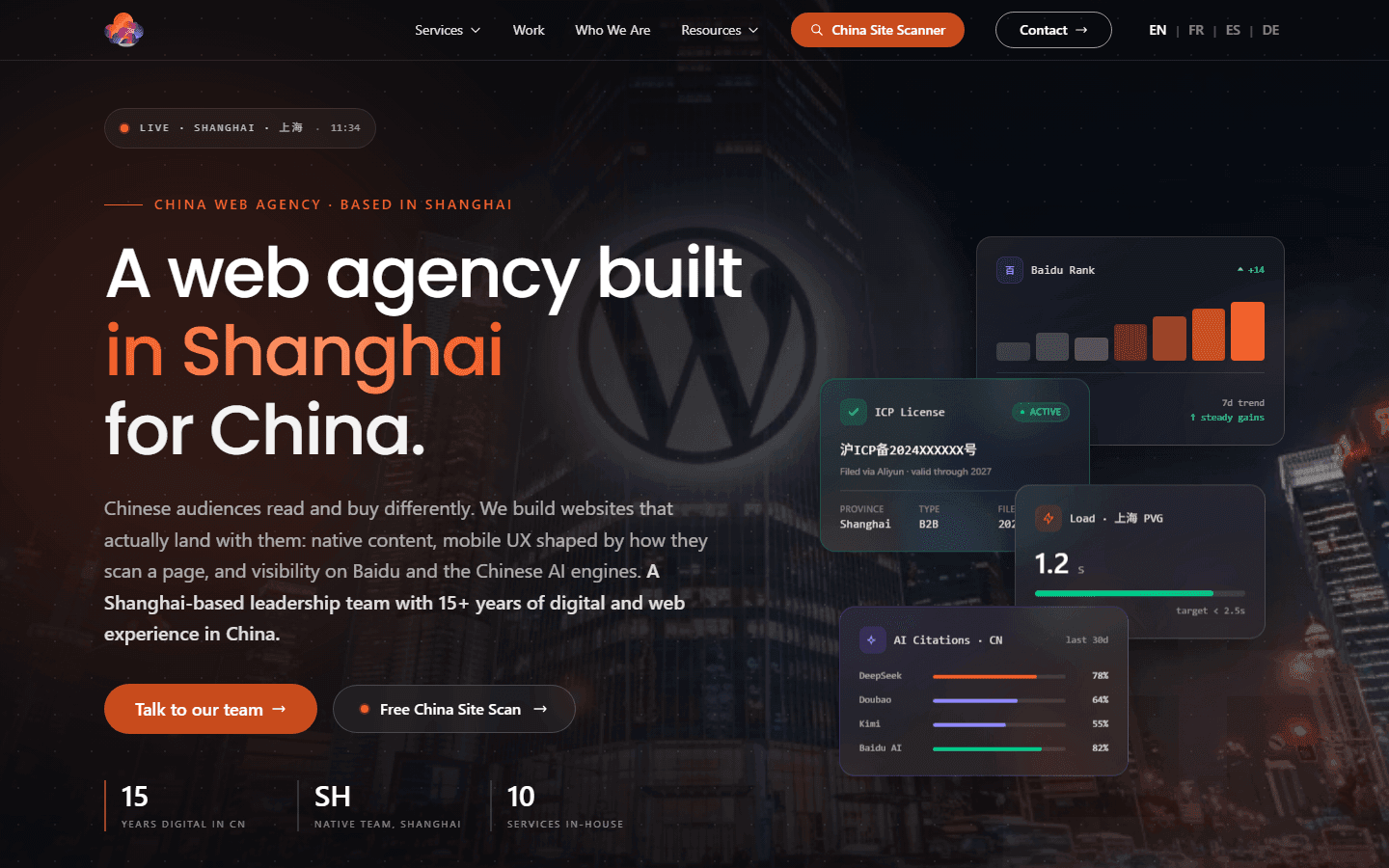 Open the site
 Five gaps open at once.
Most foreign brands launch in China by translating the global website. Six months later the pipeline is empty. Here they are, roughly in the order they hurt.
Open a gap to read it.

Chinese buyers scan for trust signals foreign teams bury near the footer: founder credibility, certifications, partner logos, awards. A native writer puts them on the page in the order a Chinese reader looks for them.
Mobile-first, usually inside the WeChat in-app browser. Long-scroll, dense, trust signals up front. Western minimalism reads as unfinished.
Different ranking signals, different indexing rules. Baidu will not index a site properly without an ICP filing and a Chinese host. The Google playbook does not transfer.
Baidu holds roughly half of China's search market. Google sits under 3%. Source: Statcounter Global Stats, China, 2024.
Doubao, Kimi, DeepSeek and Baidu's Wenxin now answer questions that used to go to a search box. The user rarely clicks through. If your pages are not structured for an AI to cite, you are invisible.
Slow loads, broken plugins, scripts that fail silently behind the Firewall. Get the floor right, then brand resonance is what wins the customer.
ICP filing, plainly.
A registration number from the Ministry of Industry and Information Technology, tied to one domain and one mainland host. Closer to a licence plate than a certificate. Without it, no server in China is allowed to serve your domain.
- Chinese entityA mainland legal entity holds the filing. Not the agency.
- SubmitFiled through your Chinese host, with a domain and a real address.
- MIIT reviewSeveral weeks of waiting. This is the long pole.
- Number issuedYour 备案号 goes in the site footer. Hosting turns on.
What the filing opens
- Baidu indexes the site properly
- Hosting inside the mainland
- WeChat and mini program integration
- Payment on a mainland domain
The trap
The filing sits with a Chinese legal entity, so who holds it matters more than it first looks. Let a vendor file on your behalf and you may find, two years later, that you cannot move hosts without their cooperation.
Start it before the design, not after. The wait runs happily in parallel.
A WeChat mini program, or a mobile site?
Different problems, and the wrong answer costs you quietly. Plenty of brands need both eventually. Almost nobody needs both first. Four questions get most teams to an answer.
Does the payment have to close inside WeChat, with no redirect?
Do you need strangers to find you on Baidu or in the AI engines?
Do buyers come back, and do membership or stored value matter?
Will someone local publish new content most weeks?
WeChat mini program 小程序
Lives inside WeChat. Close to invisible outside it.
Right call when
- WeChat Pay has to close the sale
- Membership, tiers and stored value matter
- Buyers arrive from group chats, pushes and in-store QR codes
- The experience is transactional and people come back
Wrong call when
- You mostly need to be found by someone searching
- Nobody on the team can keep a second product surface fed
Mobile site 移动站
Can be found, linked and indexed. Cannot take a WeChat payment on its own.
Right call when
- Search visibility is the point, on Baidu and in the AI engines
- Content changes often and a local marketer has to publish it
- You want one URL to share anywhere, not only inside WeChat
- The buying decision is long and mostly research
Wrong call when
- Payment has to close inside WeChat with no redirect
- Your whole audience already lives in one official account
Keeping customers in WeChat
A WeCom (企业微信) account costs RMB 300 a year to verify. Customer management software runs from about RMB 8,000 a year for a small team to RMB 150,000 and up for an enterprise set-up. WeChat Shop charges 1% to 5% commission by category. Brands that keep customers here pay no ad money for the second purchase.
The numbers move fast once the floor is right.
Median load time on launched sites, measured from Shanghai.
Median bounce rate before and after, foreign brand sites in China, first 90 days.
Measured by ChinaWebFoundry across launched client sites. Bounce rate is a before and after on the same brands.
We don't build websites. The people down the hall do.
ChinaWebFoundry sits in the same office as the team running your Tmall store. Same group, same weekly meeting, so nothing gets lost between the people who know the channel and the people who write the code.
Next step is a China Site Scan. They run your domain from inside the mainland and send back what actually happens. Free, a few days.