In China, social is the shop.
Search happens there. Reviews happen there. So does customer service, and a real share of the checkout. Run those accounts as a posting schedule and you have misread the market.
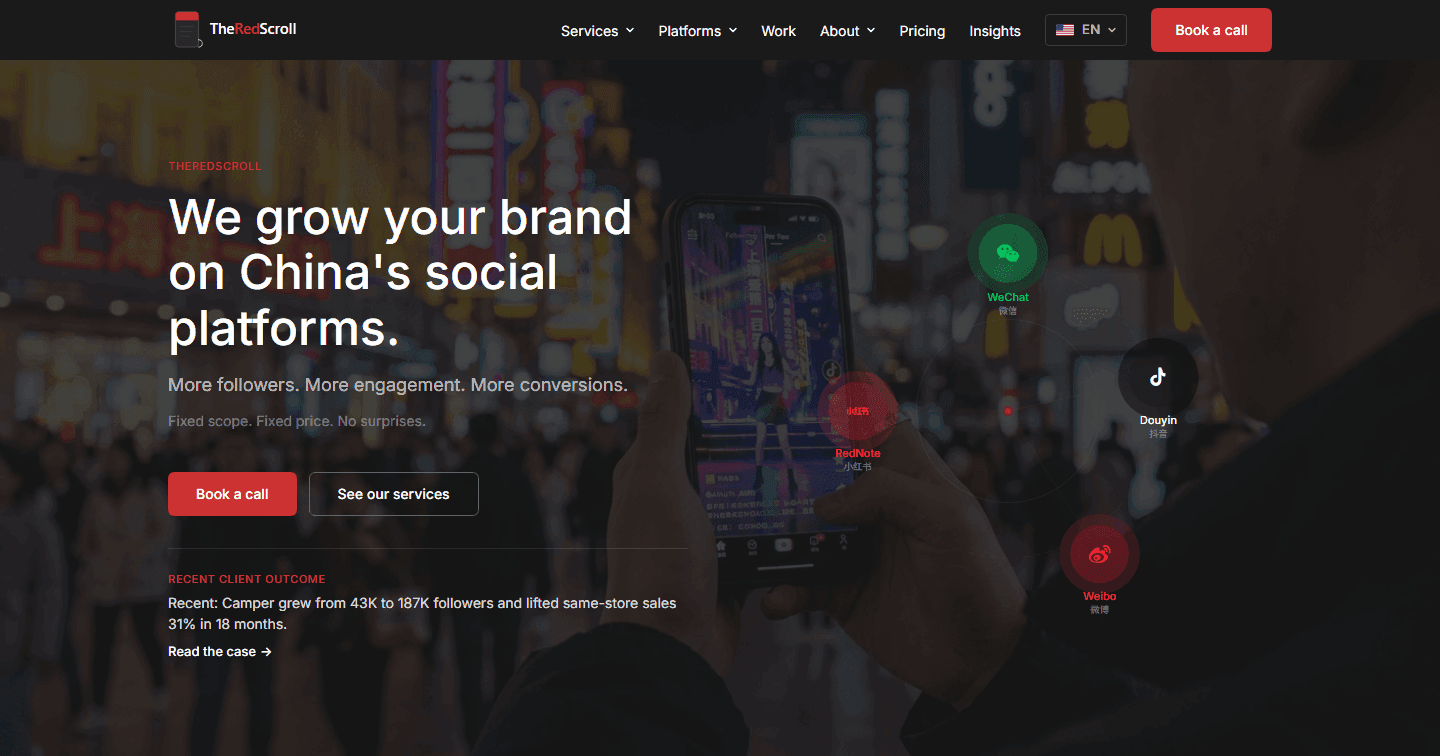
Here is what each platform is for, and who should run which half of the work. The day-to-day belongs to TheRedScroll, our social agency.
 Open the site
 Four platforms, four different jobs.
The expensive mistake is running one message across all four. Each one owns a different moment in the same purchase, so a post that works on one underperforms on the others by design.

Nobody browses WeChat looking for brands. They arrive by QR code, group chat or a friend. What WeChat does better than anywhere else is hold the relationship afterwards, and take the payment. Official account, mini program, WeCom, Channels.
Moments ads run RMB 30 to 180 per 1,000 views; groups and a mini program cost little to run.
Shared surface. The store side is ours, the audience side is theirs. See the line

RedNote
Xiaohongshu outside China. Part search engine, part review site. A shopper who has heard your name comes here to find out whether real people liked it. Beauty, fashion, wellness and travel live or die on it. Search behaviour looks like Google, which is why content written for Instagram lands flat.
Where shoppers decide. Small-creator notes cost RMB 300 to 2,000; the sale often closes on Tmall or JD through tracked links.
Runs with TheRedScroll. See the line

Douyin
A storefront with a video feed attached. Follower count matters far less than the store: short video that ends in a product card, livestream that closes in the same session. The algorithm will hand a brand new account real reach if the content earns it.
Where shoppers buy what they watch. Creator videos average about RMB 40,000; live selling costs more.
Shared surface. The store side is ours, the audience side is theirs. See the line
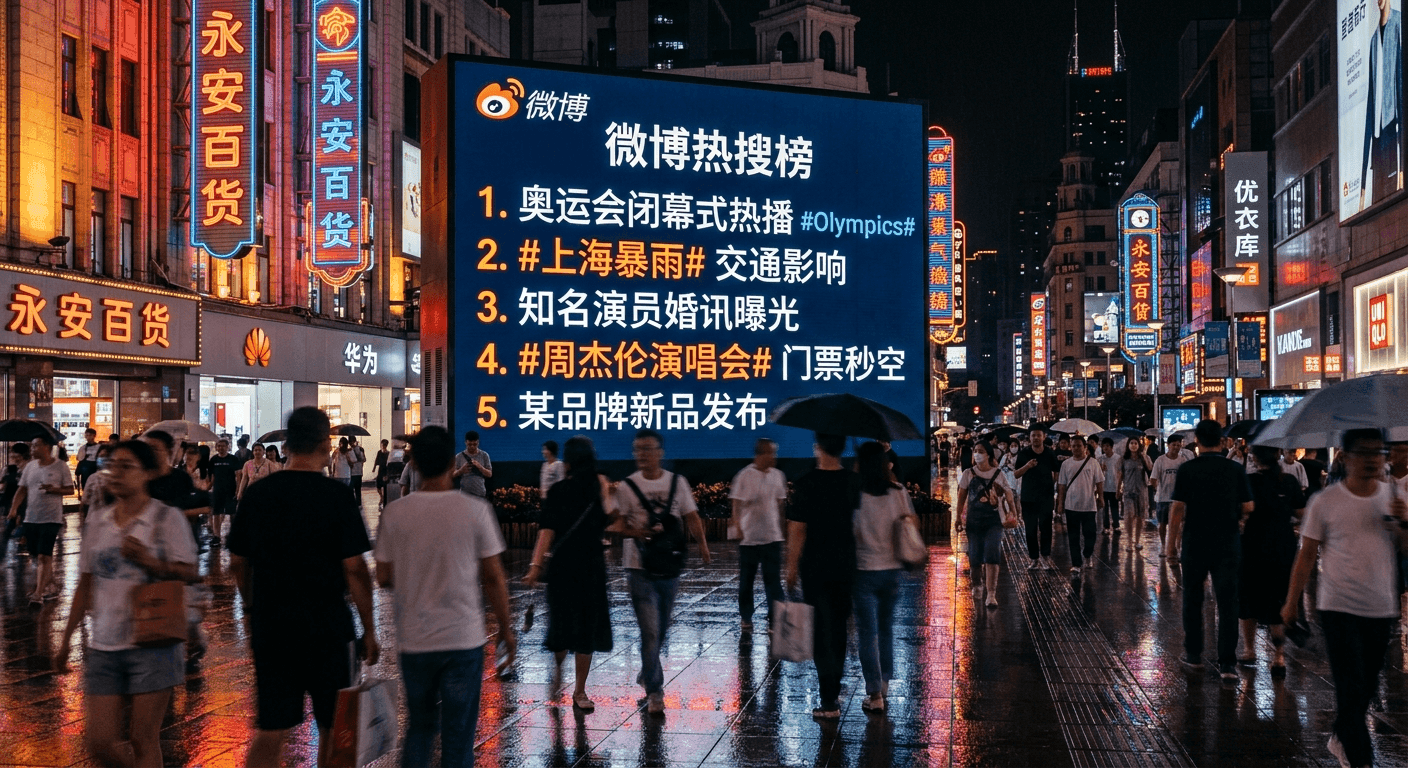
Quieter than it was, still the closest thing China has to a public square. Celebrity partnerships become news here. Hashtags get bought into trending lists. A brand problem surfaces here first, which is why most brands run it as reputation cover rather than growth.
For launches and celebrity news. Creator booking starts from a RMB 2,000 top-up.
Runs with TheRedScroll. See the line
And the long tail, which is longer than most decks admit.
Some categories live almost entirely out here. Appliances on Zhihu. Anything aimed at students on Bilibili. Ignore it by default, but check it before you write the plan.
- Bilibili 哔哩哔哩Students, gaming, long-form
- Kuaishou 快手Lower-tier cities, livestream
- Zhihu 知乎Research-heavy buys, appliances
- Toutiao 今日头条News feed, older readers
- Meituan 美团Local services, F&B, footfall
- Pinduoduo 拼多多Price-led volume
Where social sells, and where it only builds.
Two companies in one group can easily pitch the same brief. So here is the line, written down, and it holds in both directions.
Social that ends in a transaction
Measured on GMV- Douyin store: setup, catalogue, product cards, the operations behind them
- WeChat mini store, checkout and the membership mechanics attached to it
- Livestream built to close sales in the session
- Festival campaigns hanging off a store: 618, Double 11, Chinese New Year
- Paid media bought to feed a storefront, judged on what the store did
Commerce jobs wearing social clothing. They sit with the team that already runs your Tmall and JD operations, because the inventory, the pricing and the promotion calendar live there.
Social that builds the ground underneath
Measured on audience- Daily content across every account, in Chinese, by Chinese writers
- Community management, comments, DMs, private-domain work in WeChat groups
- KOL and KOC seeding, casting, briefing and the relationships behind it
- Brand campaigns judged on reach, sentiment and search volume
- Account setup, verification, and the long grind of building a following
A different discipline on a different clock. It compounds over quarters and needs native writers producing volume every week. It fails when a commerce team runs it as a side task.
Where it blurs, and it does, the test is what the number at the end of the month is. If it is revenue, the work is ours. If it is audience, it is theirs. A livestream can be either, depending on why you are running it. Sequencing matters too: selling into an audience that does not exist yet is the most common way to conclude that Chinese social does not work.
Audience built, then sales that followed it.
Camper followers across WeChat, RedNote and Weibo, over 18 months.
Camper same-store sales, year on year, over the same period.
New followers in month one for Blue Insurance, launching from zero audience.
Client work delivered by TheRedScroll. Camper's follower and same-store figures cover the same 18 months, on WeChat, RedNote and Weibo. Blue Insurance launched Hong Kong's first digital life insurer with no existing audience.
Fixed scope, fixed price, a team that already works here.
TheRedScroll works the way agencies mostly stopped working. Deliverables in the contract, monthly price in the contract, both agreed before anyone starts. No hourly billing, no scope drift halfway through the quarter.
Next step is a 30-minute discovery call. Bring your category, your accounts if you have them, and what you are trying to move. If the answer turns out to be the commerce side, they send you back to us and nobody loses a month to the handoff.