A real China distributor buys your stock, keeps it in its own warehouse and sells it to retailers it already supplies. A trading company takes an order, books a margin and moves on. To verify a China distributor, run eight checks. Six run on public records and storefronts, so you can finish them before the first call. The last two need a conversation.
Both kinds of company turn up at the same fair booth, handing out the same card with “importer and distributor” printed under a WeChat QR code.
The pool is big.
More than 780,000 businesses in China had import or export records in 2025. Source: Xinhua (新华社), reporting General Administration of Customs (海关总署) figures released at a State Council Information Office press conference, January 2026. https://www.news.cn/fortune/20260114/cde5cc17877d4284aac90e0c6ef48717/c.html
Any of them can call itself a distributor. Far fewer will put a sales team behind a brand Chinese shoppers haven’t heard of yet. The eight checks below are the ones our guide to finding a distributor in China lists. This piece adds the method behind each one, and the answers that should end the conversation. Every rule cited here was checked against its source on October 14, 2026.
Why the distinction matters more than category fit
Brands usually screen for category first. Does this company sell cheese, or skincare, or pet food? It’s a reasonable question asked too early, because a trading company can show category fit on a slide. It may well have shipped your category last quarter. Once.
The real difference is what each company does with the goods after customs.
A distributor puts its own money into stock and holds it until retailers buy. That’s a heavy commitment, and the people who make it say so.
One distributor put a year in numbers: four to five million RMB spent on stock, for less than 300,000 RMB of actual profit. Source: Jiemian (界面新闻), carrying Kuaidao Caijing (快刀财经), July 2025. https://www.jiemian.com/article/13003026.html
Margins that thin make a real distributor picky. It will push hard on your price and on who pays for marketing, because the stock it buys from you is its risk until a store reorders.
A trading company buys when a buyer has already placed an order, back to back, and its interest ends when that invoice clears. Your brand gets a first shipment and then silence. No one is selling it into stores, so no store reorders, and a stray pallet can turn up online below the shelf price you had planned.
The people differ too. A distributor employs key-account managers who see buyers at chains like Sam’s Club and Ole’ every month. A trading company has a founder and a phone full of buyers’ WeChat contacts. Ask about category once you know which of the two you’re talking to.
Six checks to verify a China distributor before you call
All six run on public records or public storefronts. A colleague in China, or a commercial database such as Qichacha (企查查), can pull most of them without ever contacting the candidate.
The business license, and who is on the payroll
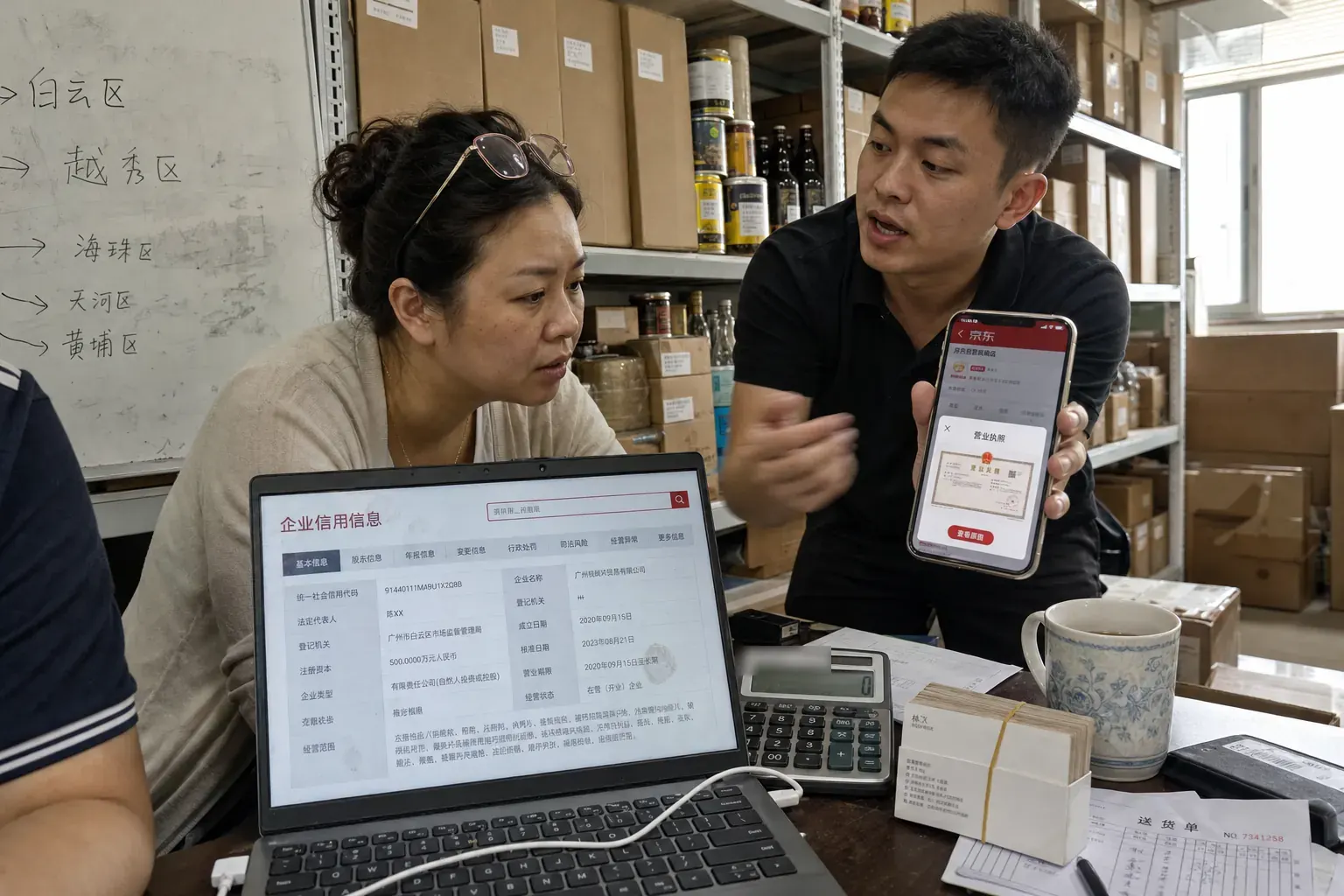
Pull the company record and read the business scope against your product. Our Chinese company report checklist covers the eight registry fields that matter, with a pass or stop box for each.
Then find the headcount line. The annual report a company files on the national credit system (GSXT) states how many employees it insures, and the company can’t hide that number.
Since the 2016 annual report, companies report the types of social insurance they pay and their number of insured employees, and both items must be public. The contribution base, the amount paid and any arrears are the company’s choice to publish. Source: State Administration for Industry and Commerce, Ministry of Human Resources and Social Security and National Bureau of Statistics, notice 工商企监字〔2016〕226号, via the Qiaokou District Government of Wuhan (武汉市硚口区人民政府), July 2023. https://www.qiaokou.gov.cn/hdjl/cjwt/cjwt/201804/t20180427_147988.shtml
A distributor that claims key-account teams in four cities and its own delivery vans can’t run all that on three insured people. The figure sits in last year’s report, and some firms pay staff through an outsourcing agency, so a low number is a question for the first call. Ask it.
The court and credit record
One pattern matters more than the rest: suppliers suing the company over unpaid goods, in sale-of-goods disputes (买卖合同纠纷).
A distributor sells on credit, so it will have some cases, mostly as the plaintiff chasing retailers for invoices. That’s normal. A run of suits in which suppliers are the plaintiffs means it pays late, and you’d be its next supplier.
Check the dishonest-debtor list (失信被执行人) too, for the company and its legal representative. The checklist above has a box for both.
Customs and category filings in its own name
A company that will import for you has to be on the customs register itself.
A customs declaration entity is an importer or exporter of goods, or a customs broker, that has filed with customs. Customs completes the filing within three working days and publishes it on the China Customs enterprise import and export credit platform. Source: General Administration of Customs (海关总署), Decree 253, Provisions on the Filing of Customs Declaration Entities, articles 2 and 7, in force January 1, 2022, via the Ministry of Commerce (商务部) policy database. https://policy.mofcom.gov.cn/claw/clawContent.shtml?id=92148
Search the candidate’s name on that platform. You want it filed as a consignee or consignor of imported and exported goods (进出口货物收发货人), in its own name. A trading company may not be. It brings goods in through an import agent that holds the filing, and customs only knows the agent.
Food adds a second register.
Food importers must file with the entry-exit inspection authority, which regularly publishes the lists of filed importers and registered overseas producers. Source: Ministry of Commerce (商务部) policy database, Food Safety Law (食品安全法), article 96, as amended September 2025. https://policy.mofcom.gov.cn/claw/clawContent.shtml?id=104105
Then comes the sales permit. That’s a food business license, or a simple filing for a company that sells prepackaged food only. Cosmetics and infant formula, to name two, run on regimes of their own. Whatever the category, the permit should carry the candidate’s name.
The brands it carries today
Take the logos off the deck and check them one at a time. With imported food, the pack tells you who brought it in.
Imported prepackaged food must carry a Chinese label stating the place of origin and the name, address and contact details of the domestic agent. Food without it may not be imported. Source: Ministry of Commerce (商务部) policy database, Food Safety Law (食品安全法), article 97, as amended September 2025. https://policy.mofcom.gov.cn/claw/clawContent.shtml?id=104105
Product photos on JD.com and on Tmall, Alibaba’s marketplace for brands, often show the back label. If three of the “portfolio” brands name some other company as their agent, ask why. There can be a fair answer (the candidate sells, a separate importer clears), and it’s better to hear it before the first call.
Then pick two brands from the deck and email their export managers yourself. Ask what the candidate sells for them, and since when.
The retail accounts it names
Ask for the account list in writing, then go and look. A distributor that says it supplies Ole’ and Hema in East China should have its brands on those shelves in Shanghai and Hangzhou, and in those chains’ own apps. If someone on your side visits China before the first call, two store walks will tell you more than the deck.
Watch the verbs, too. “We work with” a chain can mean a direct supply contract, or a wholesaler two steps down that sells to it once a quarter.
Write it down if the answer is “we cover all of China.” No distributor does.
The stores it runs online
Many distributors sell online as well, through stores of their own on Tmall, JD or Douyin, or as a supplier to the platforms’ self-run arms. Their own stores are the easy part to check.
An online seller must continuously display its business license information, or a link to it, in a prominent place on its store homepage. Source: Cyberspace Administration of China (中央网信办), E-Commerce Law (电子商务法), article 15, September 2018. https://www.cac.gov.cn/2018-09/01/c_1123362506.htm
Open the license badge on each store the candidate says it runs. The company named there should be the candidate, or a subsidiary that shows up in its registry record. If the store belongs to somebody else, you have found the company that actually sells.
The two checks that need a call
These need the candidate across the table, or at least on a video call that walks you through the warehouse.
Sell-out data
Ask for scan or depletion data from a brand like yours, with the name blacked out: units leaving each account, month by month, and how many days of stock sit in the warehouse. A distributor that sells into chains has this, because the chains send it.
A trading company has sell-in, the orders it placed with brands. Sell-in tells you what went into a warehouse. Whether any of it left is a separate question, and sell-in can’t answer it.
The team that would sell your brand
Ask who, by name. Then ask where those people sit and how much of their week would go to you. Ask to meet the key-account manager as well as the business development director who staffed the fair booth.
A real answer has names and cities in it. The red flag is a founder who pitches well and promises a dedicated team you never get to meet before signing.
The eight checks at a glance
Print this and keep it next to the call notes.
| Check | What to ask | What a real answer sounds like | What the red flag sounds like |
|---|---|---|---|
| License and headcount | “Can you send the license and your latest annual report?” | “Here they are. Most of our insured staff are in sales and the warehouse.” | “We’re lean. Our partners do the selling.” |
| Court and credit record | “Tell me about this case number.” | “We sued a retailer over an unpaid invoice. It settled.” | “That was the old company. Different people now.” |
| Customs and category filings | “Who is the consignee on your import declarations?” | “We are. Here’s our customs filing and our food business license.” | “Our partner holds the import license.” |
| Brands carried | “Which two brands can I call?” | Two brand names, two export managers, two email addresses | “Our brands are confidential.” |
| Retail accounts | “Which chains, in which cities?” | “Ole’ and Hema in Shanghai and Hangzhou. Here’s the store list.” | “We cover all of China.” |
| Online stores | “Which stores do you run, under which company?” | “Our JD store, under this entity. Check the license badge.” | “We have a WeChat account and a website.” |
| Sell-out data | “Can I see depletion data for a comparable brand?” | Monthly units by account and days of stock, brand name blacked out | Sell-in totals only, or “retailers don’t share that.” |
| The team | “Who sells my brand, and how much of their week is mine?” | Named people in named cities, with a share of their week | “The founder handles key brands personally.” |
The three answers that end a conversation
Some answers don’t deserve a second meeting.
“Our partner holds the license.” Then the partner is your importer, and the company in front of you sits between you and it, taking a cut. Meet the partner instead.
“Ship the first order on consignment. We’ll pay as it sells.” Buying stock and carrying the risk is what a distributor does for a living. A company that won’t buy your first order wants you to carry its risk while it finds out whether your brand sells itself.
“We’ll register your trademark here for you.” China gives a trademark to whoever files first. File in your own company’s name before the first meeting, and never let a candidate file on your behalf.
What a vetted shortlist actually looks like
Run the six desk checks on a long list and it gets short quickly. That’s the point of doing them before anyone books a flight.
Compass, our database of distributors and partners in China, works from the other end. We have met every company in it in person, and we file each one under the categories we have seen it sell.
A typical Compass shortlist runs three to five distributors, usually two to three weeks from the brief. From Compass, September 2026.
Each name comes with a short note on its strengths and weak spots, and on where to push in the negotiation. The two call checks still happen: you meet the team and read the sell-out data. You just start from companies that have already cleared the first six.
Compass takes no commission from the partners in it, so no partner pays us to put its name on your list. The shortlist itself is project-based, quoted after the first call.
Signing is where the work begins. Langnese had stable distribution in China and falling sales. The brand and its distributor agreed nine growth pillars and opened regional channels where the honey had never sold before; the Langnese case shows how. Brands that want the search and the negotiation run for them use our distributor sourcing and management work, and the database itself is at Compass.
Questions buyers ask
What’s the difference between an importer and a distributor in China?
An importer clears customs and puts the Chinese label on your pack. A distributor sells to retailers and keeps stock for them. Some companies do both. Plenty of importers only move boxes, so if the company you sign has no sales team, you’ll need someone else who sells.
Can I verify a China distributor from outside China?
Mostly. Commercial databases such as Qichacha and Tianyancha (天眼查) work from abroad and copy the registry and court data, and store license badges on Tmall, JD and Douyin are public. The national credit system refused our requests from outside mainland China in September 2026, so have someone in China confirm the credit code before you sign.
Does a trading company ever make sense?
Sometimes, as an importer of record when you already have a distributor that doesn’t import, or your own sales team. Then hire it as a service provider, paid per shipment, with no exclusivity and no say over your trademark. The selling still needs a distributor, or your own team.
Get a Compass shortlist of distributors already selling your category
Updated October 14, 2026
Working on China? Let's grab a coffee.
Tell us where you are now and where you want to get to.