Almost a third of Chinese e-commerce merchants lost money last year. Not slowed down. Lost money.
A January 2026 survey of more than a thousand Chinese e-commerce merchants found that 30.1% posted a negative net profit, and another 30% cleared margins of between zero and 5%. Asked what was eating the profit, 78% pointed to the cost of traffic and 60.2% to price undercutting by competitors. Source: 36Kr (36氪), citing the 2025 E-Commerce Survival Survey
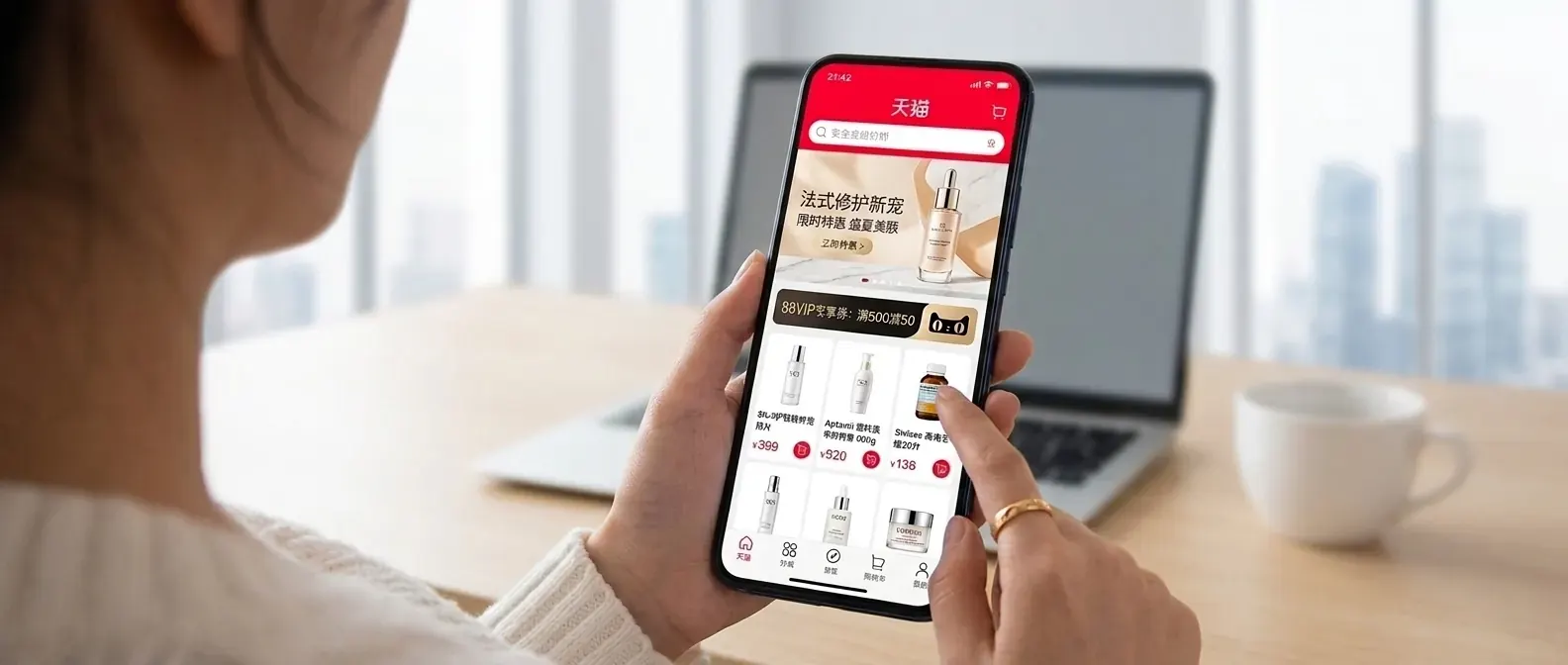
That is the backdrop to everything Tmall announced on March 26 at TopTalk (天猫TOP TALK), its annual invitation-only summit for brand partners in Shanghai. Around a thousand brands in the room. Tmall president Liu Bo, who goes by Jialuo (家洛) internally and in all Chinese coverage, spent the session explaining how the platform intends to make its best merchants more profitable rather than simply larger.
Four months on, most of it has shipped. The AI back office went live at the end of March, the new product traffic pool ran through 618, and the 88VIP coupon budget is being spent as you read this. So the mechanics below are not a roadmap. They are the rules your competitors are already playing by.
For a foreign brand weighing a China move, or already running a store and wondering why the numbers feel tight, there is a more useful way to read the announcement than as good news. Tmall is not being generous here. It is trying to fix a supply-side problem that has started to threaten its own base.
The 2026 plan at a glance
| Commitment | The mechanic | Size |
|---|---|---|
| Consumer subsidy | Coupons issued to 88VIP members, plus an algorithm memory upgrade | RMB 100 billion (USD 14.0B) |
| Merchant conversion | AI-issued store coupons, plus a platform top-up on converting ads | RMB 10 billion (USD 1.4B) |
| New product launches | Dedicated traffic for super new products, 30-day first-sale support | RMB 60 billion (USD 8.4B) |
| AI operations | Business Advisor “Lobster” release, AI Dianxiaomi, Wukong platform | Trillion-token commitment |
Tmall spent a year proving the incentive works
None of this arrived out of nowhere. Tmall spent 2025 testing it. A February pilot in beauty, apparel and sports and outdoor paid quality brands an operating rebate, and the detail that mattered was the form it took: cash, not traffic vouchers. By the end of the year the payment was running quarterly.
The results are the reason it is being expanded.
Brands turning over more than RMB 100 million a year on Tmall grew 15% year over year in 2025. More than 13,000 brands in the RMB 10 million band posted double-digit growth in annual transaction value. Source: China Daily (中国日报网), citing Tmall
Liu framed the year ahead in the language of certainty rather than scale, telling the room that the platform’s 2026 investment in quality brands would be “stronger and more comprehensive,” aimed at giving brands a predictable path to growth. Read against the survey data, that is less a boast than an admission of what has been missing.
Chinese business commentator Liu Run put the underlying problem more bluntly than any platform would: brands built on bought traffic eventually die of bought traffic. The survey data backs him up. Among mid-sized merchants doing between RMB 10 million and RMB 100 million a year, nearly half were pushing between a fifth and all of their revenue straight back into media.
You cannot build a brand on that math. We see it in the P&Ls we review, where media has become the second largest line after cost of goods and the only one still climbing. Tmall appears to have worked that out about its own merchants.
The money is going to 88VIP, not to everyone
If you take one number away from TopTalk, take this one.
Tmall will issue coupons worth RMB 100 billion to 88VIP members in 2026, exceeding previous years. The program has grown for ten straight quarters at double-digit rates, doubling from 30 million members to close to 60 million. Source: 36Kr (36氪), citing Tmall
What 88VIP actually is
88VIP (88VIP会员) is Alibaba’s paid membership tier, and it is not a loyalty scheme in the Western sense. Membership costs RMB 888 a year at full price, dropping to RMB 88 for shoppers whose Taobao activity score clears a threshold. People pay for the status, and they shop like people who have paid for something.
88VIP members spend eleven times more per year on Tmall than non-members, and account for more than half of the business done by the platform’s leading brands. Source: 36Kr (36氪), citing Tmall
Sixty million people out of roughly a billion annual buyers generate the majority of top-brand revenue. Sit with that for a second, because it should reset how you think about merchandising here. Your Chinese consumer, in practical terms, is that person, and the mass-market volume play you may have modeled in a spreadsheet is chasing the wrong half of the platform.
Brands have already noticed
Tmall opened its marketing IP to partners last year, covering member-exclusive buys, calendar moments and collaborations. Take-up was fast.
The number of brands working with 88VIP grew 51% over the past year, the number of member-benefit products grew 42%, and those products received roughly double the exposure they had previously. Source: 36Kr (36氪), citing Tmall
Alongside this, Tmall lengthened the memory window on its recommendation algorithm. Instead of reacting to what a shopper searched an hour ago, the system now weights how their interests and life stage have shifted over months. For a brand selling considered purchases, skincare regimes, supplements, prams, appliances, that is a meaningful change. Your product no longer has to win a single moment of intent. It has to keep showing up as the shopper’s situation changes, which rewards range and consistency over a clever launch.
Tmall will now co-pay your discount
The second commitment is the one most brands will feel in their P&L, and it is barely covered in English.
The mechanic is called intelligent follow-on investment (智能跟投). When one of your ad placements converts above a threshold, the platform layers a product coupon on top of it. Tmall funds the coupon. You keep the conversion and you keep your margin, because the discount that closed the sale did not come out of your gross.
They have a reason to think this works.
AI-issued red packets from Tmall’s Smart Engine at Double 11 last year lifted conversion rates by 81% quarter on quarter. Tmall is committing RMB 10 billion to continue issuing AI store coupons in 2026. Source: 36Kr (36氪), citing Tmall
| What gets subsidized | Who pays | What you need to bring |
|---|---|---|
| 88VIP member coupons | Tmall | Products approved into the pool |
| Coupon on converting ads | Tmall | Ad placements already working |
| New product launch reach | Tmall | A genuine new SKU, ideally exclusive |
| Baseline store traffic | You | Media budget, as before |
Worth noticing what has not moved. Your own money still buys exactly what it always bought. Everything new sits on top of performance you have to produce first.
The launch pool nobody translated
The new product commitment is the largest traffic number of the year and it did not make it into most English coverage at all.
Tmall is adding RMB 60 billion in dedicated traffic in 2026 for launching super new products, with resources weighted toward Tmall-exclusive editions and technology-led products. All qualifying new products receive traffic support during a 30-day first-sale window. Source: 36Kr (36氪), citing Tmall
The 2025 base was already large.
Super new products first launched on Tmall generated RMB 120 billion in sales during 2025, up 20% year over year, drawn from more than 16 million quality new products introduced on the platform. Source: China Daily (中国日报网) and 36Kr (36氪), citing Tmall
An executive at appliance brand Dreame described how the launch spike creates a large pool of shoppers who add to cart or favorite without buying, and Tmall’s mechanics then let you re-approach those hesitators during the follow-on selling period. Treat the launch window as list-building rather than as the sale itself and the second month stops looking like a collapse.
The AI tools are shipping, not previewing
So much for the money. The other half of the announcement was about who does the work.
Every platform in China announced an AI strategy this year, and most of it was slideware. Tmall’s is more concrete, mainly because it is shipping into tools merchants already open every morning.
Business Advisor (生意管家), the store back office, went live at the end of March with an upgrade internally nicknamed the Lobster release. It covers the full operating chain and runs around the clock, and Tmall’s stated ambition is that one person can once again run a store. Store inspection, sales analysis, ad placement, creative generation, customer service, all executed rather than merely reported.
The customer service layer is further along than most people outside China assume.
AI Dianxiaomi has cumulatively served 300 million customer interactions and will receive a trillion-token investment this year as it shifts from answering questions toward guided selling. Source: 36Kr (36氪), citing Tmall
From March 2026, Taobao and Tmall’s A/B test data showed AI Dianxiaomi combined with human agents beating human-only service on conversion rate, not only overnight but in every hour of the day. Source: GeekPark (极客公园)
Sitting above all of this is Wukong (悟空), which Alibaba launched on March 17 as an enterprise AI-native work platform built by the DingTalk team. Commerce capabilities from Taobao, Tmall, 1688, Alipay and Alibaba Cloud plug in as modular skills. Our honest read after four months is that Wukong matters less for what it does today than for what it signals: Alibaba intends store operations to be assembled from agents rather than staffed by headcount, and the pricing of every service provider you deal with will eventually reflect that.
A caveat nobody at TopTalk mentioned. These tools are Chinese-first in interface and in data model, and the support behind them is too. A brand running its Tmall store from a European headquarters with no Chinese-reading operator will not extract the value. In our experience it usually cannot even find the settings.
The gate nobody puts in the press release
Here is the part that gets skipped in the recaps, and it is the part that decides whether any of the above reaches you.
Most of these programs are allocated, not published. The 88VIP benefit pool, the follow-on ad subsidy and the new product traffic weighting are distributed through category teams during annual planning, and in most categories that conversation happens inside an annual framework agreement (年框) that commits you to a minimum spend and a set of platform activities. No agreement, no allocation. Plenty of cross-border brands run for years without signing one and never work out why the subsidies they read about in the trade press never show up in their back office.
Timing matters here more than most brands expect. Those conversations cluster in the fourth quarter for the year ahead, so a brand reading this in the summer is realistically negotiating for 2027, not for what is left of 2026.
The cost side has not changed either. You still carry a store deposit and an annual technical service fee, a commission on every transaction that varies by category, and either a team or a Tmall Partner retainer to actually run the thing. Subsidies improve the return on that spend. They do not remove it, and any model that treats platform money as a substitute for operating budget will be wrong by the second quarter.
If you need a number before your next budget meeting, our Budget Calculator walks through the line items.
Where this could go wrong for you
A plan funded this heavily deserves a skeptical question or two. Three, in our case.
Subsidized conversion flatters your numbers. If Tmall is paying for the coupon that closed the sale, your reported conversion rate is partly the platform’s money, and the baseline underneath it is lower than the dashboard suggests. Model the unsubsidized case before you scale spend against it.
Concentrating on 88VIP narrows your audience on purpose. That is fine while the program grows. It also ties a large share of your China revenue to the economics of somebody else’s membership scheme, and those economics are reviewed annually by people who do not work for you.
And “going all-in on quality brands” is a selection policy, which means somebody is not selected. Brands that fall outside the favored tier are not standing still. They are competing against rivals whose customer acquisition is now partly funded by the platform. If you are not in the program, your position got harder this year, not neutral.
What this means if you sell in from outside
Most of the above applies whether you run a domestic Tmall store or a cross-border Tmall Global store. The 88VIP shopper does not care which warehouse the parcel leaves from. Our piece on the 2,415 overseas brands that opened on Tmall Global in 2025 covers the entry mechanics if you are earlier in the process, and our China 2026 predictions piece sets this alongside what Douyin, JD and Xiaohongshu are doing with the same budgets.
Four things we would do differently this year, based on what was announced.
Getting products into the 88VIP benefit pool is the single most valuable merchandising decision available on the platform right now, and it is negotiated rather than granted. It happens through your category team, usually during annual planning, and if nobody on your side has asked, the answer is no by default.
Reserve a real launch for the new product window. RMB 60 billion is chasing new SKUs, and the weighting favors platform-exclusive editions. A market-specific size, format or bundle can qualify. Shipping your global range unchanged and calling it a launch will not.
The third change is harder because it means spending less. The subsidy structure now rewards placements that already convert, so the money follows whoever fixed the product page and the pricing ladder first, with service response close behind. Buying more traffic against a weak page just moves your own cash out faster than before.
Budget for a Chinese-speaking operator, not just media. The AI tooling collapses the workload of running a store, but somebody has to be inside the back office reading it.
One last thing, because it catches brands out every year. None of this changes the festival calendar. 618 and Double 11 still carry a large share of annual sales, and subsidies are heaviest around them. Build your inventory and content plans around those dates from the start, with the livestream calendar locked at the same time, not in the six weeks before.
Both things are true at once. Tmall has lowered the cost of running a good brand on its platform, and it has done nothing about the difficulty of becoming one. If your team can say in a sentence why a Chinese shopper should choose you over the domestic alternative, this year’s mechanics will pay you for that clarity. If it cannot, the subsidies just get you to the same conclusion faster, with a larger media invoice attached.
This piece reflects what had actually shipped as of late July 2026. Tmall revises these programs at TopTalk each spring, so check the current year’s announcement before you build a plan on the numbers above.
Updated July 27, 2026
Working on China? Let's grab a coffee.
Tell us where you are now and where you want to get to.