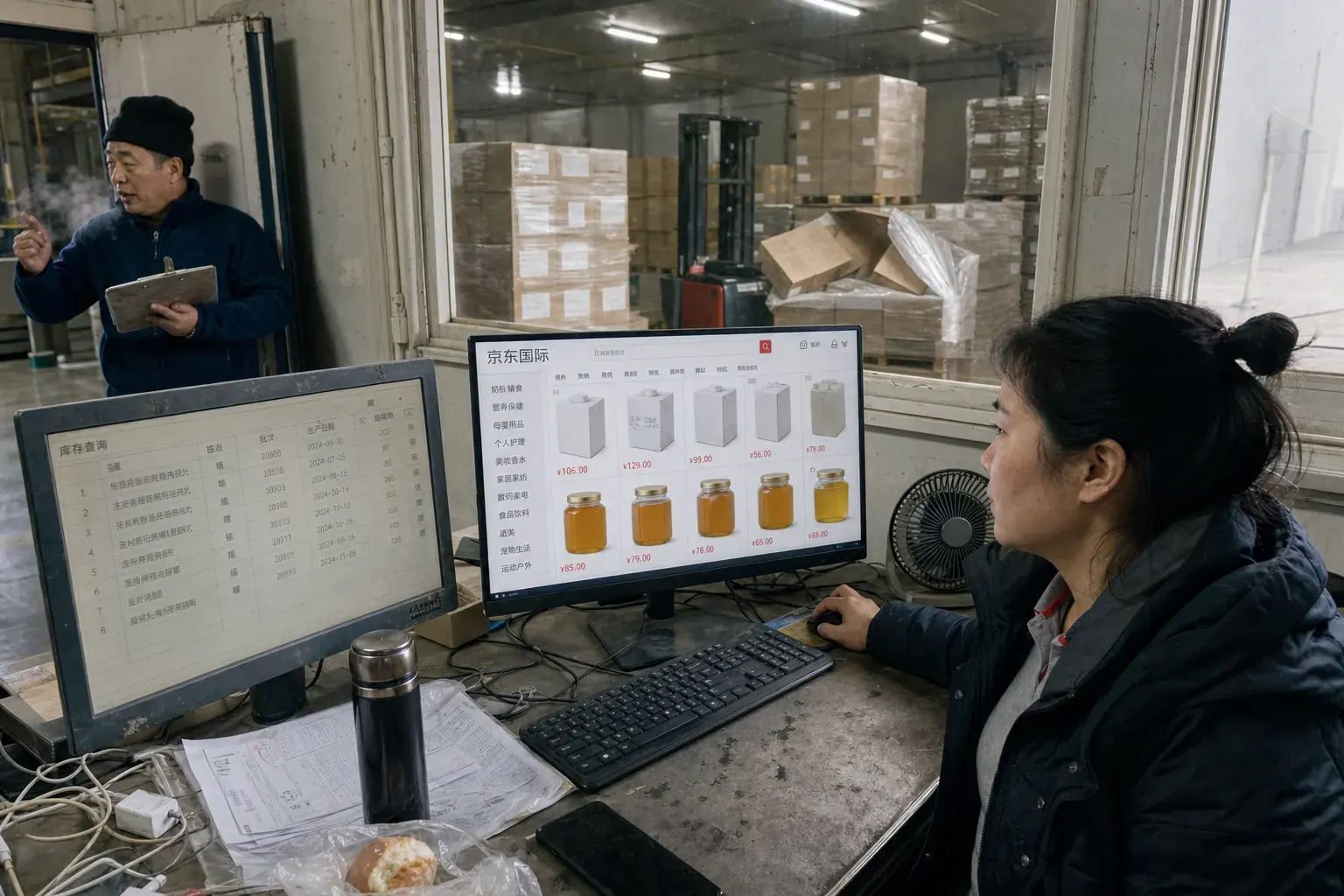
Start on Tmall Global. Dairy and spreads cost 80,000 RMB to open there, against 42,600 RMB on JD Worldwide and 50,000 RMB on Douyin cross-border. Tmall takes 2% of each sale, the lowest band on the platform. Then the parcel decides your year: 15 RMB of pick, pack and last mile lands on every order, whatever is inside.
Food is cheap to open and expensive to ship. That’s the shape of this category, and it catches brands who budget for platform fees and forget the box.
Two routes exist for a butter, a yogurt, a honey or a nut spread. Bonded cross-border walks past paperwork that has held brands at the border for years. General trade walks straight into it.
What it costs to open a dairy or spreads store in China
| Dairy and spreads, first year (RMB) | Tmall Global | JD Worldwide | Douyin cross-border |
|---|---|---|---|
| Security deposit, refundable | 50,000 | 35,500 (about US$5,000) | 50,000 |
| Annual platform fee | 30,000 | 7,100 (about US$1,000) | none |
| Commission on each sale | 2% | 4% | 4% |
| Cash in before the first sale | 80,000 | 42,600 | 50,000 |
Deposit, annual fee and commission by category for packaged food, grain, oil and snacks on Tmall Global, JD Worldwide and Douyin cross-border. Source: TheChinaPath calculator data, September 2026.
That 2% is the lowest commission Tmall Global charges anybody. Skincare pays 4%, apparel and footwear pay 5%. Douyin wants 50,000 RMB from a food store and 100,000 RMB from an apparel or beauty store. Bands checked September 2026, and a TM trademark or a multi-brand store raises the Tmall figure.
JD is the cheapest door by a wide margin. It quotes deposit and annual fee in dollars, on a ladder that climbs with cumulative sales, so 42,600 RMB is the entry rung rather than a steady state. JD adds a flat 0.9% transaction fee on top of the 4%.
Two routes in: bonded cross-border and general trade
Bonded cross-border is the easy one. Goods have to sit on the cross-border retail import positive list.
The cross-border e-commerce retail import commodity list (2019 edition) was adjusted with effect from March 1, 2022. Source: eight departments including the Ministry of Finance and the General Administration of Customs, Announcement 2022 No. 7, January 2022. https://www.gov.cn/zhengce/zhengceku/2022-02/21/content_5674854.htm
Cross-border e-commerce retail imports are supervised as personal-use inbound goods, and the first-import permit, registration and filing requirements are not applied to them. Source: Ministry of Commerce and five other bodies (商务部 发展改革委 财政部 海关总署 税务总局 市场监管总局), 商财发〔2018〕486号, November 2018. https://www.gov.cn/zhengce/zhengceku/2018-12/31/content_5437823.htm
The words doing the work there are “personal-use”. Your goods clear as something a shopper bought for herself, so the importer paperwork a wholesale pallet would need never comes up.
The shopper pays 9.1% at checkout: zero duty, and 70% of the 13% import VAT. Dairy and spreads carry no consumption tax, so they sit at the general-goods rate instead of the higher one that lands on perfume and alcohol.
The cross-border retail import tariff rate is set at 0%, and import VAT and consumption tax are levied at 70% of the statutory payable amount. Source: Ministry of Finance (财政部), 财关税〔2016〕18号, March 2016. http://www.mof.gov.cn/gp/xxgkml/gss/201603/t20160324_2510682.htm
General trade is a different building. Your plant has to be registered with Chinese customs before a pallet moves, and for dairy and honey you cannot apply directly. Your own government has to recommend you.
Dairy products (乳品) and bee products (蜂产品) are among the food categories whose overseas producers are registered on the recommendation of the competent authority of the exporting country or region. Source: General Administration of Customs (海关总署), Decree No. 248, Article 7, April 2021. https://www.gov.cn/gongbao/content/2021/content_5616161.htm
Decree 248 was replaced by Decree 280 on June 1, 2026, and both categories survived the rewrite. Unroasted coffee and cocoa beans came off the recommendation list. Dairy and honey stayed on.
The catalogue of imported foods requiring registration on the recommendation of the competent authority includes 乳品 and 蜂产品. Source: General Administration of Customs Announcement 2026 No. 27 (海关总署公告2026年第27号), March 2026. https://www.gov.cn/zhengce/zhengceku/202603/content_7063537.htm
So the timeline runs through a ministry in Helsinki or Hamburg, and it can take a season. Which is why so much European dairy arrives in China through a bonded warehouse first and a customs declaration later.
General trade asks for more besides. A health certificate from the exporting government on every shipment. A test report against the Chinese national food safety standard on the first one, where “first” means same producer, same product name, same formula, same exporter, same importer, same port.
Imported prepackaged dairy must carry a Chinese label and Chinese instructions, and both must meet Chinese law and the national food safety standards. Source: Measures for the Inspection, Quarantine and Supervision of Imported and Exported Dairy Products (进出口乳品检验检疫监督管理办法), General Administration of Customs Decree No. 243, Article 14, as amended November 2018. https://policy.mofcom.gov.cn/claw/clawContent.shtml?id=65699
Then there is the label rewrite coming. GB 7718-2025 carries a two-year transition and bites on March 16, 2027. Milk and nuts are on the allergen list that has to be declared. Zero-added claims go.
GB 7718-2025 makes eight allergen classes mandatory declarations. The list includes 乳及乳制品(包括乳糖)and 坚果及其果仁类制品. Source: Food Mate Network (食品伙伴网), March 2025. https://fsc.foodmate.net/show.php?itemid=712970
The revised prepackaged food labeling standard takes effect March 16, 2027, and 零添加, 不添加 and 不使用 claims are prohibited under it. Source: Beijing Municipal Administration for Market Regulation (北京市市场监督管理局), May 2026. https://scjgj.beijing.gov.cn/zwxx/scjgdt/202605/t20260507_4639154.html
If your honey sells on “no added sugar” in Europe, the Chinese pack needs a new argument before 2027. Put it to your packaging team this year.
Infant formula sits outside all of this. It has its own product registration. It also has a three-month shelf-life gate at the border, and a Chinese label that has to be printed on the pack before it lands, never stuck on afterwards. Separate Tmall category, separate piece. Rules above checked September 2026.
What one order actually costs
Start with what the goods are worth at the border.
China imported 2,657,400 tonnes of dairy in 2025, up 1.6%, worth US$12.78 billion. Packaged milk came to 371,600 tonnes, down 10.8%, at an average US$1,046 a tonne. Source: Dairy Online (乳业在线), from the January 2026 Dairy Economy Observer report on China Customs statistics. https://www.dairyonline.cn/13031.html
US$1,046 a tonne is about 7.4 RMB a litre. Now put that litre in a box and ship it to an apartment in Chengdu.
| Per 100 parcels shipped, Tmall Global (RMB) | Single 128 jar | 250 basket | 498 case |
|---|---|---|---|
| Orders kept at a 5% return rate | 95 | 95 | 95 |
| Platform commission at 2% | 243 | 475 | 946 |
| Payment fee at 1% | 122 | 238 | 473 |
| Pick, pack and last mile | 1,500 | 1,500 | 1,500 |
| Return handling and the leg back | 130 | 130 | 130 |
| Cost per kept order | 21 | 25 | 32 |
| Share of the order value | 16.4% | 9.9% | 6.4% |
| Tax the shopper pays at checkout | 12 | 23 | 45 |
Cost per kept order for three food baskets on the per-order logistics defaults in the Tmall Global model, at the calculator’s 5% return rate. Source: TheChinaPath calculator data, September 2026.
Look at the row that doesn’t move. Pick, pack and last mile costs 1,500 RMB per hundred parcels at every basket size, because a courier charges by the box. On the single jar that’s 82% of your store cost. On the case it’s 53%.
The commission barely registers next to it. Tmall takes 243 RMB per hundred small orders, less than a fifth of what the couriers take. Brands arrive arguing about commission bands and leave working on units per box.
Which is why imported milk sells in China as a 12-pack and imported honey sells in gift boxes at Mid-Autumn. The arithmetic pushed the format there long before anyone wrote a positioning deck about it.
Breakeven, at the 250 RMB basket on a 50% gross margin: each kept order contributes about 100 RMB after store cost. Against the annual fee, a 25,000 RMB store build over three years and a Tmall Partner retainer at a common 35,000 RMB a month, you need roughly 4,600 kept orders. About 1.15 million RMB of year-one GMV, near US$162,000, before advertising.
Which platform first
Tmall Global, unless cash is the binding constraint. The 2% commission compounds over every order you’ll ever ship, and Tmall Global is where a European food brand gets taken seriously by a distributor later.
Two things flip it. If year-one cash is under about 300,000 RMB all in, open on JD Worldwide and move across when volume justifies the 80,000. And if you already have Chinese-language video and somebody who can host, Douyin food opens for 50,000 RMB and no annual fee. Cheapest way to find out whether anyone wants the product.
All of that assumes ambient or chilled-tolerant stock. Short shelf life changes the math in a way the fee table can’t show you, because bonded inventory that stops turning gets written off rather than carried.
What the Valio and Langnese pages show
We have worked this category twice, and neither project was a platform-fee problem.
Valio, which takes 85% of Finland’s milk production, came to China to move from B2B to B2C. The work was positioning and a Chinese name for the eila sub-brand, then the identity system that carried it. A Finnish dairy brand arriving unnamed in a premium Chinese category has no price argument.
Langnese was harder. Germany’s leading honey brand had distribution and shelf space, and sales fell month after month anyway. Chinese shoppers had no clear reason to pay roughly twice what the local jar beside it cost. So we rebuilt the distribution map and ran consumer research in tier 1 and tier 2 cities until the consumption occasions where a premium European honey could win showed up. The decline reversed. Brand and distributor agreed nine growth pillars, and Langnese opened regional channels where it had none.
Everything above is on the case pages. The content and creator side of that work belongs to TheRedScroll, the group’s China social media agency; what we own is the commercial route.
Run your own numbers
The table above is the food category as our calculator loads it. Change the basket and the margin and it tells you a different story.
Run the Tmall Global setup and run calculator with “Packaged food, grain, oil, snacks” selected, then put in your real average order value. For the general-trade route, the registration sequence sits inside cross-border setup and the partner side inside distribution in China.
Questions we get asked
Does dairy need GACC registration to sell cross-border?
Not under bonded cross-border. Customs supervises the goods as personal-use imports and does not apply first-import permit, registration or filing requirements there. Under general trade the registration is required, and for dairy your own government’s competent authority has to recommend the plant. That recommendation is the slow part, and it is outside your control.
What tax does the Chinese shopper pay on imported butter or honey?
9.1% at checkout. Duty is zero under the cross-border route, and import VAT is charged at 70% of the 13% statutory rate. Dairy and spreads carry no consumption tax. On a 250 RMB basket that’s about 23 RMB, shown before she pays.
Why is Tmall Global’s food commission so much lower than skincare?
Tmall bands commission by first-level category, and packaged food sits at 2% against 4% for skincare and 5% for apparel. Basket size is the trade-off. Food orders are small and heavy, so the courier takes more of the order than the platform ever will.
Send us one product, its shelf life and the pack size you sell in Europe, and we’ll come back with the landed cost per order on all three platforms. Start with cross-border setup.
Updated September 23, 2026
Working on China? Let's grab a coffee.
Tell us where you are now and where you want to get to.