When a partner runs your Tmall store, the store belongs to whichever company registered it, and Chinese courts go by that registration. So open the Tmall store and the Douyin shop in your own entity. Keep the ad accounts and the brand authorization in your name. Write the data handover into the contract before you sign.
Platform agreements and court records checked September 24, 2026.
Most foreign brands in China hire someone to run the store: a Tmall Partner (TP) for Tmall Global (Alibaba’s cross-border marketplace) or domestic Tmall, a Douyin Partner (DP) for a Douyin shop. Plenty of those partners will offer to open the store in their own company. It’s quicker than pushing your own documents through, and for a domestic store you may not have a Chinese entity yet. Nobody gives it another thought until the contract ends.
That’s when it bites. The platform contracts recognize one merchant per store, and that merchant keeps the store when the relationship ends. The deposit goes back to its account, too.
The money is real. A Tmall Global store ties up 80,000 to 330,000 RMB in deposit and annual fee before it sells anything. The default partner fee in our Tmall Global calculator (35,000 RMB a month plus 10% of sales) adds up to 770,000 RMB in year one at the model’s default 3.5 million RMB of sales. Your partner will quote its own figure. Either way, that’s a lot of money to put into a store you may not own.
A Tmall Global store needs 80,000 to 330,000 RMB of deposit and annual fee by category, and the calculator’s default partner fee totals 770,000 RMB in year one. Source: TheChinaPath calculator data, September 2026.
The Hunan case: a brand loses the Douyin shop it paid for
In May 2023 an operator surnamed Zhang approached a long-established egg company in Taojiang County, Hunan, and offered to run its online business. They settled it over WeChat. Zhang would register Douyin and Tmall stores in the company’s name and run them.
That November he registered the Douyin shop on a sole-proprietor license held by his father. The egg company paid the shop’s deposit and its promotion costs, and helped run it. In February 2024 the two sides fell out over profit sharing. Zhang pulled the company’s preserved eggs from the shop and started selling another brand’s.
The company sued to end the arrangement, to be declared owner of the shop and to recover 300,000 RMB of lost earnings. It lost on every count.
The Taojiang County People’s Court dismissed all of the egg company’s claims. With no express agreement on ownership, it declined to override the platform’s rules. The company had known which license the shop sat on and never objected, and paying the costs did not transfer the right to use it. Source: Hunan Daily Xinhunan (华声在线), April 2025. https://m.voc.com.cn/xhn/news/202504/28496327.html
The company paid the deposit and the traffic budget, and it had a verbal deal that the shop would open in its name. The court went by the registration anyway.
Its reasoning leaned on Douyin’s own terms, which tie an account to whoever registered it.
Douyin’s user agreement says an account is for the holder’s own use only and bars giving, lending, renting, transferring, or selling it to anyone else. Source: Douyin User Service Agreement, updated February 2026. https://www.douyin.com/draft/douyin_agreement/douyin_agreement_user.html
The judge’s advice: put account ownership, the data handover, what counts as a breach, and the damages into a written contract.
The authorization chain on Tmall and Douyin
Your trademark decides who can open which kind of store, and Tmall writes the split into its entry standard.
A flagship store (旗舰店) is opened with the merchant’s own brand, or with a brand the trademark owner has authorized it to use exclusively. A specialty store (专卖店) runs on an ordinary authorization from the trademark owner, for one brand or for several brands under the same controlling owner. A multi-brand store (专营店) sells two or more brands within one Tmall business category. Source: Tmall (天猫), Tmall entry standard (天猫入驻标准), in force January 1, 2019, revised June 6, 2025. https://rulechannel.tmall.com/?type=detail&ruleId=9257&cId=378#/rule/detail?ruleId=9257&cId=378
Douyin runs the same split, and says so in its shop help center.
Douyin’s shop help center lists two kinds of brand authorization letter: ordinary letters for specialty and multi-brand stores, exclusive letters for flagship stores. It also says a shop’s subject type cannot be changed once certified. Source: Douyin shop help center (抖店), checked September 2026. https://fxg.jinritemai.com/question/type
So a partner can only hold a flagship for your brand if you signed an exclusive authorization. That letter is the one piece of the chain that stays yours even when the store doesn’t. Give it a term that matches the contract and it runs out when the partner leaves.
Nike pulled a version of that lever in July. Topsports, its biggest retail partner in China, will stop selling Nike online.
Topsports said Nike had formally notified it that its online platform sales of Nike products in mainland China would end from January 1, 2027. Those sales brought in about 22% of group revenue in the year to February 28, 2026. Source: Securities Times (证券时报), July 2026. https://www.stcn.com/article/detail/4033646.html
A store can also change hands when both sides want it. Allbirds moved its flagship out of its own company and into its licensee’s, the opposite of your move, but proof the process exists.
Allbirds’ Tmall flagship changed its operating entity on July 4, 2024, from the brand’s Shanghai trading company to a wholly owned Belle Fashion subsidiary, under a 10-year license effective June 28, 2024. Source: Sina Tech (新浪科技), July 2024. https://finance.sina.com.cn/tech/roll/2024-07-27/doc-incfqazc6472819.shtml
For a brand with no Chinese company, Tmall Global is the simplest way to own the store outright. The merchant there is your company back home.
Tmall Global’s merchant agreement is signed between the overseas merchant and Taobao China Holding Limited. The merchant may not transfer its account, or let anyone else use it, without Tmall Global’s written consent. Source: Tmall Global Merchant Service Agreement, updated October 2022. https://terms.alicdn.com/legal-agreement/terms/suit_bu1_tmall/suit_bu1_tmall202111051504_43705.html
A domestic Tmall store or a domestic Douyin shop needs a Chinese business license. That’s where the trouble usually starts. You don’t have a China company yet, the partner does, and the store goes on theirs “for now.”
Two ad platforms sit on top of the stores. Qianchuan (巨量千川) is Douyin’s ad system for shops. Alimama is Alibaba’s, and it runs from the Tmall store’s own account. Whoever holds those accounts keeps the ad history.
Store ownership with a Tmall or Douyin partner: who holds what
| Asset | Who should hold it | Cash tied to it (RMB) | At exit, if the partner holds it |
|---|---|---|---|
| Tmall Global store | Your overseas company | 80,000 to 330,000 deposit and annual fee | The partner keeps the store, its reviews and followers, and gets the deposit back |
| Douyin shop | Your company | 500 to 5,000 deposit on Douyin Global, set by last month’s sales | The partner keeps the shop and its ratings, even if you paid the deposit |
| Qianchuan ad account | Your company, funded by you | Your ad spend | Spend history and audiences stay on the partner’s side |
| Alimama ad account | Opened from your store’s main account | Your ad spend | Campaign history leaves with the store |
| Brand authorization letter | You, as grantor, with an end date | None | You let it lapse and the partner can no longer list your brand |
| Business Advisor (生意参谋) data | Your store’s main account | None | Years of sales and traffic history stay with the store holder |
| Content: images, video, and detail pages | You, by assignment in the contract | Production cost | Without an assignment, expect a fight over reuse |
| Customer service records | Your store’s main account | None | Chat logs and after-sales history stay with the store |
The Tmall Global range covers all 19 categories in our calculator. It’s 80,000 RMB in 11 of them, 110,000 RMB in seven, and 330,000 RMB for health supplements, where the deposit alone is 300,000. Run your own category in the Tmall Global cost calculator.
Tmall Global deposit plus annual fee: 80,000 RMB in 11 of 19 categories, 110,000 RMB in seven, and 330,000 RMB for health supplements. Source: TheChinaPath calculator data, September 2026.
Douyin Global asks far less. Its base deposit tracks the shop’s sales in the previous month, whatever the category.
Douyin Global’s base deposit is 500 RMB at up to 50,000 RMB of last month’s sales, 2,000 RMB up to 100,000 RMB and 5,000 RMB above that. Source: Douyin E-commerce (抖音电商), Douyin Global deposit rules, revised June 2025. https://school.jinritemai.com/doudian/web/articlev0/107821
Sub-accounts and data access, and when to revoke them
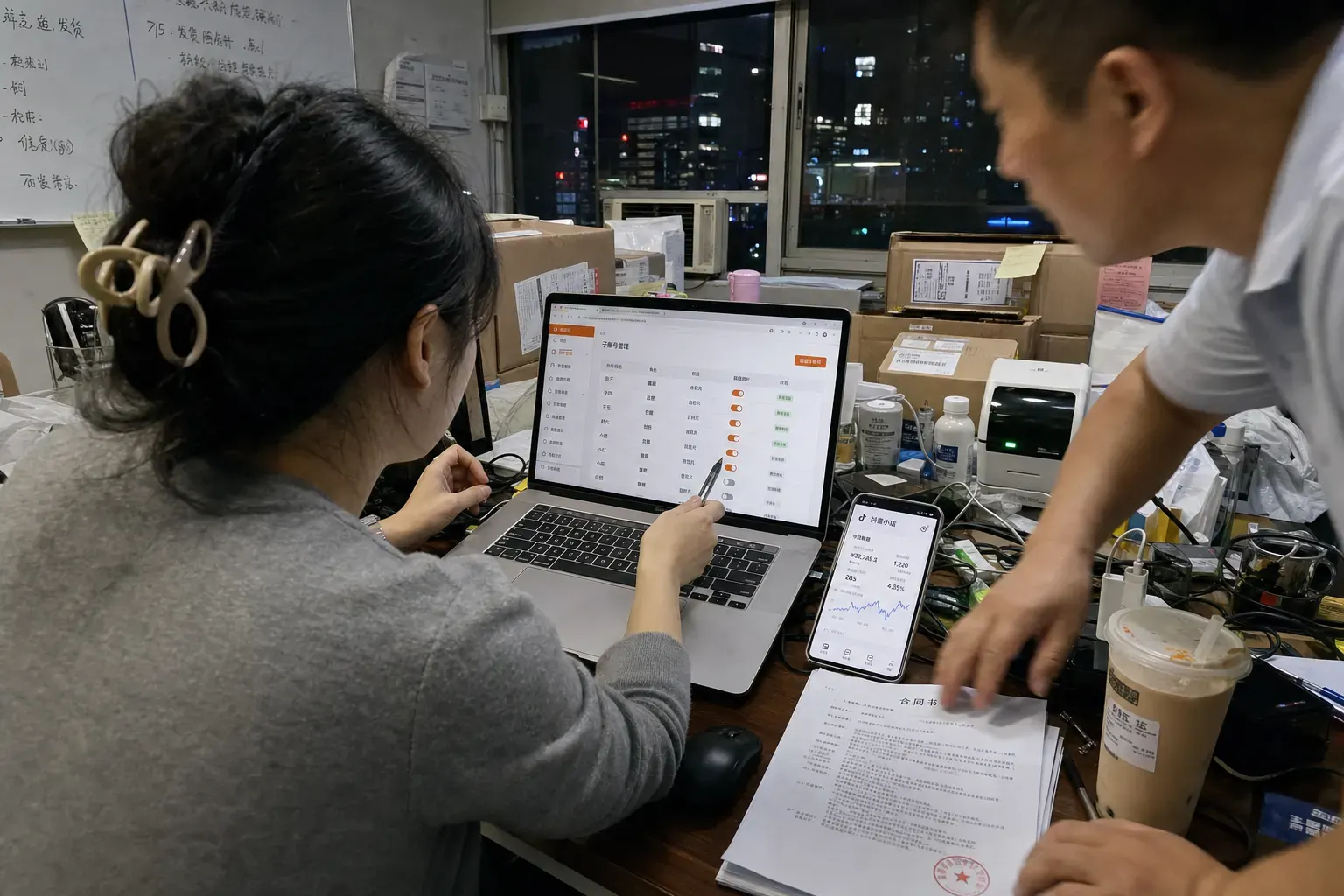
The partner doesn’t need the main account to do its job. Alibaba built sub-accounts for precisely this case.
Taobao’s sub-account agreement lets a seller create sub-accounts under its own account for employees, agents, consultants, advisers, or third-party service providers. They can use Business Advisor and the ad tools the main account has opened, within the permissions set, and their operation logs can be checked. Source: Taobao sub-account license agreement, revised June 2023. https://terms.alicdn.com/legal-agreement/terms/suit_bu1_tmall/suit_bu1_tmall201802012028_72666.html
Douyin shops have sub-accounts too, and the main account decides what each one can see and do.
The data is a different matter. On Tmall, you don’t really “own” it at all.
Tmall’s merchant agreement says the data Tmall collects and records from a merchant’s use of the service belongs to Tmall and is its trade secret. The deposit goes back to the merchant’s payment account once three months pass after termination with no open orders, complaints, or disputes. Source: Tmall Merchant Service Agreement, updated March 2026. https://terms.alicdn.com/legal-agreement/terms/TD/TD201609271722_89275.html
What you can hold is access, and access follows the main account. If it sits in your company, years of Business Advisor history are still there the morning after the partner leaves, along with the service chats. If the partner holds it, you open a new store with no sales history and no reviews.
Cut access whenever someone on the partner’s team rotates off your account. On the last day of the contract, do it in one sitting (the same afternoon, if you can): disable every partner sub-account, change the main password, move the bound phone number and email to your own people, then read the final week of operation logs.
Contract lines that settle ownership
These are the clauses the Taojiang egg company never had.
Start with the registration itself. The contract should name the entity the store is registered to, and it should be yours. Any exception (a partner entity for a test period, say) needs a date on which the store moves to you and a written undertaking to cooperate with the platform’s change process.
Then access. The partner works through sub-accounts. The main password, and the phone number bound to it, stay with your people. Ad accounts sit in your company and you fund them directly, Qianchuan on Douyin and Alimama on Tmall. A partner that fronts the ad spend and bills you later also ends up controlling the account.
Give the authorization letter an end date that matches the contract, with a line saying it lapses on termination. Content made for you (photography, video, detail pages, livestream recordings) should be assigned to you as it’s delivered.
And the exit. Name what gets handed over: Business Advisor and ad platform exports, customer service records, every content file, the logins to any tools the partner set up. Set a deadline in days. Bar the partner from deleting listings or changing prices once notice is given. Notice periods, KPIs and the commission base are the other clauses that decide how cleanly you leave. Our piece on Tmall Partner contract terms takes them one at a time.
Have a lawyer qualified in China read the final draft. We run stores, and this is an operator’s checklist, so it doesn’t replace legal advice. If a store already sits in someone else’s name, talk to the lawyer first.
What to do if your store already sits in someone else’s name
Some readers are past the contract stage already. If that’s you, check first: the law puts the holder’s license on the storefront.
The E-Commerce Law requires e-commerce operators to display their business license information, or a link to it, prominently on their homepage. Source: Cyberspace Administration of China (中央网信办), carrying the E-Commerce Law, September 2018. https://www.cac.gov.cn/2018-09/01/c_1123362506.htm
Find the license badge and read the company name.
Next, get it in writing while relations are good: a short side letter in which the partner confirms it holds the store for your brand and will cooperate with an entity change on request.
Then ask for the change. The Allbirds switch shows a flagship can move between companies. It needs the holder’s cooperation and the platform’s approval, since neither Tmall nor Tmall Global lets an account change hands without consent.
The partner has a reason to agree. It stays exposed as long as its name is on the store.
Where a registered shop holder transfers the account and shop by agreement without updating the public operator information, consumers can claim against both the registered operator and the one actually running it. Source: Supreme People’s Court (最高人民法院), Fa Shi [2022] No. 8, March 2022. https://www.court.gov.cn/zixun/xiangqing/348031.html
If they refuse, you still hold the trademark. End the authorization at its term, open a new store in your own entity, and tell your customers where you’ve moved. The reviews and followers stay behind, which costs you a season or two of sales. The old store’s deposit, once Tmall releases it three months after closing, goes to the partner.
When you shortlist a replacement, ask each candidate whose name the store goes on before you talk fees. Our guides on how to find a Tmall Partner and how to find a Douyin Partner put that question near the top. Compass, our vetted partner database, is where we’d begin.
Questions brands ask about store ownership
Can a Tmall Partner open my flagship store in its own company? Yes, if you give it an exclusive authorization. The store is then the partner’s, even though it carries your brand and you fund it. Your hold over it is the letter. Tie its term to the contract so it lapses when the relationship ends.
Is the customer data mine? Not in the way most brands expect. Tmall’s merchant agreement says the data it records belongs to Tmall. What you control is access through the store’s main account, where Business Advisor and the service logs live. Keep that account in your company.
Can I move an existing store to my own company? Sometimes. It takes the current holder’s cooperation and the platform’s approval, because Tmall and Tmall Global both bar account transfers without consent. Allbirds’ flagship moved entity in 2024. On Douyin, where a shop’s subject type is fixed once certified, ask the platform first.
Do I need a Chinese company to own my store? Not for Tmall Global, which signs its merchant agreement with your overseas company. A domestic Tmall store or a domestic Douyin shop needs a Chinese business license. If you sell domestically before you have one, agree in writing on the date and process for moving the store into your entity.
Ask Compass for a shortlist of partners who open stores in your name
Updated September 24, 2026
Working on China? Let's grab a coffee.
Tell us where you are now and where you want to get to.