
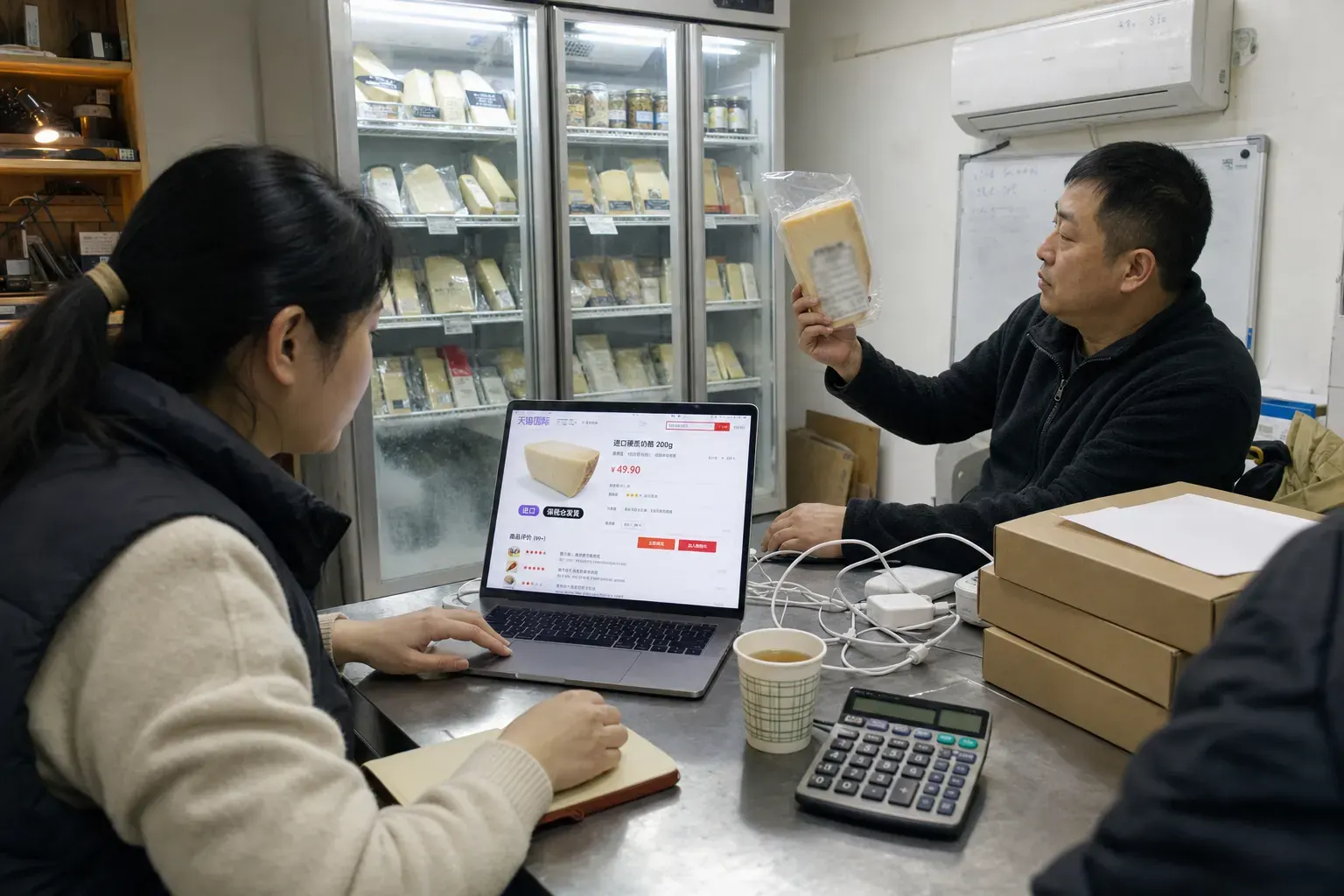
An imported product’s shelf price in China is your ex-works price with freight, duty, VAT and three margins stacked on top: the importer’s, the distributor’s and the retailer’s. In the worked example below, a cheese wedge that leaves a French dairy at 24 RMB sells for 78.60 RMB. Build that ladder backward from the shelf before you quote anyone.
Most brands work the other way around. They send an export price list to a Chinese importer and find out the shelf price months later, usually from a phone photo of a shelf tag sent over WeChat. By then it’s set, and there’s little room left to move it.
The ladder below is an illustration. One 200 g wedge of aged French hard cheese, tariff line 04069000 (“other cheese”), imported under general trade and sold in a supermarket. Every tax rate comes from the regulator and is cited further down; all are 2026 rates, checked on September 24, 2026. Freight, port costs and the margins are our planning inputs, marked as illustration.
| Step | Rate | Source | Adds (RMB) | Running price (RMB) |
|---|---|---|---|---|
| Ex-works price | Illustration | 24.00 | 24.00 | |
| Chilled sea freight and insurance to Shanghai | Illustration | 3.00 | 27.00 | |
| Import duty on 27.00 | 8% (2026 provisional; MFN 12%) | 2026 tariff plan, annex 1 | 2.16 | 29.16 |
| Import VAT on 29.16 | 13% | VAT Law, articles 10 and 14 | 3.79, paid at the border and credited later | 29.16 |
| Port handling, inspection, clearance, cold storage | Illustration | 2.00 | 31.16 | |
| Importer margin | 20% of its selling price | Illustration | 7.79 | 38.95 |
| Regional distributor margin | 20% of its selling price | Illustration | 9.74 | 48.69 |
| Supermarket margin | 30% of its selling price | Illustration | 20.87 | 69.56 |
| VAT on the shelf price | 13% | VAT Law, article 10 | 9.04 | 78.60 |
The factory price is 30.5% of what the shopper pays. Duty is 2.7%. The three margins come to 38.40 RMB, or 49%.
Why the ladder starts at the shelf
Shoppers never see your ex-works price. They see a tag on a chilled shelf or a price on a product page, next to a Chinese brand and two other imports. That number decides whether the wedge moves. Everything under it is a negotiation between you and the companies that carry the goods there.
So pick the shelf price first, from what comparable imports sell for in the stores and on the platforms you’re aiming at. After that, strip the layers off it.
Say the category sits at 69.90 RMB for 200 g. Take out 13% VAT and the retailer’s pre-tax price is 61.86. At a 30% margin it buys at 43.30. The distributor, at 20%, buys at 34.64. The importer, also at 20%, needs goods landed at 27.71. Take off 2.00 of port costs, divide out the 8% duty and subtract 3.00 of freight. Your ex-works price has to be 20.81 RMB, 13% under the 24 RMB on your list.
None of this is new.
In 2013 a tariff official at Changsha Customs told a local paper that duty was a small share of an imported food’s cost and that resale through layer after layer of distributors drove the price up. A trader in the same report said imported wine passed through at least three distributor layers, each adding 50% or more to its purchase price. Source: Sanxiang Metropolis Daily (三湘都市报), carried by People’s Daily Online (人民网), April 2013. http://finance.people.com.cn/n/2013/0412/c1004-21110790.html
Duty and VAT: what the border takes
Duty is charged on the customs value, which is your price plus freight and insurance to the Chinese port.
China’s Tariff Law, in force since December 1, 2024, bases the dutiable value of imported goods on the transaction price plus transport, related costs and insurance up to the point of unloading in China. Source: Tariff Law of the People’s Republic of China (中华人民共和国关税法), Xinhua on the Chinese government portal (中国政府网), April 2024. https://www.gov.cn/yaowen/liebiao/202404/content_6947843.htm
The rate depends on the tariff line and on where the goods come from. The same law says a provisional rate replaces the most-favored-nation (MFN) rate whenever one exists, and cheese has one this year.
For 2026, “other cheese” (tariff line 04069000) carries a 12% MFN rate and an 8% provisional rate. The 2026 plan sets provisional rates on 935 tariff lines from January 1, 2026. Source: Customs Tariff Commission of the State Council (国务院关税税则委员会), 2026 tariff adjustment plan, annex 1, December 2025. https://gss.mof.gov.cn/gzdt/zhengcefabu/202512/P020251229510521217364.pdf
The four-point cut saves 1.08 RMB at the border on our wedge. After three margins and VAT have multiplied it, it’s worth 2.72 RMB on the shelf.
Origin can lower the rate further.
China applies agreement tariff rates to eligible goods from 34 trading partners under 24 free trade agreements and preferential arrangements, among them Switzerland, New Zealand and Australia. The rates are listed in annex 6 of the 2026 plan. Source: Customs Tariff Commission of the State Council (国务院关税税则委员会), 2026 tariff adjustment plan, December 2025. https://gss.mof.gov.cn/gzdt/zhengcefabu/202512/P020251229510520940591.pdf
The EU has no such agreement with China, so a French or Italian cheese pays the provisional rate. A Swiss one should check annex 6 first.
Then VAT.
China’s VAT Law, in force since January 1, 2026, sets 13% on imported goods and 9% on farm products, edible vegetable oil and edible salt. Import VAT is charged on the dutiable value plus duty and any consumption tax. Source: VAT Law of the People’s Republic of China (中华人民共和国增值税法), State Taxation Administration (国家税务总局) policy database, December 2024. https://fgk.chinatax.gov.cn/zcfgk/c100009/c5237365/content.html
Which band you land in is set by the tax authorities’ scope notes. For a food brand the line runs through the middle of the catalog.
The 2026 scope notes for the 9% rate exclude dairy products made from fresh milk, naming yogurt, cheese and cream, and list olive oil among the edible vegetable oils taxed at 9%. Source: Ministry of Finance and State Taxation Administration (财政部 税务总局), Announcement 2026 No. 9, annex 1, January 2026. https://fgk.chinatax.gov.cn/zcfgk/c102416/c5247431/content.html
So a French brand shipping cheese and olive oil in the same container pays 13% on one and 9% on the other.
This is where homemade ladders tend to go wrong. Import VAT passes down the chain. The importer pays 3.79 RMB at the border and deducts it from the VAT it charges the distributor, who does the same with the retailer. The state ends up with 13% of the pre-tax shelf price, 9.04 RMB, collected once. A ladder that adds import VAT as a cost and then adds VAT again at the shelf is counting it twice. It’s still cash, though. The importer fronts that 3.79 RMB a wedge until it sells, and the cost of that money sits inside its margin.
Where distributor margins sit, and why they multiply
Three companies stand between your loading dock and the shopper. Each quotes a margin on its own selling price, and each applies it to a price that already carries the margins above it.
The stack ends up bigger than it looks. Margins of 20%, 20% and 30% multiply: the landed cost is divided by 0.8, then 0.8, then 0.7, which is 2.23 times, before VAT. And a 20% margin is a 25% markup on cost. Thirty percent is a 42.9% markup. When a distributor says “25,” ask which one. Chinese price sheets use both: 毛利率 is margin on the selling price, 加价率 is markup on cost.
Listed companies give floor readings for each layer.
Pinlive Foods (品渥食品), a listed Shanghai importer of German dairy and beer, reported a 2025 gross margin of 16.24%. Its dairy line ran at 12.20%. Source: Eastmoney (东方财富网), April 2026. https://finance.eastmoney.com/a/202604223714189425.html
Yonghui Superstores (永辉超市) reported a 17.00% gross margin on retail in 2025 and 18.72% on food and daily goods. It said it was moving suppliers to net pricing with fewer back-end fees. Source: Yonghui Superstores 2025 annual report, April 2026. https://www.yonghui.com.cn/upload/financial/12102322.PDF
Milkground (妙可蓝多), a listed Shanghai cheese maker, earned a 4.06% gross margin on 623 million RMB of dairy trading in 2025. It sold through 6,047 distributors at year end. Source: Milkground 2025 annual report, via CNINFO (巨潮资讯网), March 2026. https://static.cninfo.com.cn/finalpage/2026-03-25/1225029557.PDF
Read those as floors. Milkground’s trading line, goods in and goods out with nobody building a brand, made about 4%. An importer that holds stock and carries its customers’ credit made 12% on dairy and 16% across its whole range. The supermarket sits a little higher, 17% to 19% averaged over a food aisle, and a specialty import usually has to beat the aisle average to keep its facing. Hence the 30% we give the retailer in the illustration (our planning assumption, not a reported figure).
The same arithmetic runs in reverse. A yuan off the ex-works price or the freight comes off the shelf 2.72 times, because duty, three margins and VAT all sit on top of it. A yuan off port costs comes off 2.52 times. A yuan the retailer adds only picks up VAT.
The same wedge through a cross-border store
Cross-border retail import skips all three middle layers. Goods wait in a bonded warehouse in China and clear one parcel at a time when a shopper orders on Tmall Global or JD Worldwide.
China’s customs service created two codes for this in 2014: 9610 for cross-border e-commerce and 1210 for bonded cross-border e-commerce. Source: Jiaxiang County Commerce Bureau (嘉祥县商务局), January 2024. http://jiaxiang.gov.cn/art/2024/1/17/art_72008_2758261.html
Cheese only gets one of them.
“Other cheese” (04069000) is on the cross-border retail import positive list, restricted since the 2022 adjustment to bonded online purchases (网购保税) only. Source: Ministry of Finance and seven other departments (财政部等八部门), Announcement 2022 No. 7, adjustment table, February 2022. http://gss.mof.gov.cn/gzdt/zhengcefabu/202202/P020220221322524635155.pdf
The tax changes shape as well.
In cross-border retail imports the shopper is the taxpayer. The dutiable value is the actual transaction price, including retail price, freight and insurance. Duty is set at 0% within the limits, and import VAT and consumption tax are levied at 70% of the statutory amount. Source: Ministry of Finance (财政部), 财关税〔2016〕18号, March 2016. http://www.mof.gov.cn/gp/xxgkml/gss/201603/t20160324_2510682.htm
Thirteen percent times 70% is 9.1%. That’s the default in our Tmall Global calculator, which also assumes the shopper pays it on top of the listed price. The table runs the same wedge through a Tmall Global store at the calculator’s food-category defaults, with the shopper paying the same 78.60 RMB all in.
| Line, per wedge | Source | RMB |
|---|---|---|
| Shopper pays, all in | Same as the supermarket shelf | 78.60 |
| Cross-border tax, 9.1%, paid by the shopper | 财关税〔2016〕18号, VAT Law | 6.56 |
| Listed price, the brand’s revenue | 72.04 | |
| Platform commission, food, 2% | TheChinaPath calculator data | -1.44 |
| Payment fee, 1% | TheChinaPath calculator data | -0.72 |
| Tmall Partner commission, 10% | TheChinaPath calculator data | -7.20 |
| Pick, pack and last mile, 15 RMB a parcel, three wedges an order | Calculator data; order size is illustration | -5.00 |
| Bonded storage, 0.8 RMB an order a month for two months, over three wedges | TheChinaPath calculator data | -0.53 |
| Returns, 5% of parcels at 15 RMB | TheChinaPath calculator data | -0.25 |
| Sea freight to the bonded warehouse | Illustration | -3.00 |
| Ex-works value of the wedge | Illustration | -24.00 |
| Left above ex-works, before media and fixed fees | 29.90 | |
| Paid media, 60% of sales at a return on ad spend of 2 | TheChinaPath calculator data | -21.61 |
| Creator commission, 20% of sales at 20% | TheChinaPath calculator data | -2.88 |
| Partner retainer and annual fee, spread over 3.5 million RMB of sales | TheChinaPath calculator data | -9.26 |
| Result per wedge, year one | -3.85 |
TheChinaPath calculator data, September 2026, Tmall Global calculator defaults for the food category. The 15 RMB parcel is the calculator’s ambient default. A chilled parcel costs more, so get a quote.
In general trade you invoice 24 RMB and the chain pays for everything after your dock. Cross-border, the whole 72.04 RMB is yours, and so is every bill in the table. At the calculator’s year-one defaults the spread goes on traffic and the partner, and the wedge ends 3.85 RMB short of its ex-works value. Put another way, the brand recovers 20.15 RMB for a wedge it sells for 24 RMB to an importer. A better return on ad spend, a bigger basket or a second year with repeat buyers moves that line, and the calculator lets you test each one. Its year-two column tends to look kinder, because organic sales climb once the store has reviews and repeat buyers. Our comparison of a China distributor against your own store covers what else changes hands, from customer data to control of the price.
What to cut, and what never to cut
Cut layers first. A distributor with its own import license folds importer and distributor into one company. At a single 25% wholesale margin, same retailer, same taxes, the illustration shelf price falls from 78.60 to 67.07 RMB. That’s 11.53 RMB, far more than a freight renegotiation is likely to find.
Then cut cost before the first margin, where it counts 2.72 times over. Consolidate the chilled containers. Clear at the port nearest your distributor’s cold store, so the goods don’t cross half the country before anyone has marked them up. And confirm the tariff line with the importer’s customs broker before you price. On our wedge, 8% against 12% is 2.72 RMB at the shelf.
Don’t squeeze the distributor to a trader’s margin. A company earning 4% can move boxes. It can’t pay for a sales team or a Double 11 promotion, and your wedge sits in its cold store until the date runs out. And don’t build a ladder that leaves the retailer below what it earns on the rest of the aisle. A buyer who makes less on your wedge than on its neighbors has little reason to reorder it. Ask for the retailer’s terms as a net price, too. Yonghui says it’s moving its suppliers that way, and a net price is easier to put on a ladder than a list of listing and promotion fees.
Quote every candidate on the same basis. If one importer gets an ex-works price and another a delivered price to Shanghai, their shelf prices can’t be compared.
Take the ladder to every distributor meeting. Ask each candidate to fill in its own margin and the retailer’s, then compare offers on the shelf price, the way our guide to finding a distributor in China recommends. Our distributor sourcing and management work starts from the same sheet, and Compass holds the distributors we have already vetted by category.
Frequently asked questions
How much margin does a Chinese distributor take on imported products?
It depends on the channel and on who pays for listing fees and promotions. Listed benchmarks give floors: a Shanghai dairy importer reported 12.20% gross margin on dairy in 2025, and a national supermarket chain 18.72% on food and daily goods. Our illustration uses 20% for the importer, 20% for the regional distributor and 30% for the retailer.
Does import VAT get added to the shelf price twice?
No. The importer pays VAT at the border, then deducts it from the VAT it charges its own buyer, and each layer does the same. The state collects 13% of the pre-tax shelf price once. The border payment is still a cash cost for the importer until the goods sell, and it’s priced into the margin.
What duty does imported cheese pay in China in 2026?
“Other cheese,” tariff line 04069000, has a 12% MFN rate and an 8% provisional rate for 2026, and the provisional rate applies. Goods from a country with a trade agreement may pay less. Cheese then pays 13% import VAT, because the tax rules keep dairy products made from fresh milk out of the 9% band.
Is cross-border cheaper than general trade for an imported product?
For the shopper it can be: no duty, and 9.1% tax where general trade charges 13% VAT. For the brand it swaps three margins for platform fees, a partner and paid media. At our calculator’s year-one defaults, the cheese wedge in this piece brings the brand 20.15 RMB cross-border against 24 RMB ex-works in general trade.
Get a Compass shortlist of distributors who will price from the shelf
Updated September 24, 2026
Working on China? Let's grab a coffee.
Tell us where you are now and where you want to get to.