LEGO began selling in China in 1983 and opened its first mainland brand flagship in 2016. Its Jiaxing factory expansion carried an announced RMB 1 billion investment, according to The Paper. The sequence separates selling costs from factory investment. The sources reviewed disclose no total China retail launch budget, so the factory figure cannot answer what a first store costs.
Sources for the opening dates and announced investment: LEGO Group, November 2018 and March 2022; The Paper, June 2025. https://www.lego.com/en-gb/aboutus/news/2019/october/steam-courses-for-chinese-schools https://news.lego.cn/v/news/article?aid=352 https://m.thepaper.cn/detail/31041417
For a foreign toy brand, the useful question is which commitment comes next. Selling stock to a retailer creates a different cash obligation from building a factory to supply a region. LEGO’s chronology helps keep them apart.
Sources and the JD storefront were checked on October 16, 2026. Operating recommendations below are our analysis, not statements about LEGO’s private contracts or internal decisions.
What LEGO’s China storefront shows today
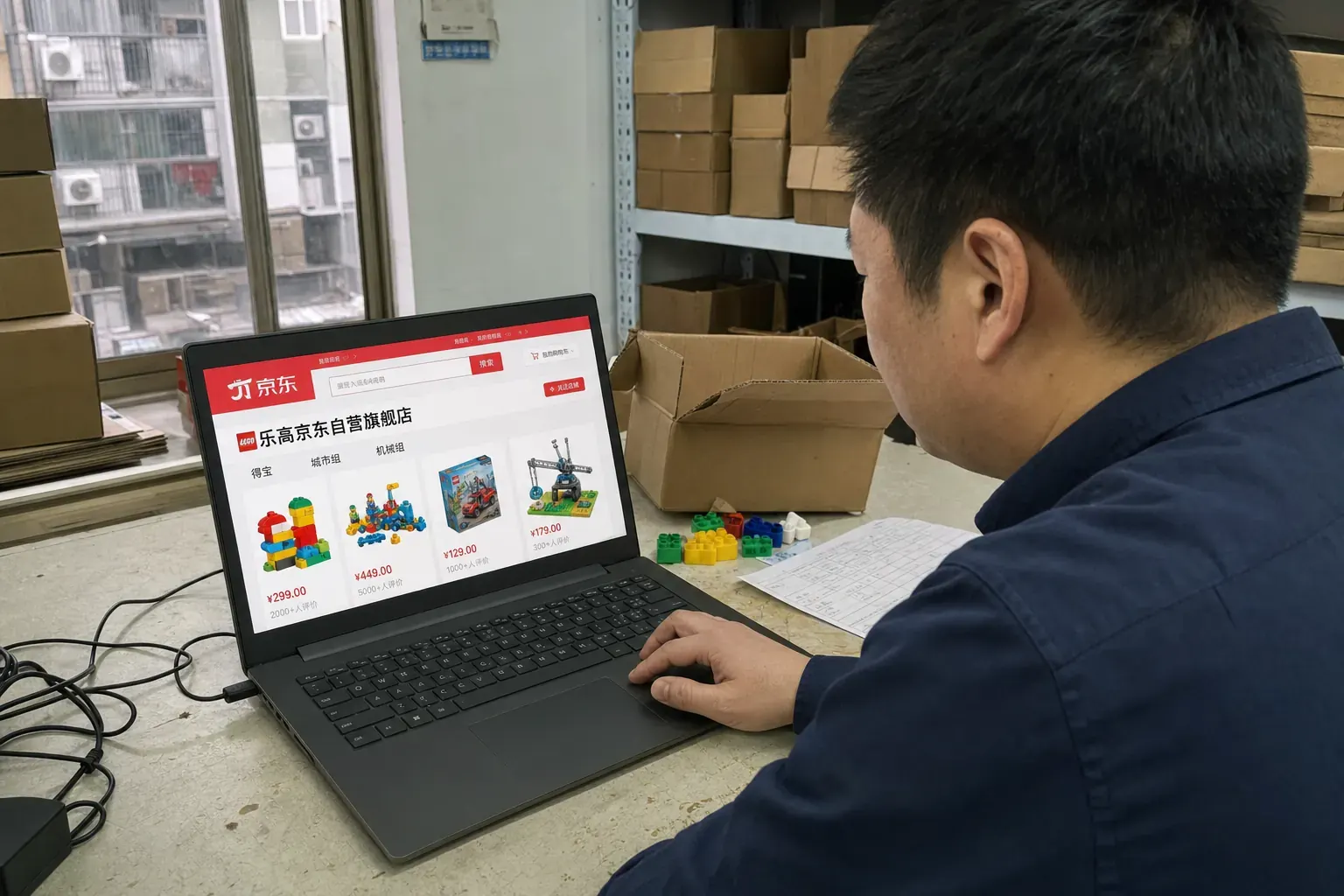
The accessible JD shop view separates vehicles from licensed collections. It also groups learning and play products apart from art and lifestyle themes. DUPLO appears alongside ranges aimed at older builders.
The LEGO JD self-operated flagship’s retrieved ranking panel shows six product tiles, including DUPLO 10914 and Technic vehicles. It exposes no complete assortment total, numeric prices or product review counts. Source: JD (京东), storefront observation, October 16, 2026. https://lego.jd.com/view_search-396203-0-1-1-24-11.html
That is a partial shop view, with rankings that can change. A rank is not a unit-sales figure, and the visible tiles cannot establish the size of LEGO’s China range. Nor can they establish current price positioning.
JD labels this shop as self-operated. That identifies the retail format; it does not reveal the terms on which JD buys or holds LEGO stock.
We read that navigation as separate routes for a parent buying preschool toys and someone looking for a display model. For your own store, ask whether a buyer can identify the right age and use without already knowing the product name. Check that distinction before buying traffic for a broad catalog.
How LEGO entered China over several stages
LEGO’s sales history predates the Disneytown store. The table keeps the production start separate from the factory’s formal inauguration too.
| Milestone | Date | What the evidence establishes |
|---|---|---|
| First China sales | 1983 | The brand’s own account dates sales to this year |
| Jiaxing begins production | Late 2015 | Production preceded the formal factory opening |
| Shanghai Disneytown flagship | May 11, 2016 | First mainland brand flagship, 800 square meters |
| Jiaxing inauguration | November 25, 2016 | Factory intended to serve China and Asia |
| First regional Lunar New Year sets | January 1, 2019 | Announced availability in China and Asia Pacific |
| Jiaxing expansion | 2022 to 2024 | Announced investment of RMB 1 billion; completion in 2024 |
LEGO dates its first China sales to 1983. In November 2018 it reported 47 branded stores in 16 Chinese cities and announced its first regional Lunar New Year sets for January 1, 2019. Source: LEGO Group, November 2018. https://www.lego.com/en-gb/aboutus/news/2019/october/steam-courses-for-chinese-schools
LEGO’s first mainland brand flagship opened at Shanghai Disneytown on May 11, 2016, with 800 square meters of floor space. Source: LEGO Group (乐高集团), March 2022. https://news.lego.cn/v/news/article?aid=352
Jiaxing began production at the end of 2015. The expansion announced in 2022 added 42,000 square meters and was completed in 2024. Source: The Paper (澎湃新闻), June 2025. https://m.thepaper.cn/detail/31041417
For a smaller entrant, we suggest an approval condition for each new commitment, such as a retailer placing a paid repeat order. A new entrant can test whether retail orders repeat before taking on a larger fixed cost. Nothing in these sources establishes that another toy brand needs LEGO’s time frame or factory footprint.
The earliest evidence records product sales
The earliest verified milestone is product sales. The sources used here do not identify the first Chinese retail partner. An exact first-channel claim would go beyond the evidence.
Later disclosures distinguish company flagships from authorized retail.
In March 2022, LEGO reported seven brand flagships and more than 300 authorized stores across a retail network covering more than 85 cities in China. Source: LEGO Group, March 2022. https://news.lego.cn/v/news/article?aid=352
Our reading of that network is that stock funding and shop costs need separate decisions. The store count leaves those costs unexplained. A distributor proposal should make those obligations explicit before a sales target enters the agreement.
Use China distribution planning to define the route, then test a candidate’s actual retail access through the China distributor finder.
Ask a prospective toy distributor which accounts would place the opening orders, then request evidence of previous replenishment. Mall names alone will not tell you whether the buyer has placed an order.
Ask to see invoices. Then reconcile them with stock reports.
What the factory investment actually bought
The disclosed money belongs to manufacturing expansion. Keep that scope in view when you compare the figure with your own launch budget.
The Paper reported that LEGO announced RMB 1 billion of additional investment in Jiaxing in 2022, adding automated warehousing and production facilities. The expansion was completed in 2024. Source: The Paper, June 2025. https://m.thepaper.cn/detail/31041417
The report gives an announced investment and a completion year. It does not provide an audited total of cash spent. Using that amount as a store-opening budget would mix different costs and stages of the business.
At its November 2016 inauguration, Jiaxing covered about 165,000 square meters and employed more than 1,200 people. At opening, LEGO expected it to produce 70% to 80% of the products sold in Asia. Source: LEGO Group, November 2016. https://www.lego.com/en-us/aboutus/news/2019/october/jiaxing-factory-grand-opening
Jiaxing was intended to supply the wider Asian market. Charging all of its cost to China retail would give you the wrong market comparison. The production share was an expectation stated at opening; these sources do not verify the share actually achieved.
Our advice for a smaller entrant is to keep the store budget separate from the supply decision. Put opening inventory and retailer deductions in the commercial model. State when you pay the supplier and when the retailer must pay you. Model local manufacturing only when the order volume and replenishment needs justify investigating it.
Our first supply question would be: which confirmed orders would a local source fulfill sooner, and what cash would that require? Inventory funding for those orders belongs in the working-capital forecast.
Equipment and buildings belong in the capital-spending plan. Keeping separate records lets you test whether faster replenishment supports the proposed spending.
A supplier quote leaves customer acquisition and retailer returns unanswered. Ask for those inputs separately.
The expansion did not remove demand risk
The sources give no measure of an avoidable launch delay or lost sales. They document weak demand after years of investment.
LEGO’s 2023 results said consumer sales declined in China because of the economic environment. The release gave no China decline percentage. Source: LEGO Group, March 2024. https://www.lego.com/en-gb/aboutus/news/2024/march/lego-delivered-topline-growth-and-outpaced-market-in-2023
That disclosure cannot support a claim that a particular store format failed. It also cannot put a price on lost time. That statement describes 2023; it does not establish the results in every later year.
In August 2026, CEO Niels Christiansen described China as the exception to broad first-half growth and said consumers were reluctant to spend. The company continued investing in its brand and stores; separate China revenue was not disclosed. Source: Yicai Global (第一财经), August 2026, reporting the earnings call. https://www2.yicaiglobal.com/news/china-is-only-exception-for-legos-broad-base-revenue-growth-in-first-half-ceo-says
We would tie expansion to repeat orders that can be verified. Before approving another outlet, inspect the stock still sitting in the current one. Track what happens to the cartons after delivery. Stock that remains on a retailer’s shelf still affects the next order you hope to receive.
Sell-through means sales to the final buyer. Our proposed reporting rule for a new partner is a weekly statement of units sold and stock left by product and outlet. Record transfers between shops separately, and keep returns visible instead of subtracting them silently from sales. Match it against replenishment orders before agreeing to another shipment. This is a control you can negotiate; LEGO’s reporting practices are not disclosed in these sources.
What a foreign toy brand can use
Keep retail access and supply capacity in separate budgets. For your first partner agreement, define how sell-through will be reported and when you can reduce the range. Treat those as proposed controls for your business, not as a description of LEGO’s contracts.
The regional Lunar New Year products offer another useful example. The company’s announcement describes products built around a local occasion. Our inference is that a localized assortment deserves testing at product level, with a buyer and a reorder decision attached. Agree on the test before producing the range: which outlets will carry it, and how many units must sell at the intended price before you repeat the order? Set those measures for your own launch. No sales lift for LEGO’s regional sets is established by the launch announcement.
Avoid using flagship counts as a payback calculation. The cited releases do not disclose China store economics, and the JD snapshot does not fill the gap. Request the costs and sales evidence for the route you actually intend to fund.
Questions about LEGO’s China entry
Was the flagship LEGO’s first sale in China?
No. LEGO’s own history dates China sales to 1983, while its first mainland brand flagship opened in 2016. The earlier sales record does not name the first retailer. A brand can use retail partners before operating its own flagship, but the sources here do not describe LEGO’s original contract.
How much did LEGO spend entering China?
The sources reviewed do not give a total entry budget. The RMB 1 billion figure concerns a later manufacturing expansion announced in 2022. It does not establish store setup costs, advertising spend or the time it took stores to repay their costs. Ask a prospective operator to separate inventory funding from running costs and state which assumptions drive its break-even forecast.
Does the JD shop prove the China business is profitable?
No. The accessible storefront establishes a retail presence and shows product groupings. It does not disclose a China profit figure or the cost of acquiring a customer. Our advice is to assess a proposed route using the partner’s commercial terms and your own order economics.
Updated October 16, 2026
Working on China? Let's grab a coffee.
Tell us where you are now and where you want to get to.