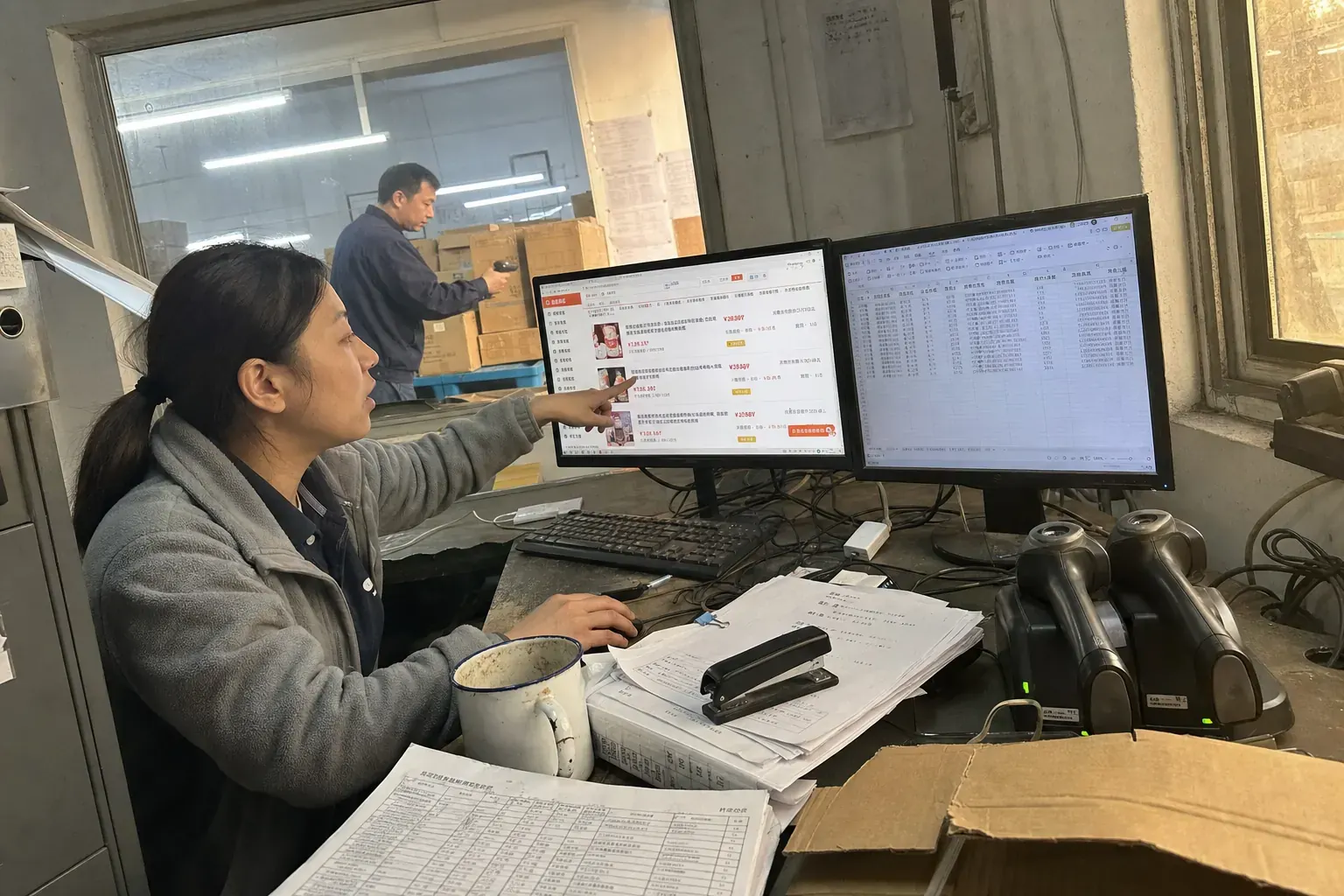
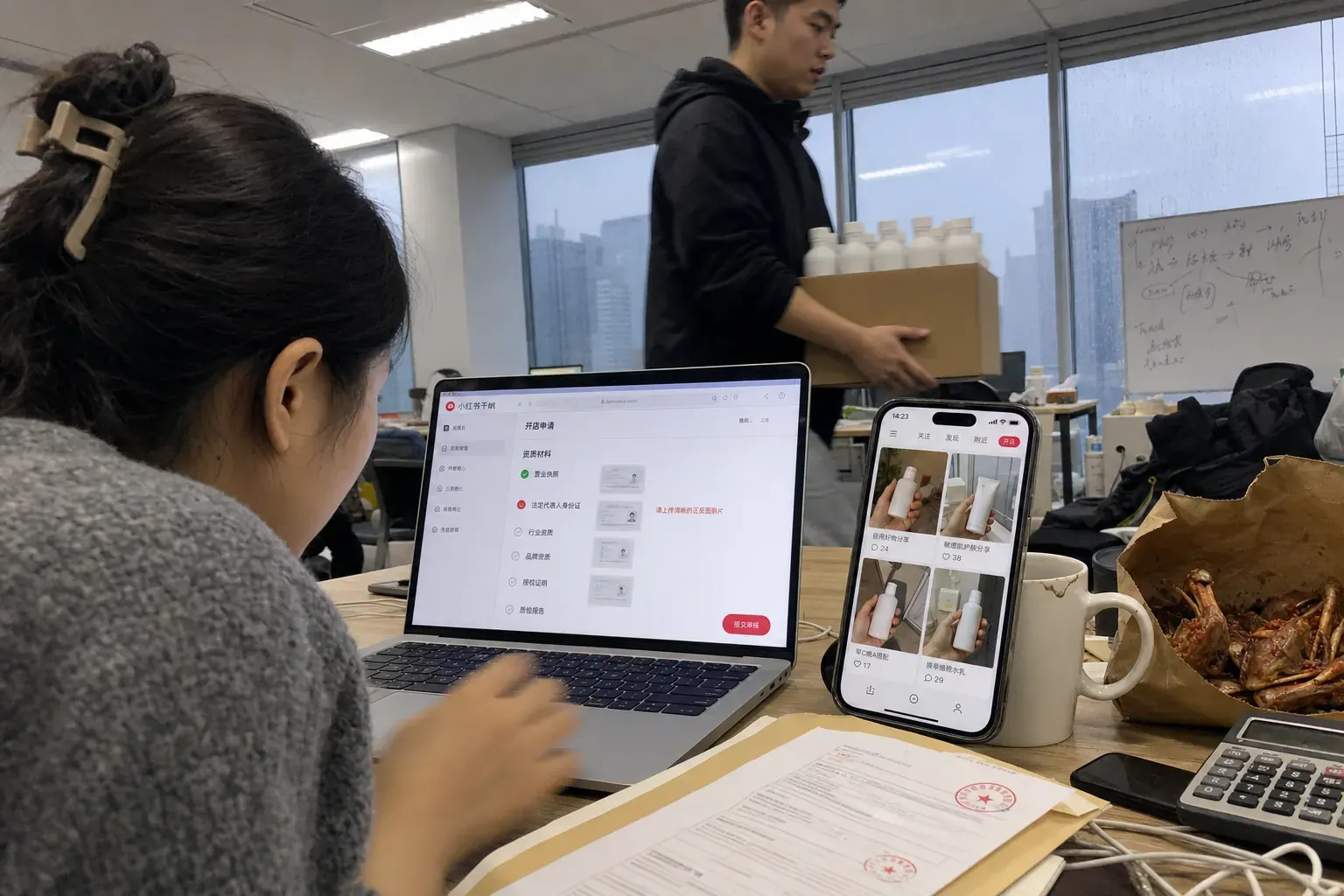
Yes, a company registered outside China can open a cross-border store on Xiaohongshu (RedNote). Since July 2, 2026, it also needs a mainland company that co-signs for joint liability. The default deposit is US$400, less than 4% of the RMB 80,000 that Tmall Global’s cheapest categories take in deposit and annual fee. And the store is rarely the point. Buyers find the brand in notes and search first. The store just takes the order.
That last part decides whether Xiaohongshu store setup is worth your quarter. The cash is small. The paperwork, and above all the mainland partner, is the long part. And a store with no notes pointing at it sells nothing.
The money gap with Tmall Global is real, though. In our Tmall Global cost calculator, deposit plus annual fee comes to RMB 80,000 in 11 of its 19 product categories, RMB 110,000 in seven, and RMB 330,000 for health supplements. RedNote’s default cross-border deposit is about RMB 2,840 at the calculator’s rate of 7.1 to the dollar, and its fee rules list no annual fee.
Tmall Global deposit plus annual fee: RMB 80,000 in 11 of 19 categories, RMB 110,000 in 7, RMB 330,000 for health supplements. Source: TheChinaPath calculator data, October 2026.
Every RedNote rule below was read on the platform’s own pages on October 4, 2026.
Requirements and costs to open a RedNote store
| Item | What RedNote asks of an overseas company | Date or deadline in the rules |
|---|---|---|
| Entity | Company registered outside mainland China; flagship, franchise, specialty, or multi-brand store | No review time published |
| Mainland partner | Affiliate or agent with import-export scope, a joint-liability undertaking, and customs registration | Required since July 2, 2026 |
| Documents | Registration plus Chinese-English translation, passport, registered trademark, authorization chain, and 12 months of purchase proof | Fix a rejection within 30 days or it lapses |
| Deposit (US$) | 400 by default; 700 or 2,800 once monthly sales pass RMB 100,000 or RMB 500,000 | Pay within 2 working days of signing |
| Commission | Mostly 2% to 5% by category (beauty 4%, apparel 5%), plus a 0.7% payment fee on cross-border orders | Charged per order |
| Fulfillment | Bonded warehouse or direct mail from abroad | Ship in 72 hours (bonded), 120 hours (direct mail) |
Each row is sourced in the sections below.
What a RedNote store is, and what it isn’t
A RedNote store is a shop inside the app. Notes and livestreams link to its products, and checkout happens without leaving RedNote. An overseas company opens it under the cross-border rules, so goods ship from a bonded warehouse in China or straight from abroad, and the store name carries a “海外” (overseas) tag the platform adds on its own.
Stores opened by an overseas entity have their store type renamed automatically, for example to 海外旗舰店 (overseas flagship store). Source: Xiaohongshu rule center (小红书电商学习中心), store type and naming rules, July 2024. https://school.xiaohongshu.com/rule/detail/26/823
That matters for a store because the traffic is already shopping. People open the app to decide what to buy.
Xiaohongshu has more than 400 million monthly active users and up to 800 million searches a day. Source: Beijing Business Today (北京商报), May 2026. https://finance.sina.com.cn/jjxw/2026-05-27/doc-inhziqxq9291575.shtml
About 200 million users a month look for buying advice on Xiaohongshu (platform data, January to November 2025). Source: Ebrun (亿邦动力) via Sina, December 2025. https://finance.sina.com.cn/tech/roll/2025-12-24/doc-inhcwtcp4511859.shtml
Two things it is not. It isn’t Redshop, the export project RedNote set for June 2026, which carries Chinese sellers’ goods to buyers abroad.
Redshop, Xiaohongshu’s overseas project, was set to launch in June 2026 with 50 invited seed merchants, starting in markets including the United States, the United Kingdom, Singapore, and Malaysia. Source: 36Kr (36氪), April 2026. https://www.36kr.com/p/3763928410866433
And it isn’t a replacement for Tmall Global or JD Worldwide, where shoppers type a product name and compare prices. On RedNote people read notes first, and the store gets the orders those notes produce.
Who can open one, and what the file needs
An overseas company can open four store types: a flagship store, a franchise store (专卖店), a specialty store (专营店) or a multi-brand store. Ordinary company stores, sole-trader stores, and personal stores are closed to overseas entities.
Flagship, franchise, and multi-brand stores accept a mainland or an overseas entity, and specialty stores accept overseas registration papers with a Chinese-English translation; ordinary company, sole-trader and personal stores do not accept overseas entities. Source: Xiaohongshu rule center (小红书电商学习中心), merchant admission standards, February 2024. https://school.xiaohongshu.com/rule/detail/26/817
The same page sets most of the file. The legal representative can use a passport. The trademark can be registered abroad, through WIPO, or in China, but it has to be registered already, and a picture-only mark is refused. One company can run two stores at most.
Decide early whose name goes on the store. A flagship needs first-level exclusive rights from the brand owner, so a distributor that opens your flagship holds exclusivity on RedNote for as long as its letter runs. Franchise and specialty stores can sit up to three levels down the chain, which lets a reseller sell without locking up the brand.
A flagship store requires first-level exclusive authorization; franchise and specialty stores accept an authorization chain of up to three levels. Source: Xiaohongshu rule center (小红书电商学习中心), merchant admission standards, February 2024. https://school.xiaohongshu.com/rule/detail/26/817
Then, in July 2026, the file got heavier.
Every cross-border store must file four documents, none optional: its overseas registration certificate, the business license of a mainland affiliate or agent with import-export scope, the mainland entrusted company’s undertaking of joint liability for product sourcing and compliance, and a customs registration. Source: Xiaohongshu rule center (小红书电商学习中心), cross-border qualification notice, July 2026. https://school.xiaohongshu.com/rule/detail/19/119851
That notice also asks for proof of purchase from the last 12 months: contracts, invoices, and shipping papers that match. For regulated categories the licensing runs on both sides of the border. The overseas company shows its home-country license, and the mainland partner shows the matching Chinese one, each valid for at least 30 more days.
Cross-border merchants must provide the category license of their home country or region, and their mainland entrusted company must hold the matching Chinese license. Source: Xiaohongshu rule center (小红书电商学习中心), industry qualification requirements, March 2025. https://school.xiaohongshu.com/rule/detail/26/807
So who signs? The candidates are the importer or distributor you already work with, or the service partner that will run the store. Pick it the way you’d pick a distributor, because it answers for your goods. Douyin Global asks for the same thing, a mainland domestic agent that carries joint liability, and nothing stops one partner from signing for both stores if it accepts the exposure.
Douyin Global requires a mainland domestic agent (境内代理人) that carries joint liability and files its business license with an entrustment declaration. Source: Douyin E-commerce (抖音电商), Douyin Global admission rules, July 2026. https://school.jinritemai.com/doudian/web/article/108056
The deposit is the light part. The default for a cross-border category is US$400, down from US$3,500 before an April 2025 revision. Some categories carry their own figure in the platform’s category sheet, so check yours.
Default category deposit for cross-border stores: US$400 (US$3,500 before the revision). Source: Xiaohongshu rule center (小红书电商学习中心), category deposit standard, April 2025. https://school.xiaohongshu.com/rule/detail/27/858
It rises with sales. Since July 1, 2026, overseas merchants also owe a floating deposit set by the previous month’s settled sales, and they pay whichever of the two is higher.
Floating deposit for overseas merchants: US$400 at RMB 50,000 to 100,000 of monthly settled sales, US$700 at RMB 100,000 to 500,000, US$2,800 above RMB 500,000. Source: Xiaohongshu rule center (小红书电商学习中心), deposit management rules, July 2026. https://school.xiaohongshu.com/rule/detail/27/119848
The deposit-free trial on the same page covers personal and sole-trader stores only. A cross-border store pays from day one. Getting it back is quick: once a refund request goes in, the rule gives RedNote one to seven working days.
Xiaohongshu store setup, step by step
RedNote doesn’t publish how long it takes to review a new store. Nothing in the rule center gives a number of working days for the qualification or brand check, and the figures that circulate online trace back to agency blogs. So plan around the parts you control, which are most of them.
Line up the mainland partner. Get its business license, its customs registration, and the signed joint-liability undertaking. Expect this to be the slow step, because it’s a negotiation over who carries the risk.
Build the document file. Registration and translation, passport, trademark proof, the authorization chain, a year of purchase papers, and the category licenses on both sides. Any document that isn’t in Chinese or English needs a stamped translation (German, French, and Japanese papers included).
Apply, and fix fast. A rejected application gets 30 days.
If a rejected application is not corrected and resubmitted within 30 days, the store application is cancelled. Source: Xiaohongshu rule center (小红书电商学习中心), merchant admission standards, February 2024. https://school.xiaohongshu.com/rule/detail/26/817
Sign and pay. The cross-border store agreement gives two working days to pay the deposit once it takes effect. In the same system you set the settlement currency and enter your own receiving bank. You pay the bank charges.
The merchant pays the deposit within 2 working days of the agreement taking effect, enters its settlement currency and beneficiary bank in the Xiaohongshu system, and bears all bank charges. Source: Xiaohongshu rule center (小红书电商学习中心), store service agreement for cross-border merchants, April 2026. https://school.xiaohongshu.com/rule/detail/97/119738
Connect fulfillment. The same agreement makes you declare goods to customs truthfully, and if you run orders through a third-party ERP, you report the vendor to RedNote.
Ship on time. The clock starts at payment.
Ship-by limits after payment: 72 hours for bonded goods, 120 hours for direct mail and for personal-postal goods. Source: Xiaohongshu rule center (小红书电商学习中心), merchant shipping rules, September 2026. https://school.xiaohongshu.com/rule/detail/35/119927
One more line item, and this one belongs to the brand account. Verifying an enterprise professional account costs RMB 600, with a RMB 600 review every year. The rule opens verification to overseas companies only from regions the platform has switched on, and it names Hong Kong, Singapore, and Malaysia.
Enterprise professional-account verification costs 600 RMB per application and 600 RMB for the annual review; overseas entities may apply from regions the platform has opened. Source: Xiaohongshu Juguang help center (小红书聚光帮助中心), account verification rules, August 2026. https://ad.xiaohongshu.com/next_help/docs/195c5fe505c71b4b0335a2fe0d61d8e0
What it costs to run once it’s open
The commission is a percentage by category. Most sit between 2% and 5%.
Base technical service fee, in force May 12, 2026: makeup and fragrance 4%, skincare 4%, women’s and men’s apparel 5%, health supplements 3%, snacks 2%. Source: Xiaohongshu rule center (小红书电商学习中心), base technical service fee schedule, May 2026. https://school.xiaohongshu.com/rule/detail/27/119797
Cross-border orders carry an extra charge.
Cross-border orders pay a 0.7% payment-channel fee on the goods and shipping actually paid. Source: Xiaohongshu rule center (小红书电商学习中心), technical service fee rules revision, February 2024. https://school.xiaohongshu.com/rule/detail/17/2590
If you read about RedNote’s commission-free year, it’s over. The platform waived commission on each merchant’s first RMB 1 million of sales from September 2025 and meant to run it to August 31, 2026. It stopped on May 15.
From September 1, 2025 to August 31, 2026, each merchant’s first RMB 1 million of payment volume was to be commission-free, with a 0.6% payment cost kept. Source: National Business Daily (每日经济新闻) via Securities Times, August 2025. https://www.stcn.com/article/detail/3257637.html
The commission-free plan ended on May 15, 2026; orders created before then kept the old terms. A merchant growth program paying out in traffic vouchers started on May 11. Source: Sina Tech (新浪科技), May 2026. https://finance.sina.cn/chanjing/gsxw/2026-05-09/detail-inhxhzaz1374118.d.html
Run it for a skincare store selling RMB 300,000 of goods a month. That puts the floating deposit in the US$700 band, above the US$400 default, so US$700 sits with RedNote, about RMB 4,970. Commission at 4% is RMB 12,000. The payment fee adds RMB 2,100, a little more once shipping is counted, since it applies to both. Call it RMB 14,100 a month to the platform.
Put next to Tmall Global, the running fees look alike. Our calculator carries skincare on Tmall Global at a 4% commission and a RMB 30,000 annual fee, so the same month costs RMB 12,000 in commission plus RMB 2,500 of the annual fee, before payment charges. Where the two part ways is the cash you put down before the first sale: RMB 80,000 against roughly RMB 2,840.
The bigger bill is traffic, and the fee schedule doesn’t show it. A store on RedNote gets found through notes and creator posts first, then through ads once something converts. Each is its own budget line. Content production and creator seeding are the work of TheRedScroll, the group’s China social media agency. The store side is ours: listings, orders, customer service, and the paid media that pushes buyers to checkout, covered under social commerce.
Why the store comes last
Look at what RedNote itself counts. At its first merchant conference, in April 2026, the figures it chose to share were about demand and repeat buyers, measured on rise100, its list of top merchants.
Every day 39 million users show clear intent to buy on Xiaohongshu, adding up to 140 million purchase requests. The 2025 rise100 merchants grew GMV more than 2.6 times, and returning customers made up 81% of what they sold. Source: 21st Century Business Herald (21世纪经济报道), April 2026. https://www.21jingji.com/article/20260409/herald/3b578d625dae8e23682d670de2f4e6e8.html
Members of a merchant’s group chat repurchase within 30 days about 5.1 times as often as other users. Source: Guangzhou Daily (广州日报大洋网), April 2026. https://news.dayoo.com/ds/202604/13/154574_54947113.htm
Read those numbers as a sequence. Someone searches and reads notes from people they trust, then buys. After that, the group chat and the store livestream bring them back. The store sits at the end of that chain, and it’s the cheapest part to build.
A foreign brand that opens the store first, with nothing written about it on the platform, owns an empty room. The search bar returns other brands. So we treat a RedNote store as the place where a content plan starts paying, and we put the work on China social media ahead of the store application.
A word on sales forecasts, since someone will pitch you one. RedNote has never put out a figure for its total sales.
The platform has never published its overall GMV. Source: Yicai (第一财经) via Securities Times, August 2025. https://stcn.com/article/detail/3304269.html
So any forecast you see for “sales on RedNote” is somebody’s estimate. Build your plan on your own notes and your own search volume.
When to open one, and when to wait
Open a store when all of this holds at once. Notes about your products already exist and people search your brand name in the app. A mainland partner will sign for you and hold the Chinese licenses your category needs. Someone can ship bonded orders inside 72 hours and answer buyers in Chinese, every day, which is the part brands underestimate.
Wait if the brand has no presence on RedNote yet. Spend the first months on notes and search, and measure what moves.
If you’re already live on Tmall Global and RedNote readers find you there by search, think hard before adding a second store. It doubles the stock planning, and the same shopper sees two prices.
And wait if no one will co-sign. Since July the store can’t open without that partner, so finding it comes first. If you don’t have an importer or a service partner in China yet, a Compass shortlist of vetted partners in your category is the place to start.
The cash, at least, won’t stop you. US$400, plus whatever the category sheet says for your products.
FAQ
Can a foreign company open a Xiaohongshu store without a Chinese company?
It can open the store in its own name, as an overseas entity. Since July 2, 2026, it also needs a mainland affiliate or agent whose business covers import and export. That company files its license, signs an undertaking of joint liability for the goods, and brings a customs registration. Without all four documents, the application doesn’t go through.
How much does it cost to open a RedNote store as an overseas brand?
The default deposit for a cross-border category is US$400, and it rises to US$700 or US$2,800 as monthly sales pass RMB 100,000 or RMB 500,000. The fee rules list no annual fee. Commission runs mostly 2% to 5% by category, plus 0.7% on cross-border orders. For most brands, ads, creators, and the daily operations cost more than all of that put together.
How long does RedNote take to approve a store?
RedNote doesn’t publish a review time for new stores. What it does publish are the deadlines around the review: 30 days to fix a rejected application, two working days to pay the deposit after signing, and 72 hours to ship a bonded order after payment. Most of the calendar goes to finding the mainland partner and assembling the documents.
Is the commission-free program still running?
No. The plan waived commission on each merchant’s first RMB 1 million of sales from September 2025 and was set to run until August 31, 2026. RedNote ended it early, on May 15, 2026. Its newer merchant program pays out in traffic vouchers. A store that opens now pays the category rate from its first order.
Talk to us about whether a RedNote store fits your China plan
Updated October 11, 2026
Working on China? Let's grab a coffee.
Tell us where you are now and where you want to get to.