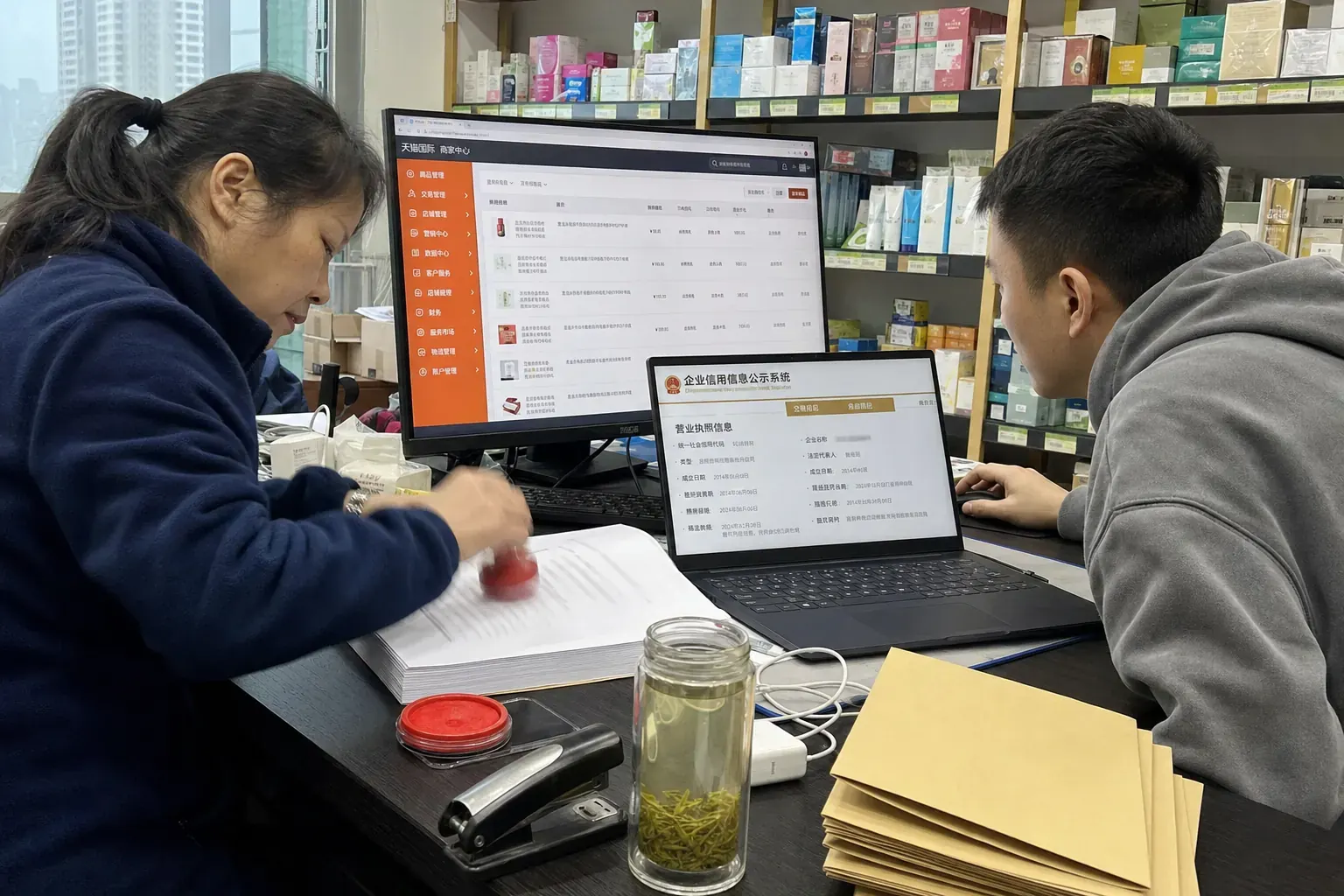
Sign a bilingual China distribution contract and name the Chinese text as the one that controls. Check that the company chop and the person signing match your partner’s business license. Then choose arbitration that can reach the partner’s assets, which usually means CIETAC or HKIAC in Hong Kong. A contract that a Chinese court can’t read or enforce won’t protect you.
Your distributor, your Tmall Partner or your Douyin Partner keeps its bank accounts and its stock in mainland China. So if the deal goes wrong, the fight ends in a Chinese courtroom. Or it ends in front of a tribunal whose award a Chinese court will be asked to enforce. Either way, someone reads your contract in Chinese.
Chinese courts hear foreign-related civil cases in the national common language and script; a party that wants an interpreter pays for one. Any foreign-language documentary exhibit must carry a Chinese translation. Source: National People’s Congress (全国人民代表大会), Civil Procedure Law, Arts. 273 and 73, as amended September 1, 2023, text carried by the State Taxation Administration Guangdong bureau (国家税务总局广东省税务局), December 2025. https://guangdong.chinatax.gov.cn/gdsw/zjfg/2025-12/31/content_bcd30b4a0fbf4de7b4d4c388599a5194.shtml
The stakes are real money. At the default settings of our Tmall Global calculator, a Tmall Partner on a 35,000 RMB monthly retainer and 10% commission on 3.5 million RMB of first-year sales bills you 770,000 RMB in year one, about 108,000 USD (TheChinaPath calculator data, October 2026). That’s what your dispute clause is guarding.
This is a commercial guide, not legal advice. Have a lawyer qualified in China draft the clauses and read the Chinese text before you sign. The rules and fees below were checked in October 2026.
China distribution contract choices, row by row
Every distribution, store-operation or agency contract with a Chinese partner makes the same nine choices, whether anyone talks about them or not. If you’re signing the partner’s template, it has already made them, in its own favor.
| Choice | What to choose | Why |
|---|---|---|
| Language | Chinese and English side by side | Courts and CIETAC work in Chinese by default; your team has to read it too |
| Controlling version | Name one, usually Chinese, and have your own lawyer check it | Two “equally authentic” texts leave a mismatch to be settled by purpose (Civil Code Art. 466) |
| Chop | The company seal on every signature page, with the name on the seal matching the license | A contract forms on signature, seal or fingerprint (Civil Code Art. 490) |
| Signatory | The legal representative named on the license, or a written authorization | Authority decides whether the company is bound (SPC interpretation Art. 22) |
| Governing law | PRC law in most partner deals | It’s the law the partner’s assets, license and seal answer to |
| CIETAC | Mainland arbitration in Chinese or both languages | 10,000 RMB registration fee for a foreign-related case; award enforced by Chinese courts |
| HKIAC | Hong Kong seat, English or bilingual | HKD 10,000 registration fee; mainland courts can freeze assets before the award |
| Chinese courts | Only if you accept Chinese-language litigation | A foreign party that hires a lawyer must hire a Chinese one (Civil Procedure Law Art. 274) |
| Your home courts | Rarely worth it | China recognizes a foreign judgment only under a treaty or on reciprocity (Civil Procedure Law Art. 299) |
Which language controls
Plenty of bilingual contracts end with a line saying both versions are equally authentic. It sounds fair, and in practice it hands the gap to a judge.
When a contract is made in two or more languages and the parties agree the versions have equal effect, the words in each are presumed to mean the same. Where they differ, they are interpreted by the contract’s related clauses, nature and purpose, and the principle of good faith. Source: National People’s Congress (全国人民代表大会), Civil Code, Art. 466, in force January 1, 2021, via the Ministry of Commerce (商务部) policy database, accessed October 2026. https://policy.mofcom.gov.cn/claw/clawContent.shtml?id=70524
So pick one. Chinese is the practical choice, because the court or tribunal will work from it anyway, and the partner’s staff and its bank will only ever read the Chinese.
If the parties haven’t agreed a language, Chinese is the language of the arbitration. CIETAC may decide on one or more other languages after weighing the circumstances, including the language of the contract. Source: China International Economic and Trade Arbitration Commission (中国国际经济贸易仲裁委员会), Arbitration Rules (2024), Art. 84, in force January 1, 2024. https://www.cietac.org/articles/25022
There’s a cost. If Chinese controls, the Chinese text is the contract. A partner’s own English summary isn’t. Pay your own lawyer to compare the two versions line by line, exclusivity and termination first, then whoever owns the store. Our piece on Tmall Partner contract terms lists the clauses that decide a clean exit from a store operator.
Chops, signatures and who can bind the company
Foreign teams tend to treat the red company chop as the whole signature. The law does count it. A contract signed as one document is formed once both sides have signed, sealed or fingerprinted it (Civil Code Art. 490, same source as above).
But China’s top court has made the person behind the seal the real test.
If a legal representative or employee signs within their authority, the company can’t escape the contract just because the seal isn’t its filed seal or is forged. A signature without a seal binds the company when authority is proven, unless the parties made the seal a condition of the contract. Source: Supreme People’s Court (最高人民法院), interpretation of the Civil Code contract general provisions (法释〔2023〕13号), Art. 22, published December 4, 2023. https://www.court.gov.cn/zixun/xiangqing/419382.html
So do two things. Check the partner’s business license record and confirm the legal representative’s name, then ask for that person’s signature next to the chop, or a written authorization for whoever signs instead. And if you want the seal to count, write it in: state that the contract takes effect only when both company seals are applied.
The code goes one step further. A legal representative who signs beyond their authority still binds the company, unless you knew or should have known (Civil Code Art. 504). That protects you only while you haven’t been told otherwise, so read any board resolution the partner sends.
All of that assumes the contract gets enforced somewhere.
Arbitration that reaches your partner’s assets
The forum is the choice that hurts most when it’s wrong. A judgment from a court in Paris or Chicago has to be recognized by a Chinese court first, and the Civil Procedure Law allows that only under a treaty or on reciprocity (Art. 299). An arbitral award has a clearer road.
A party seeking recognition and enforcement of an arbitral award made outside the People’s Republic of China may apply directly to the intermediate court where the debtor lives or holds property; the court handles it under the treaties China has joined or on reciprocity. Source: National People’s Congress (全国人民代表大会), Civil Procedure Law, Art. 304, as amended September 1, 2023, State Taxation Administration Guangdong bureau (国家税务总局广东省税务局), December 2025. https://guangdong.chinatax.gov.cn/gdsw/zjfg/2025-12/31/content_bcd30b4a0fbf4de7b4d4c388599a5194.shtml
CIETAC, the Beijing commission with branches in Shenzhen, Shanghai and other cities, hears foreign-related disputes as well as domestic ones (Rules Art. 3).
CIETAC charges a 10,000 RMB registration fee on each foreign-related case, on top of the handling fee, which scales with the amount in dispute. Source: China International Economic and Trade Arbitration Commission (中国国际经济贸易仲裁委员会), Arbitration Fee Schedule I, Arbitration Rules (2024), in force January 1, 2024. https://www.cietac.org/articles/25022
Hong Kong adds something no other common-law seat has: a 2019 arrangement between China’s Supreme People’s Court and the Hong Kong government that lets a Hong Kong arbitration reach into mainland courts before the award.
The arrangement covers arbitrations seated in Hong Kong and run by a listed institution. Before the award, a party may apply to the mainland intermediate court where the respondent lives or where its property or evidence sits, for property, evidence or conduct preservation. Source: Supreme People’s Court (最高人民法院), arrangement with the Hong Kong SAR on court-ordered interim measures in aid of arbitration, Arts. 1 to 3, signed April 2, 2019. https://www.court.gov.cn/shenpan/xiangqing/149552.html
By September 2025, Hong Kong arbitral institutions had handled 177 applications under the arrangement across 48 mainland courts, and approved asset freezes covered more than 27.8 billion RMB. Source: Department of Justice (律政司), Hong Kong SAR Government, speech by the Secretary for Justice, November 12, 2025. https://www.doj.gov.hk/sc/community_engagement/speeches/20251112_sj1.html
Timing is the point. A distributor that sees an award coming can move its cash long before the award lands. A freeze stops that.
HKIAC charges a non-refundable registration fee of HKD 10,000 when a claimant files a Notice of Arbitration under its 2024 Rules. Its administrative fee runs from HKD 15,000 on a claim up to HKD 400,000 to HKD 27,500 on a claim of HKD 800,000, before the tribunal’s own fees. Source: Hong Kong International Arbitration Centre, 2024 Schedule of Fees, applicable from January 1, 2026. https://hkiac.org/arbitration/fees/2024-schedule-of-fees/
Against a 770,000 RMB year with a store operator, either registration fee is small. Lawyers and tribunal fees aren’t. Both institutions scale their main fees with the amount in dispute, and HKIAC posts a fee calculator next to its schedule, so price a claim before you threaten one. Write it precisely: name the institution, the seat, the language and the number of arbitrators in one sentence. The dispute clause survives even if the rest of the contract is void or terminated (Civil Code Art. 507). After a falling-out, the other side has no reason to agree a better one.
Before you sign with a Chinese partner
You’ll face the same questions on language, chops and the forum whether you’re signing with a distributor, a store operator or a livestream agency. Our guides to finding a distributor in China, finding a Tmall Partner and finding a Douyin Partner cover the checks that come before the contract. Compass is our database of vetted distributors and partners.
Questions brands ask about Chinese contracts
Is an English-only contract valid in China?
Many are signed that way, and your lawyer can tell you whether yours holds. The bigger risk shows up at enforcement. A Chinese court needs a Chinese translation of every foreign-language exhibit, so a translator, possibly one the other side challenges, ends up deciding what your English meant. A bilingual text with a named controlling version takes that choice back.
What is the difference between a company chop and a contract chop?
Chinese companies often keep several seals, and the company seal and a dedicated contract seal are the two you’ll see on agreements. Don’t stake the deal on which one appears. The Supreme People’s Court looks at whether the signer had authority, so pair the seal with the legal representative’s signature or a written authorization.
Should I pick CIETAC or HKIAC?
Pick HKIAC if you want English hearings and the option to freeze assets in the mainland before the award, through the 2019 arrangement. CIETAC is often easier to agree on with a Chinese partner. It hears cases in mainland cities and works in Chinese unless the contract says otherwise. Either beats a foreign court for a partner whose assets sit in China.
Can I use my home country’s law?
You can propose it, and your lawyer will tell you whether it holds for your deal. In most partner deals it adds cost, because the tribunal will need expert evidence on a foreign law to judge a Chinese company’s conduct in China. PRC law is the usual choice.
Updated October 18, 2026
Working on China? Let's grab a coffee.
Tell us where you are now and where you want to get to.