Pick the importer that keeps your factory registration in order and runs the cold or dry chain your product needs, then check the part that costs most: a Chinese label that holds up in court. A defective one can cost ten times the price in damages. Test the importer’s label work before you hear its sales pitch.
China has plenty of food importers, and from across a fair stand they all look alike.
At a fair, each one says it covers the whole country and clears customs fast. Few bring a file of the Chinese labels they’ve signed off, and that file is the thing to ask for.
Since 2019, customs no longer files a food label before the first shipment. It inspects labels at the border like any other test item, and the law puts the importer in charge of getting them right. When a shopper wins a label claim against a store, the store can recover from whoever was at fault. That road leads back to the importer, and through your contract, to you.
The table below puts the checks on one page.
Food importer checks in China, at a glance
| Check | Why it matters | The rule | Red flag |
|---|---|---|---|
| Your factory registration | Customs won’t clear food from an unregistered plant | Decree 280: registration with customs, valid five years, number on the pack | It never asks for your registration number or your authority’s letter |
| Its own importer filing | Customs files food importers by name | Food Safety Law art. 96 | The filing is in a different company’s name from the one signing |
| Its check on you | The law makes the importer vet its suppliers | Food Safety Law art. 94 | It never asks for your specs or test reports |
| The Chinese label | Customs stopped filing labels in advance in 2019 | GACC Announcement 2019 No. 70; Food Safety Law art. 97 | “Customs will check it,” or a translation done by the sales team |
| Damages exposure | A buyer of food that fails a safety standard can claim ten times the price, at least 1,000 RMB | Food Safety Law art. 148 | No contract clause on who pays a label claim |
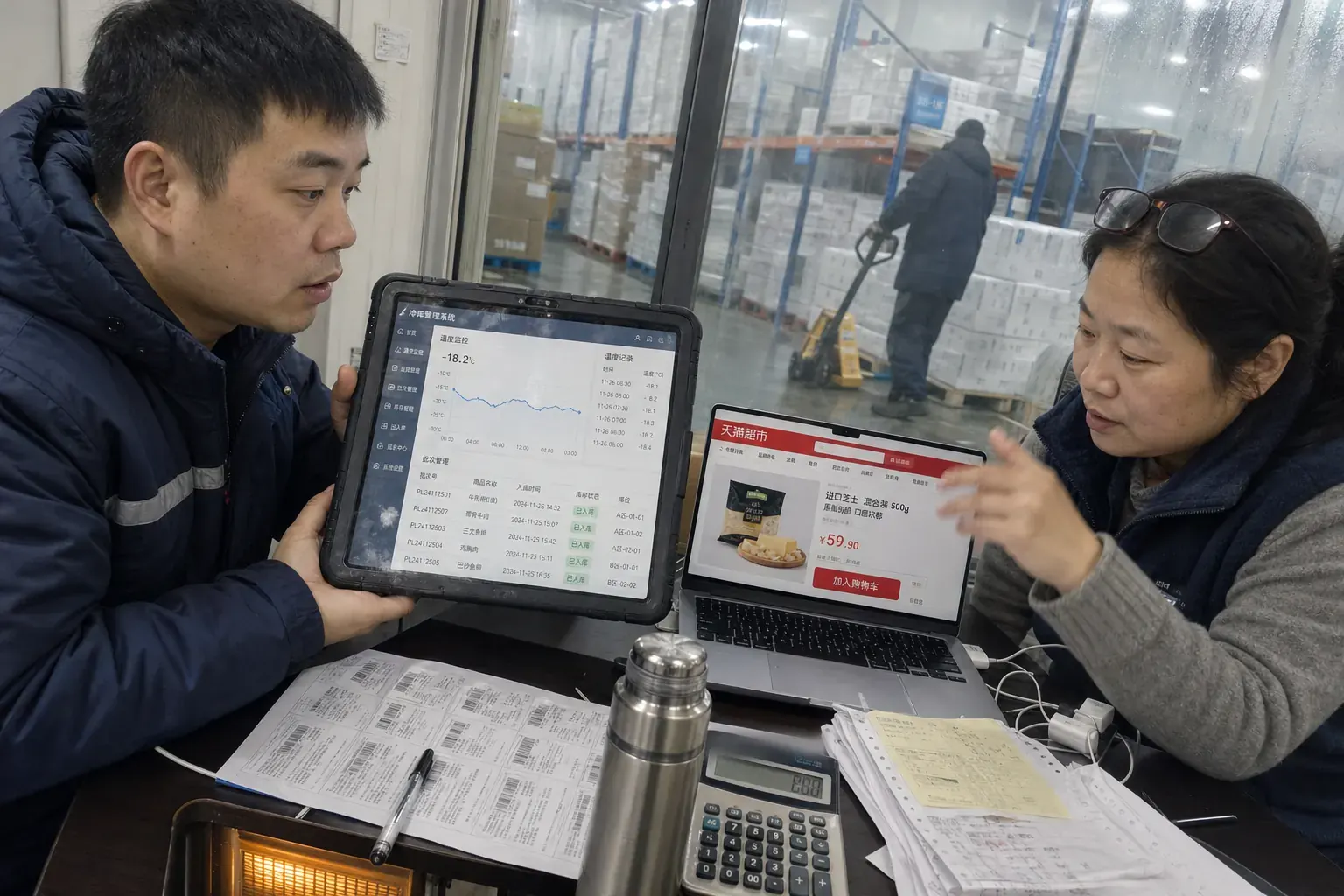
| Cold or dry chain | One warm truck can spoil a whole batch | GB 31605-2020: logged at least every 10 minutes, frozen at -18°C or colder, chilled at 0°C to 10°C | It can’t show a temperature log from a past shipment |
| Records | A recall needs batch-level sales data | Food Safety Law art. 98 | No record of who bought which batch |
Rules as cited below, all checked on October 16, 2026. The red flags are TheChinaPath’s reading from its own distributor work.
Your factory’s registration, the importer’s paperwork
Customs starts with your factory. Every overseas plant that makes food for China needs a customs registration, and the rule changed this year.
Registered overseas food plants mark either their China registration number or the number approved by their home authority on the food packaging. Registration lasts five years and renews automatically for five more, with exceptions. The decree took effect on June 1, 2026 and repealed Decree 248. Source: General Administration of Customs (海关总署), Decree No. 280, articles 14, 15, 21 and 33, October 2025, published by the China-Africa SPS Cooperation Information Network (中国-非洲国家SPS合作信息网). https://www.chinaafricasps.org/zh/spsj/zfspaqjgjl/fzshspaqzcpxkj/748006255804485.shtml
Some categories need your government’s backing first.
Seventeen categories need a recommendation from the exporting country’s authority to register, among them dairy, honey, edible oils, nuts and seeds, dried fruit and seasoning powders. Only meat and bird’s nest are excluded from automatic renewal. Source: General Administration of Customs (海关总署), Announcement 2026 No. 27, March 2026. https://www.gov.cn/zhengce/zhengceku/202603/content_7063537.htm
Your plant files the application itself. In those categories it attaches the authority’s inspection report and recommendation letter. Plants that still have to apply for renewal get a longer runway.
The window to apply for renewal widens from three to six months before expiry to three to twelve months. Source: General Administration of Customs (海关总署), interpretation of Decree 280, carried by the Hunan Provincial Government portal (湖南省人民政府门户网站), October 2025. http://www.hunan.gov.cn/zqt/zcjd/bmjd/202510/t20251031_33837720.html
A good importer asks for your registration number in the first meeting, checks it against the list customs publishes and puts your renewal date in its own calendar. A weak one learns about a lapsed registration when a container is already sitting at the port.
Then there’s the importer’s own side of the paperwork.
Overseas exporters and producers answer for the content of their labels. The importer must run a system for checking overseas exporters and producers, and may not import what fails it. Food importers file with the entry-exit inspection authority. Source: Ministry of Commerce policy database (商务部), Food Safety Law of the PRC, articles 94 and 96, as amended September 2025. https://policy.mofcom.gov.cn/claw/clawContent.shtml?id=104105
Read article 94 from the other side of the table. The law tells the importer to audit you. An importer that never asks for your specifications or test reports is skipping a job the law gives it, and the label check is part of that same job.
The Chinese label is where the money goes
Customs used to file first-time food labels. It stopped.
Since October 1, 2019, customs no longer files the labels of first-time imported prepackaged food. The importer must check that the Chinese label meets Chinese law and the national food safety standards, and may not import goods whose label fails. Source: General Administration of Customs (海关总署), Announcement 2019 No. 70, April 2019. https://www.gov.cn/zhengce/zhengceku/2019-11/05/content_5448950.htm
Imported prepackaged food needs a Chinese label stating the origin and the name, address and contact details of the domestic agent, or it may not be imported. Source: Ministry of Commerce policy database (商务部), Food Safety Law of the PRC, article 97, as amended September 2025. https://policy.mofcom.gov.cn/claw/clawContent.shtml?id=104105
That domestic agent is usually the importer, so its name goes on every pack you ship. It has every reason to get the label right. Whether it has the people to do it is what you’re checking.
The cost of getting it wrong sits in article 148.
A consumer can claim ten times the price paid, or three times the loss, from the producer of food that fails food safety standards, or from a seller that knew, with a floor of 1,000 RMB. Label defects that neither affect food safety nor mislead consumers are exempt. Source: Ministry of Commerce policy database (商务部), Food Safety Law of the PRC, article 148, as amended September 2025. https://policy.mofcom.gov.cn/claw/clawContent.shtml?id=104105
That exemption is narrower than it looks. The Supreme People’s Court drew the line in 2024.
Courts reject the harmless-defect defense when a label leaves out an item the standards require, mislabels one on purpose, or gets one wrong in a way that misleads consumers about safety. Typos and formatting slips that mislead no one, such as an irregular font size, do not trigger punitive damages. Source: Supreme People’s Court (最高人民法院), 法释〔2024〕9号, articles 6 and 8, August 2024. https://www.court.gov.cn/fabu/xiangqing/440841.html
Here’s what two missing lines cost a Beijing wine shop.
A Beijing shopper paid 3,552 RMB for four bottles of imported red wine. The Chinese label left out the production date and the distributor’s contact details, and the distributor it named said it had never sold the wine. The Dongcheng District court ordered the shop to refund the price and pay ten times the price in damages. Source: Beijing Daily (北京日报), March 2025. https://xinwen.bjd.com.cn/content/s67d2735de4b08edd28f62950.html
Regulators can fine on top of that.
Selling prepackaged food without a label, or with a label that breaks the law, draws a fine of 5,000 to 50,000 RMB when the goods are worth less than 10,000 RMB, and five to ten times their value above that. Source: Ministry of Commerce policy database (商务部), Food Safety Law of the PRC, article 125, as amended September 2025. https://policy.mofcom.gov.cn/claw/clawContent.shtml?id=104105
And the standard itself is about to change.
GB 7718-2025, the new general standard for prepackaged food labels, takes effect on March 16, 2027. It bans “zero added,” “not added” and “not used” claims. Source: Beijing Municipal Administration for Market Regulation (北京市市场监督管理局), May 2026. https://scjgj.beijing.gov.cn/zwxx/scjgdt/202605/t20260507_4639154.html
A European pack that sells on “no added sugar” needs a new Chinese label before that date. Ask every candidate how it will handle the switch.
What a real label review looks like:
- A name on it. One person at the importer checks each label against the standard before the first order ships, and signs.
- The sample, before printing. You see the Chinese label sample and the translation, the same pair customs asks for when it pulls a shipment.
- Three past labels. Ask for labels it signed off for other brands, and whether any of them drew a complaint. (A good importer has a story about one that did.)
Cold chain or dry chain: ask for the log
For chilled cheese or frozen prawns, the truck matters as much as the label. China’s cold-chain standard sets the numbers.
During transport, cold-chain food temperature should be monitored continuously and recorded at intervals of no more than 10 minutes. Frozen food travels at -18°C or colder, chilled food at 0°C to 10°C. At warehouse intake and delivery, the full-journey temperature record is checked. Source: National Health Commission and State Administration for Market Regulation (国家卫生健康委 市场监管总局), GB 31605-2020, in force March 2021, copy on the Mawei District Government site (福州市马尾区人民政府). https://www.mawei.gov.cn/xjwz/zwgk/zfxxgkzdgz/spypaq/spaqbz/202012/P020201228519962293099.pdf
Ask the importer for the log of one past shipment, from the port to the warehouse to the store. An importer that runs its own cold chain should have it on file. One that has to go back to its trucking firm for it is telling you who really controls the temperature.
Dry goods aren’t exempt. The Food Safety Law requires storage and transport equipment to meet the temperature and humidity the food needs (chocolate in a Guangzhou summer, say). Ask where your pallets will sit, and whether that warehouse is the importer’s or someone else’s.
Then ask for the records.
Importers must keep records of each import and sale: name, specification, quantity, production date, batch number, shelf life, the overseas exporter and the buyer. Source: Ministry of Commerce policy database (商务部), Food Safety Law of the PRC, article 98, as amended September 2025. https://policy.mofcom.gov.cn/claw/clawContent.shtml?id=104105
Write a monthly copy of that batch record into the contract, so a recall doesn’t start with guessing which cities got the bad lot.
Where to meet food importers, and how long it takes
The China Food and Drinks Fair puts thousands of them in one place. Its spring edition runs in Chengdu.
The 114th China Food and Drinks Fair, held in Chengdu from March 26 to 28, 2026, drew 6,615 exhibitors and more than 410,000 industry visits. The 115th fair runs October 15 to 17, 2026 in Nanjing. Source: Xinhua (新华网), March 2026. http://www.xinhuanet.com/food/20260331/272302f4d9c246caba268dca11a777f4/c.html
Our guide to China’s trade fairs covers which buyers walk which show. Bring your registration number and a draft Chinese label to the stand. The importers worth signing will start with those.
Don’t plan on signing at the fair. In our own distributor work, a first meeting to a signed contract runs three to five months (TheChinaPath distributor sourcing engagements, as published on this site). Meet in March, and expect to sign in the summer.
Ownership is a separate question. Our piece on state-owned or private importers covers who pays and which shelves each can reach.
Before you sign a food importer
The guide to finding a distributor in China has the full due diligence list. For food, the contract has to answer a few questions the general list doesn’t.
Who approves each Chinese label, in writing and by name, before it’s printed? Who pays a ten-times claim, and how fast does the importer have to tell you one has landed? Split that cost between whoever wrote the label content and whoever approved it.
Then the dull ones, which matter in a recall: a monthly batch and buyer report in a format you set, and a duty for the importer to track your registration’s renewal date.
Every importer and distributor in Compass has been met in person and vetted on site. A shortlist usually runs three to five names and takes two to three weeks from the brief (TheChinaPath, as published on this site). After signature, distributor management keeps the reporting going.
Common questions about food importers in China
Do I need an importer to sell food in China?
Only for general trade, the duty-paid route into supermarkets and restaurants. A cross-border store on Tmall Global sells to shoppers from abroad, so no Chinese importer takes title. Its food category asks for a 50,000 RMB deposit, a 30,000 RMB annual fee and a 2% commission (TheChinaPath calculator data, October 2026). Decree 280 leaves cross-border retail food to separate rules.
Who pays if a shopper sues over the label?
The shopper can claim from the producer or the seller. Under article 148, the business that receives the claim pays first, then recovers from whoever was at fault. In practice the claim travels up the chain to the importer and then to you. A contract clause settles where it stops.
Does Decree 280 change my existing registration?
Your registration still lasts five years. From June 1, 2026 it renews automatically for five more. The exceptions are meat and bird’s nest plants, plants in the middle of a correction order, and countries whose exports customs has suspended. If you do need to renew, apply three to twelve months before expiry.
How much does a food importer take?
No rule sets the margin. As our distributor guide puts it, the markup depends on the channel and on who pays for listing fees, marketing and the credit risk. Compare offers on the shelf price your product would reach, and on what the importer pays for out of its share.
Can a trade fair contact become my importer?
Yes, if it passes the checks. Ask for its importer filing, three labels it signed off and one temperature log before you meet a second time.
Get a shortlist of food importers and distributors from Compass
Updated October 17, 2026
Working on China? Let's grab a coffee.
Tell us where you are now and where you want to get to.