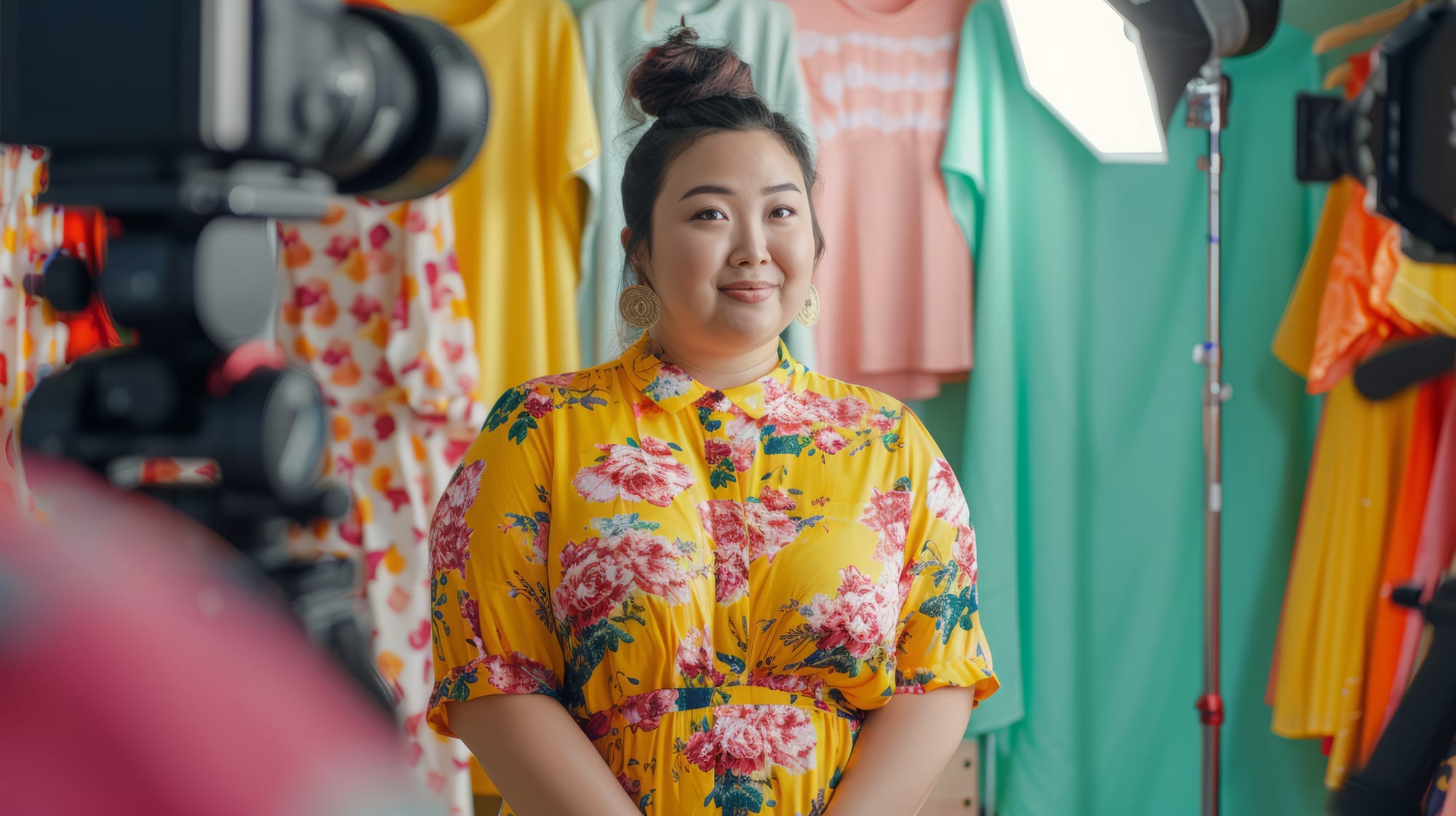
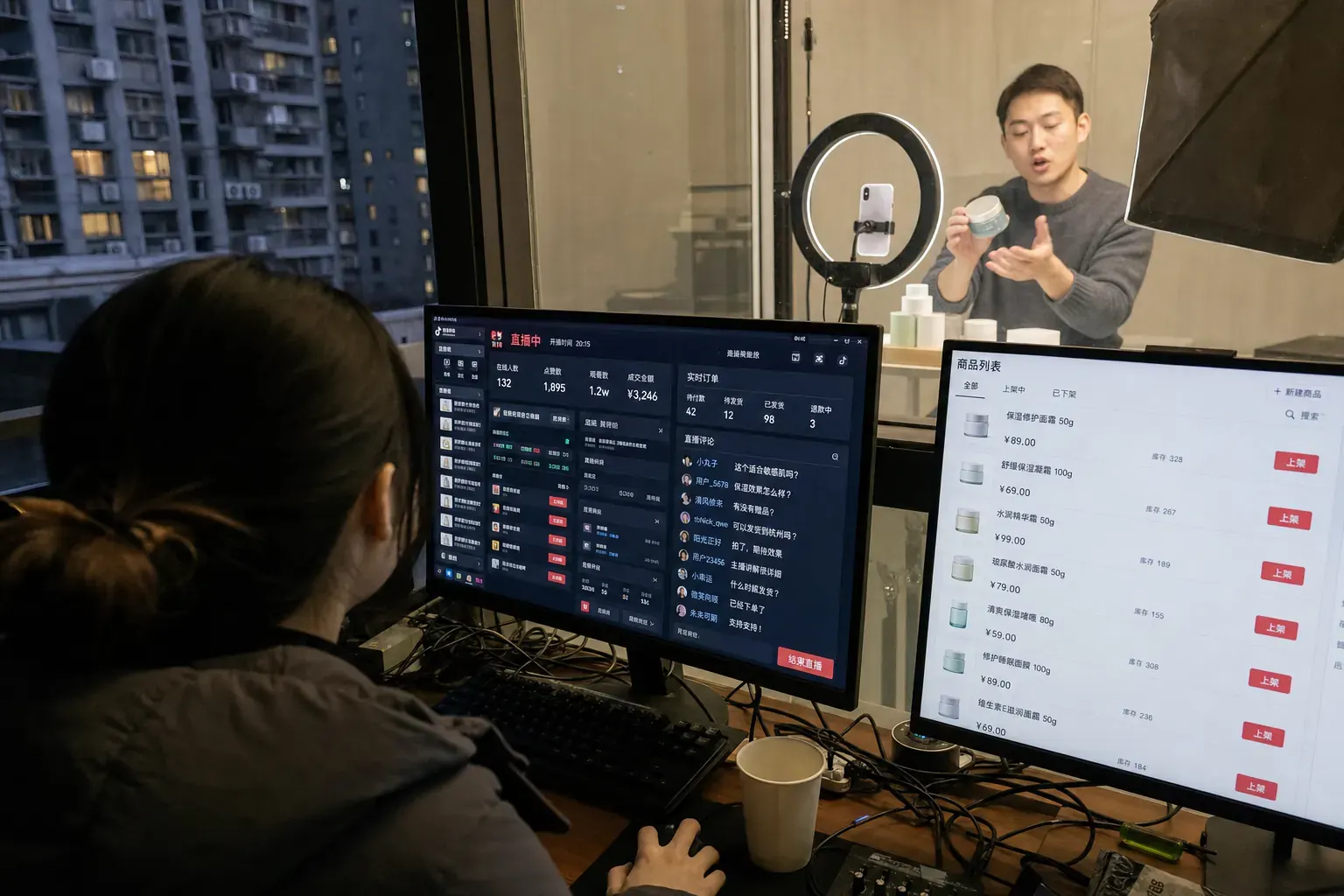
A branded livestream room creates a fixed monthly bill. In the worked budget below, a daily room costs RMB 80,000 before traffic and sales-linked expenses, about US$11,300 at RMB 7.10 per dollar. China livestream cost for brands depends on the sales target as well as the broadcast schedule. These are budget scenarios, not market averages or agency quotes.
The table compares three livestream budgets. Each cell shows the monthly allocation followed by its cost per broadcast hour in parentheses. The event column covers one event that month.
All amounts are selected planning inputs or calculations. Reviewed September 15, 2026. Historical rent and host-pay sources appear below; they do not establish current prices. The daily schedule means 26 broadcast days, allowing rest days. The three-day schedule is modeled as 13 sessions in a month. Every session lasts 4 hours except the 3-hour event.
| Budget line, RMB/month (RMB/broadcast hour) | Daily room, 104 hours | Three days/week, 52 hours | External-host event, 3 hours |
|---|---|---|---|
| Assumed sales, RMB/month | 167,000 | 83,000 | 300,000 |
| Studio and existing set | 30,000 (288) | 15,600 (300) | Included in host fee |
| Host and co-host | 26,000 (250) | 28,600 (550) | 100,000 (33,333) |
| Operator and moderator allocation | 24,000 (231) | 12,000 (231) | Included in host fee |
| Paid traffic | 26,720 (257) | 13,280 (255) | 18,000 (6,000) |
| Platform fee allowance | 6,680 (64) | 3,320 (64) | 12,000 (4,000) |
| Creator or MCN commission | 0 (0) | 0 (0) | 75,000 (25,000) |
| Samples and giveaways | 3,340 (32) | 1,660 (32) | 6,000 (2,000) |
| Total | 116,740 (1,123) | 74,460 (1,432) | 211,000 (70,333) |
Hours are on-air hours. Allow for additional paid preparation time. Hourly figures are rounded independently, so their sum can differ from the rounded total. At the calculator’s planning rate of RMB 7.10 per dollar, monthly totals are about US$16,400 for the daily room and US$10,500 for the part-time room. The event is about US$29,700. No live exchange rate is implied.
Why a project quote hides the hourly cost
A quote can cover a room, or the whole store operation. Before comparing prices, ask the supplier to separate broadcast production from the work that continues after the camera stops. Customer service may sit in either contract. Check the warehouse contract for stock handling.
Get the media budget separately. A production fee tells you what it takes to keep the room on air. It says little about how many buyers will enter. A foreign brand needs both figures before it can approve a monthly commitment.
Our social commerce page describes the operating scope. Use that scope to check a proposal for overlapping work, especially if a store partner already supplies the livestream team.
A store-led room and a hosted event buy different things
On Douyin, China’s short-video and shopping platform, a store-led room broadcasts from the brand’s account. It gives the brand control over the selling schedule and product presentation. The team can revise a demonstration after reading buyer comments.
An external-host event buys access to another account’s audience. The contract may combine a fixed placement fee with a sales commission. A multi-channel network, or MCN, can arrange the host and manage that contract. Ask for an itemized invoice and check for duplicate commission.
Large dedicated events can sit far outside a small brand’s test budget.
In a 2024 interview, a Yalu representative put dedicated top-host events at RMB 1 million to RMB 3 million, plus roughly 10% to 20% commission. These were that company’s reported experience, not a market tariff. Source: Xinhua (新华网), August 4, 2024. https://www.news.cn/fortune/20240804/ec11b5b85b514e8b9332998d0b23b020/c.html
The table’s RMB 100,000 event fee is a chosen test input. It does not price the celebrity events in that interview. Replace it with the actual contract, including what happens if the broadcast is canceled or orders are refunded.
China livestream cost for brands, line by line
The daily room assumes an existing set in a leased space. The part-time room assumes rental at RMB 300 an hour. Neither includes a new studio build.
A venue supplier estimated rent for a 100-to-300-square-meter room at RMB 20,000 to RMB 50,000 a month in noncore first-tier-city locations, or RMB 150 to RMB 500 an hour. The page labels its prices estimates. Source: Liubai Space (留白空间), September 25, 2024. https://www.liubaikongjian.com/news/198.html
Those historical estimates help frame a quote request; they are not a September 2026 rate card. Get a dated local quote before choosing a lease. List the equipment included and ask whether rehearsal time uses the same rental clock. A low on-air rate can leave several hours of preparation outside the advertised package.
Host and co-host. The daily scenario selects RMB 18,000 a month for the host and RMB 8,000 for the co-host. The part-time scenario selects hourly rates of RMB 400 and RMB 150 respectively.
Reporting from Hangzhou in April 2025, Cailian Press cited a recruiter who put monthly pay for womenswear hosts with 1 to 2 years’ experience at RMB 15,000 to RMB 20,000. A separate experienced host reported offers of about RMB 400 an hour. Source: Cailian Press (财联社), April 3, 2025. https://www.cls.cn/detail/1992813
This is dated interview evidence from a specific market. The co-host allowance is our scenario input. Employer charges and any sales bonus need their own quote; the table does not treat base pay as total employment cost.
The operator and moderator allocation is also a planning choice. Confirm the shift coverage before assuming that a smaller broadcast calendar cuts the bill in half. Confirm whether the host fee covers the event crew.
The platform allowance uses 4% from the packaged-food category in TheChinaPath calculator data, September 2026. It is a model input, not a verified current tariff for your product. Check the applicable cross-border category and settlement basis before committing funds.
The event assumes 25% creator commission. Store-led columns assume no external creator commission. Neither assumption rules out employee bonuses or a partner’s sales fee. This model applies sales-linked rates to the same sales base; actual settlement bases may differ. Samples and giveaways use a selected 2% of sales, valued at cost. Set a product-level allowance if that fits your operation better.
How paid traffic changes the monthly bill
Paid media equals the sales attributed to ads divided by return on ad spend, or ROAS. In our store-led scenario, ads account for 40% of sales at 2.5 ROAS. That makes media spending 16% of total sales. The event assumes a 15% paid share at the same ROAS, giving a 6% media bill.
These inputs need testing against your own sales history. Organic sales and creator-driven sales must also occur for the total sales target to hold. An attractive ROAS on a small paid segment can’t prove that the whole room will sell enough.
For the daily room, total cost equals RMB 80,000 plus 22% of sales. Traffic alone matches that amount at RMB 500,000 in monthly sales under the 16% assumption. That is a cost crossover, not a break-even sales target.
If ROAS falls to 1.5 while the paid share stays at 40%, the same RMB 500,000 sales target needs about RMB 133,333 of media. At 2.5 ROAS it needs RMB 80,000. Keep this spending sensitivity beside the production quote.
What each room must sell
The hourly bill helps compare suppliers. Orders decide whether you can afford it.
Use an assumed RMB 250 basket to turn the opening budgets into orders. At the stated sales targets, the daily room generates 668 orders and the part-time room generates 332. The event generates 1,200. Those volumes are arithmetic consequences of the inputs, not forecasts.
| Livestream budget, RMB | Daily room | Three days/week | External-host event |
|---|---|---|---|
| Monthly cost | 116,740 | 74,460 | 211,000 |
| Cost per placed order | 174.76 | 224.28 | 175.83 |
| Cost as share of assumed sales | 69.9% | 89.7% | 70.3% |
Product cost and fulfillment still have to be paid. Import tax sits outside this room budget, as does any separate store-management contract. Add launch capital and employer charges. Inventory funding also sits outside this budget.
Returns change the denominator. If 20% of the daily room’s orders fail to become kept orders and its budget stays fixed, cost per kept order rises to about RMB 218.45. This is a stress test: actual refunds can also change commission and platform charges. Reconcile those against settlement data.
At RMB 500,000 in sales, the daily room’s formula produces RMB 190,000 in cost, or RMB 95 per order. At RMB 1 million it produces RMB 300,000, or RMB 75 per order. Total cost per broadcast hour rises because the traffic bill rises while the schedule stays fixed.
Both formats can spread a fixed fee over more orders. An event’s placement fee also becomes cheaper per order when sales rise; its commission remains variable. Compare the formats at the sales each can credibly reach. Review settled orders after refunds before expanding the schedule.
The comparison our calculator can support
A measured comparison would need cost per order from matched managed rooms and celebrity events. We have no publishable sample for that claim. The calculation below uses our own model to isolate media and creator fees.
TheChinaPath calculator data, September 2026: select RMB 2 million in annual sales and a RMB 250 basket, producing 8,000 placed orders. Hold ROAS at 2.5. Choose the channel mixes below; these are editorial scenarios. This annual comparison is separate from the monthly room budgets. Do not add the tables together.
| Marketing model, RMB/year unless stated | Store-led mix | Creator-heavy mix |
|---|---|---|
| Paid / creator / organic sales shares | 40% / 10% / 50% | 15% / 80% / 5% |
| Creator commission assumption | 20% | 30% |
| Paid media | 320,000 | 120,000 |
| Creator commission | 40,000 | 480,000 |
| Combined marketing cost | 360,000 | 600,000 |
| Marketing cost per placed order, RMB | 45 | 75 |
The RMB 30 difference per order comes from both the sales mix and the commission-rate assumptions. It excludes placement fees and room production, as well as store overhead. It does not measure a celebrity event or prove that a store-led room will win. In particular, the store-led scenario requires half its sales to arrive without paid-media or creator attribution. To reproduce the calculation, divide media spending plus creator commission by 8,000 orders.
Bring the columns to the operator. What supports the organic sales assumption? How is an order counted when a creator and an ad both helped sell it? The calculator treats the shares as separate buckets that sum to 100%. A sales report that double-counts them will claim more sales than the store made.
When to delay a permanent room
Delay the lease until the margin left from sales can cover the room. There is no universal monthly sales threshold. Work back from the margin left after fulfillment and selling fees, then test how many orders would cover the fixed bill. Confirm that stock will be available when the host sells it.
A brand also needs someone who can approve an offer while the China team is working. Name that person before the first session. A host needs an answer while the buyer is still watching.
If you are still choosing a channel, the social selling hub explains the platform options. Resolve store eligibility before hiring a permanent team. A room won’t fix a product that cannot be listed through the intended route.
Frequently asked questions
Is a part-time room cheaper?
It can require less monthly cash. Our selected part-time budget is RMB 74,460, against RMB 116,740 for the daily schedule. Its hourly cost is higher because the host and space are rented by the hour. Compare total commitment and expected kept orders before deciding which schedule to buy.
Does a host’s fee include the whole event?
Read the scope before treating it that way. The worked event assumes the fixed host fee includes the room and crew. It adds commission and paid traffic separately. Your contract needs to state who funds discounts and how refunded orders affect each fee. Have those terms written into the quote.
Can the calculator price the room itself?
The Douyin calculator models the broader channel, including a partner’s operating fee. It does not provide a separate studio staffing quote. Use the room budget to inspect that contract, and add only costs outside its scope. Keep the marketing comparison separate from the production budget until you have removed overlapping charges.
Updated September 16, 2026
Working on China? Let's grab a coffee.
Tell us where you are now and where you want to get to.