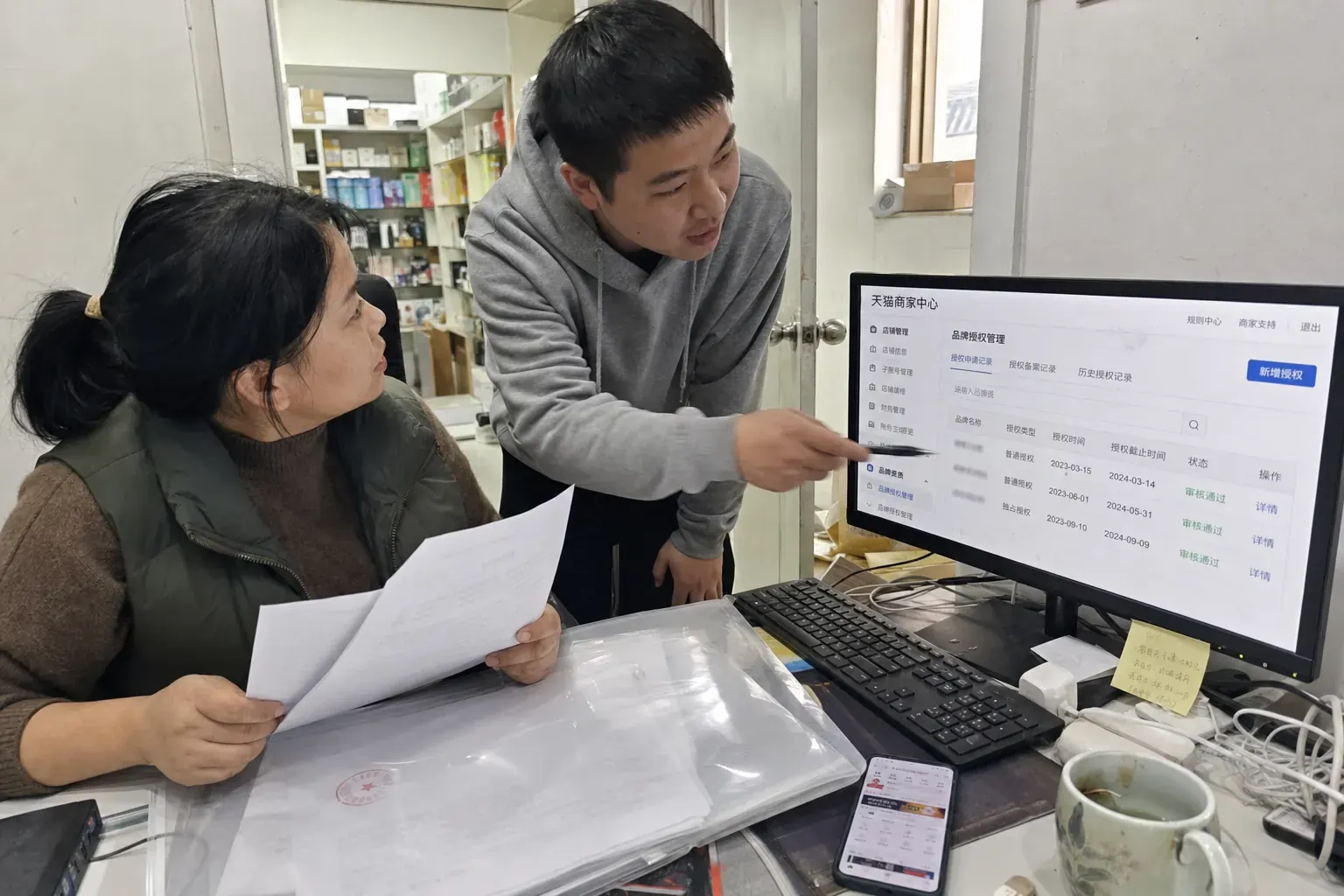
A Tmall brand authorization letter decides which store can sell your brand. A flagship needs your exclusive letter, and a specialty store needs a letter you sign yourself. A multi-brand store can sit at the end of a chain of other people’s letters. Every letter you sign is a store you’ll have to police, so sign few of them and give each one an end date.
Here’s what each store type asks for on Tmall, Alibaba’s marketplace for companies registered in mainland China, and on Tmall Global, its cross-border marketplace for companies registered outside it.
| Store type | Platform | Authorization it needs | Levels allowed | Control the brand keeps |
|---|---|---|---|---|
| Flagship (旗舰店) | Tmall | Your own brand, or your exclusive authorization | One, direct from you | High: one holder, chosen by you |
| Flagship | Tmall Global | Exclusive store letter signed by your CEO or a director | One, direct from you | High: dated end, December 31 at the earliest |
| Specialty store (专卖店) | Tmall | Ordinary authorization from you, no regional limit | One, direct from you | Medium: you can sign more than one |
| Specialty store | Tmall Global | Store letter from the trademark owner | One, direct from you | Medium: you can sign more than one |
| Multi-brand store (专营店) | Tmall | A complete chain starting with you | Set per category: one to three in food and drink | Low: you sign only the first link |
| Multi-brand store | Tmall Global | A complete chain, or purchase invoices | Up to four in most categories | Lowest: no letter needed with invoices |
Sources: the Tmall and Tmall Global rules cited below, read in October 2026.
Why your brand on Tmall always runs on a letter
Start with one rule. Tmall itself won’t take your overseas company.
Tmall does not accept applications from individual businesses, or from companies registered outside mainland China. Source: Tmall (天猫), Tmall entry standard (天猫入驻标准), in force January 1, 2019, revised June 6, 2025. https://rulechannel.tmall.com/?type=detail&ruleId=9257&cId=378#/rule/detail?ruleId=9257&cId=378
So on Tmall your brand is sold by a Chinese company: your own subsidiary, a distributor or a Tmall Partner (TP) that runs the store. Unless that company owns the trademark, it opens on your authorization. The same standard ties each store type to a kind of letter.
A flagship store opens with the merchant’s own brand, or a brand the trademark owner has authorized exclusively. A specialty store opens on an ordinary authorization from the trademark owner; that letter may carry no regional limit (some categories excepted) and must run for at least six months. A multi-brand store sells two or more brands within one Tmall business category. Source: Tmall (天猫), Tmall entry standard (天猫入驻标准), in force January 1, 2019, revised June 6, 2025. https://rulechannel.tmall.com/?type=detail&ruleId=9257&cId=378#/rule/detail?ruleId=9257&cId=378
Tmall Global works the same way when someone else holds the store. There the store sits in a company registered outside the mainland, yours or a partner’s.
On Tmall Global, a flagship store opened by a company that does not own the trademark needs an exclusive authorization from the trademark owner. A specialty store needs the owner’s authorization letter. A multi-brand store needs a complete chain of authorization from the trademark owner within four levels, or purchase vouchers. A chain A to B to C, with A the owner and C the store, counts as two levels. Source: Tmall Global (天猫国际), Merchant Qualification Standards (天猫国际商家 资质标准), published September 22, 2026, in force September 28, 2026. https://rule.tmall.hk/?type=detail&ruleId=11000442&cId=624#/rule/detail?ruleId=11000442&cId=624
Mind the words “or purchase vouchers.” A multi-brand reseller on Tmall Global with genuine purchase invoices doesn’t need your letter at all.
How long the chain can get
Flagship and specialty stores are simple. You sign, or there’s no store.
The multi-brand store is where control leaks, because you only sign the first link. Your distributor signs the second for a sub-distributor, who may sign a third for the company that actually opens the store. You may never see letters two and three.
Tmall caps that depth category by category, and it rewrote the food and drink caps last year. Tea and coffee brands with an overseas trademark owner lost a level: their multi-brand stores used to accept three, and now take two like everyone else.
From July 1, 2025, Tmall’s multi-brand stores take up to two levels of authorization in most food and drink categories, including tea and coffee, where brands whose trademark applicant is outside the mainland had three. Beer, wine and imported spirits take up to three. Penfolds needs two or fewer; Rémy Martin, Hennessy and Martell need a first-level letter from the trademark owner. Liquid milk and milk powder take up to three. Source: Tmall (天猫), notice on adjusted entry rules for food, household goods, telecom and auto parts (关于食品、居家日用、话费通信、汽车及配件大类 招商规则调整的公示通知), published June 24, 2025, in force July 1, 2025. https://rulechannel.tmall.com/?type=detail&ruleId=20007896&cId=396#/rule/detail?ruleId=20007896&cId=396
Look at who gets the short chain. For a handful of spirits houses, named one by one, every multi-brand store selling their bottles has to carry a letter straight from them.
Tmall Global allows four levels in most aisles. In the sensitive ones it tightens.
Tmall Global’s multi-brand stores need a chain within three levels, or purchase vouchers, for baby formula, baby food, baby nutrition and snacks. Special-formula milk needs a two-level chain in which the brand’s letter expressly allows sub-authorization, or a first-level purchase voucher. Health products and medicine need two levels. Source: Tmall Global (天猫国际), Merchant Qualification Standards (天猫国际商家 资质标准), published September 22, 2026, in force September 28, 2026. https://rule.tmall.hk/?type=detail&ruleId=11000442&cId=624#/rule/detail?ruleId=11000442&cId=624
That special-formula clause is worth copying into every letter you sign, whatever the category. Say in writing whether the holder may pass the right on. If the letter says no, the chain stops at one.
The end date is the lever
A letter without an end date is hard to take back. Both platforms force some kind of term, and Tmall Global wants it spelled out.
The exclusive store authorization must give its term as a specific date. The end may not fall before the end of the current calendar year, or the end of the next one for merchants entering during the renewal season. Page one is signed by the trademark owner’s CEO or a director. Source: Tmall Global (天猫国际), Qualification Rules for Operating Merchants (天猫国际在营商家资质细则), published February 21, 2025, in force March 1, 2025. https://rule.tmall.hk/?type=detail&ruleId=9223&cId=624#/rule/detail?ruleId=9223&cId=624
So the shortest exclusive letter you can sign on Tmall Global runs to December 31. On Tmall, a specialty letter runs six months at least. Pick a date that matches the distribution or TP contract, and put the renewal inside the contract, where the targets live.
Nike showed this summer what the lever does at scale.
Topsports said Nike had formally notified it that its online platform sales of Nike products in mainland China would end from January 1, 2027. Those sales brought in about 22% of group revenue in the year to February 28, 2026. Topsports said it would keep working closely with Nike on offline sales. Source: Beijing Business Today (北京商报), via CCTV.com, July 2026. https://finance.cctv.com/2026/07/23/ARTIYIQhdDU0ATsI4UwVa0Oq260723.shtml
Topsports wasn’t the only one told.
Pou Sheng International, Nike’s other large mainland dealer, also announced it had received notice ending its online cooperation. Under Nike’s plan, from January 2027 its digital business in China centers on its official flagship stores on Tmall, JD.com and Douyin, plus Nike’s own website and app. Source: Beijing Business Today (北京商报), via CCTV.com, July 2026. https://finance.cctv.com/2026/07/23/ARTIYIQhdDU0ATsI4UwVa0Oq260723.shtml
Nike gave its dealers a little over five months. A smaller brand holds the same lever, and it’s far easier to pull when every letter already carries a date. If you’re still deciding who should hold the store in the first place, our piece on who owns your Tmall store, Douyin shop and customer data walks through the split.
What a reseller has riding on your letter
A reseller that opens on your letter puts its own money down first, and that explains why lapses turn into fights.
From TheChinaPath calculator data, October 2026: the Tmall Global security deposit for a flagship with a registered trademark is 50,000 RMB (about US$7,000) in all 20 categories our Tmall Global cost calculator covers. The annual fee is 30,000 RMB in 12 of those categories and 60,000 RMB in the other eight.
That’s cash a store holder wants back, plus a year of ad spend and reviews it won’t want to walk away from. So write the end date in on day one, while both sides still want the deal.
What to put in a Tmall brand authorization letter
Platforms publish templates, and the template is the floor. The clauses that give you control are the ones you add.
- The holder, exactly. The company’s full Chinese name and its unified social credit code, the same as on the business license.
- The store. The platform and store type, plus the store’s name. One letter, one store.
- The brand. Trademark registration number, classes and the categories the store may sell in.
- The term. A start date and an end date that matches the contract.
- Sub-authorization. Allowed or not, in plain words. Default to no.
- The signatory. Your CEO or a director, which Tmall Global already requires for the exclusive store letter.
Keep a register of every letter you’ve signed, by store. When an unauthorized store appears, the register tells you in minutes whether it traces back to you.
When the store sits in your own overseas company on Tmall Global, there’s no letter to police at all: as trademark owner, you open the flagship yourself and the partner works inside it. That’s the cross-border ecommerce route. For every store someone else holds, the guide to finding a Tmall Partner covers the contract the letter should sit under, and the partners we’ve checked are filed in Compass.
FAQ
Can two companies hold a flagship for my brand on Tmall? Not for the same store. The flagship runs on your exclusive authorization, so one company holds it. Tmall does run category flagships (分品类旗舰店), which sell one brand’s products in a limited set of open categories, and that is the main way a second flagship appears. Decide that split before you sign anything exclusive.
Does a multi-brand reseller need my letter? On Tmall it needs a complete chain of letters starting with you, within the depth its category allows. On Tmall Global it can use purchase invoices instead, so genuine stock bought from your distributor may be enough. For those stores your control sits in the supply contract, not the letter.
What should a letter’s term be? At least what the platform asks: six months for a Tmall specialty store, December 31 of the current year for a Tmall Global exclusive store letter. Beyond that, match it to the partner contract. When the contract renews, sign a new letter. Never sign one that runs past the agreement it belongs to.
Get a Compass shortlist of Tmall Partners that open stores on dated letters
Updated October 31, 2026
Working on China? Let's grab a coffee.
Tell us where you are now and where you want to get to.