A cosmetics distributor in China can put your range in shops and domestic online stores only after each product is filed or registered with the National Medical Products Administration (NMPA), through a Chinese company you name as domestic responsible person. Cross-border selling needs neither. So the route picks the partner: a Tmall Partner (TP), a Douyin Partner (DP) or a distributor.
That one rule sorts most of the choice. Search-led lines, the serum a shopper already knows by name, fit a TP on Tmall Global. Products that sell on demonstration, a foundation shade or a texture, fit a DP on Douyin. Department stores and Watsons-type chains need a distributor that imports under general trade. If you are weighing who should act as your responsible person, our piece on changing your cosmetics responsible person in China shows how that role moves between companies.
What the store itself costs is in our facial skincare cost breakdown. This piece is about who you hire, and why the route you sell on settles it.
The filing comes before the partner
Chinese law splits cosmetics in two. The split decides how long you wait.
Cosmetics for hair dyeing, perming, spot removal and whitening, sun protection and hair-loss prevention, and cosmetics claiming a new efficacy, are special cosmetics. Everything else is a general cosmetic. Special cosmetics may be made or imported only after NMPA registration. Imported general cosmetics must be filed with the NMPA before import. Source: State Council Gazette (国务院公报), Cosmetics Supervision and Administration Regulation (化妆品监督管理条例), State Council Decree No. 727, arts. 16 and 17, June 2020. https://www.gov.cn/gongbao/content/2020/content_5525087.htm
A brand based abroad can’t file on its own. It needs a company on the ground.
An overseas registrant or filer must designate an enterprise legal person inside China to handle registration and filing, to help monitor adverse reactions and to carry out product recalls. Source: State Council Gazette, Decree No. 727, art. 23, June 2020. https://www.gov.cn/gongbao/content/2020/content_5525087.htm
Cross-border retail import sits outside all of that. Goods sold to a shopper through Tmall Global, JD Worldwide or Douyin’s cross-border store come in as personal purchases.
Cross-border e-commerce retail imports are supervised as goods for personal use, without the first-import permit, registration or filing requirements. Source: Ministry of Commerce and five other departments (商务部等六部门), 商财发〔2018〕486号, art. 3, November 2018. https://www.gov.cn/zhengce/zhengceku/2018-12/31/content_5437823.htm
Two routes, then. One needs paperwork in China before a single jar ships. The other needs a store.
Which partner fits each route for a cosmetics distributor in China
| Route | What must exist before the first sale | Partner type | Why that partner | Platform cash before the first sale (RMB, skincare and makeup) |
|---|---|---|---|---|
| Tmall Global, cross-border | A store; no NMPA filing | Tmall Partner (TP) | Search and shelf buying, where a known product name does the selling | 80,000 (50,000 deposit plus 30,000 annual fee), then 4% commission |
| JD Worldwide, cross-border | A store; no NMPA filing | Cross-border store operator | Same shelf logic as Tmall Global, on a smaller platform | 35,500 deposit, no annual fee, then 5% commission |
| Douyin cross-border | A store; no NMPA filing | Douyin Partner (DP) | Livestreams and short video, where the product has to be shown on skin | Up to 5,000 deposit, then 5% commission |
| General trade, domestic online stores | NMPA filing or registration, a domestic responsible person, a Chinese label | Importer-distributor, with a TP or DP running the store | Someone has to own the imported stock and the paperwork | Domestic store terms, outside our cross-border calculators |
| General trade, chains and department stores | NMPA filing or registration, a domestic responsible person, a Chinese label | Importer-distributor | Chain buyers check the filing and deal with a local supplier | No platform deposit; each chain sets its own listing terms |
Cash figures are the skincare and makeup rows of our three cross-border calculators (TheChinaPath calculator data, November 2026). Douyin’s deposit moves with last month’s sales; 5,000 RMB is the top tier. Rules on the general trade rows are from Decree No. 727 and SAMR Order No. 35, both cited here. Checked November 4, 2026.
Those numbers sit close for skincare and makeup. Tmall Global charges 4% in both, and Douyin 5%. So the platform bill rarely settles the choice on its own. The way your shopper buys usually does.
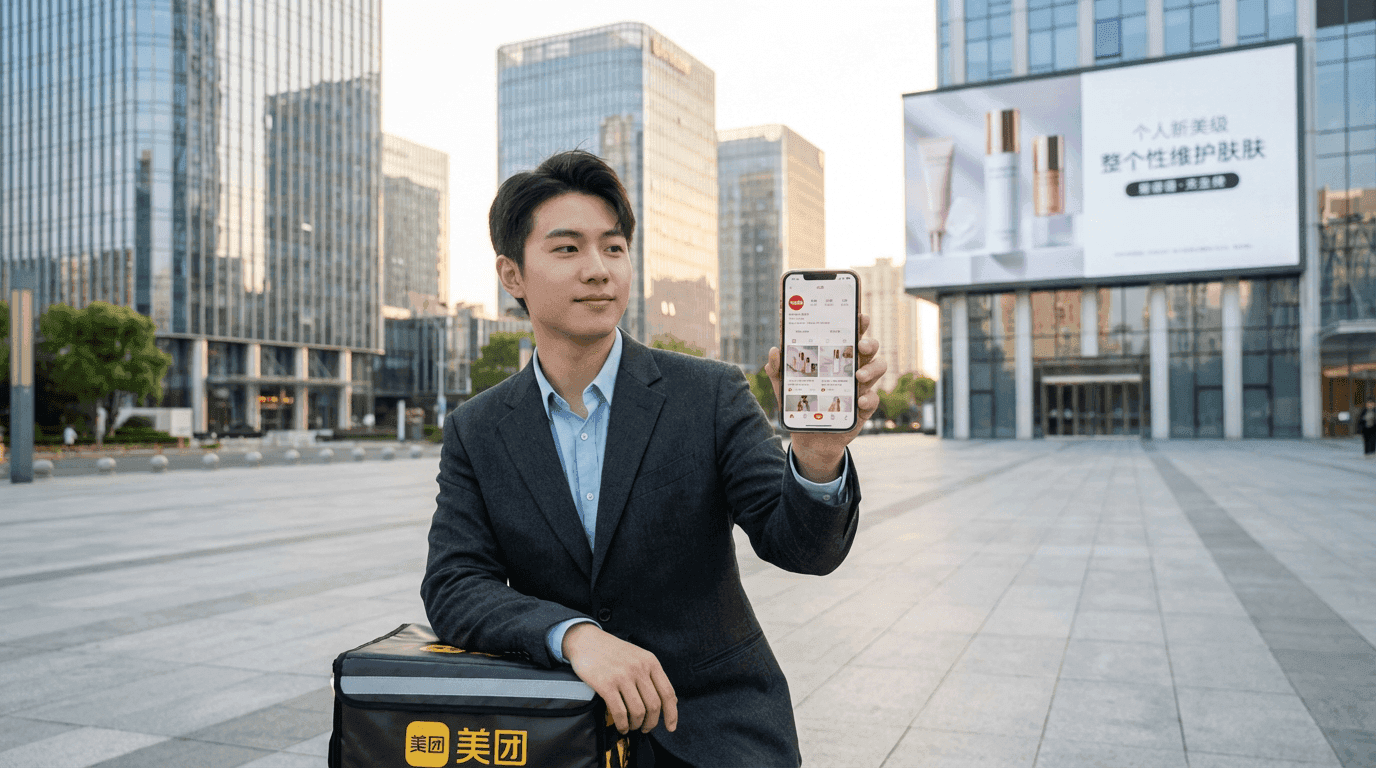
Cross-border: a Tmall Partner or a Douyin Partner
Douyin now sells more beauty than Tmall, Taobao and JD put together.
From January to September 2026, beauty sold 382.2 billion RMB across Douyin, Tmall, Taobao and JD, up 3.8%. Douyin took 218.0 billion RMB, up 11.63%, and Tmall 97.7 billion RMB, up 3.74%. JD fell 14.71% to 35.0 billion RMB and Taobao 16.53% to 31.4 billion RMB. The figures come from third-party data. Source: Cosmetics Observer (化妆品观察), carried by Sina Finance (新浪财经), October 2026. https://finance.sina.com.cn/roll/2026-10-10/doc-iniutyyz6019269.shtml
That’s the whole market, though, Chinese brands included. What matters for a foreign brand is how its own product gets bought.
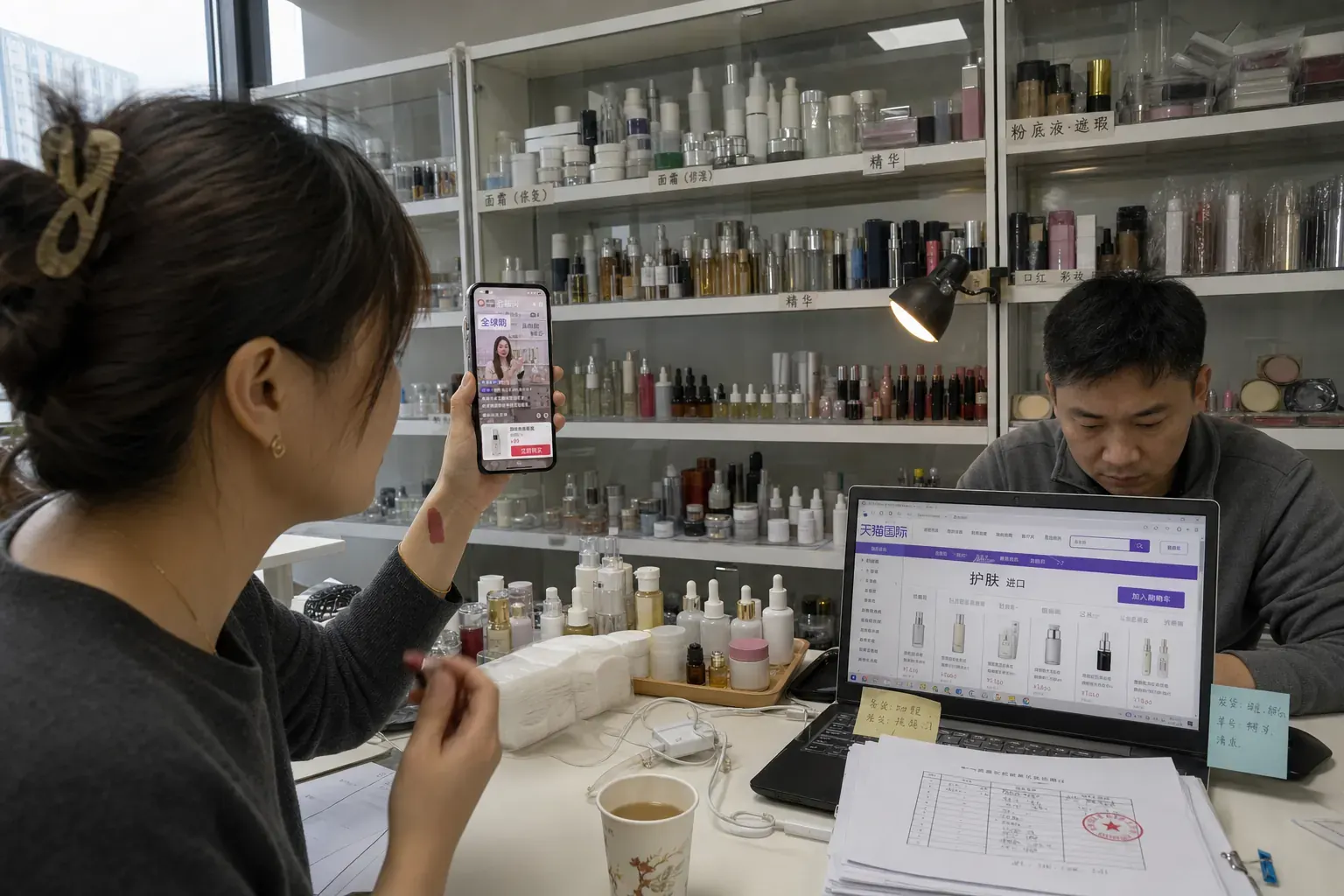
A product a shopper already knows goes to a search box. A French cleanser with a following, a sunscreen re-bought every spring, a refill. That buyer types the name and compares the price, which is the job a TP does well: the store, the listings, the search ads and the promotion calendar on Tmall Global. Our guide to finding a Tmall Partner in China covers what to check before you sign one.
A product nobody has seen needs to be shown. Color cosmetics are the clear case, because a shade has to be swatched on real skin before anyone pays for it. A DP runs the store’s own livestreams and books the creators whose videos move that kind of product on Douyin. The guide to finding a Douyin Partner in China sets out what one should show you first.
Many beauty brands end up with both, which works. Give each its own store and a clear product list, and don’t let the two fight over the same search terms with your money.
Two limits apply on every cross-border route, and they change who you can hire.
The single-transaction limit is 5,000 RMB and the annual limit 26,000 RMB. Goods bought this way are final goods for the consumer’s own use and may not enter the domestic market for resale. Source: Ministry of Finance, General Administration of Customs and State Taxation Administration, 财关税〔2018〕49号, November 2018, via the Ministry of Commerce. https://policy.mofcom.gov.cn/claw/clawContent.shtml?id=65769
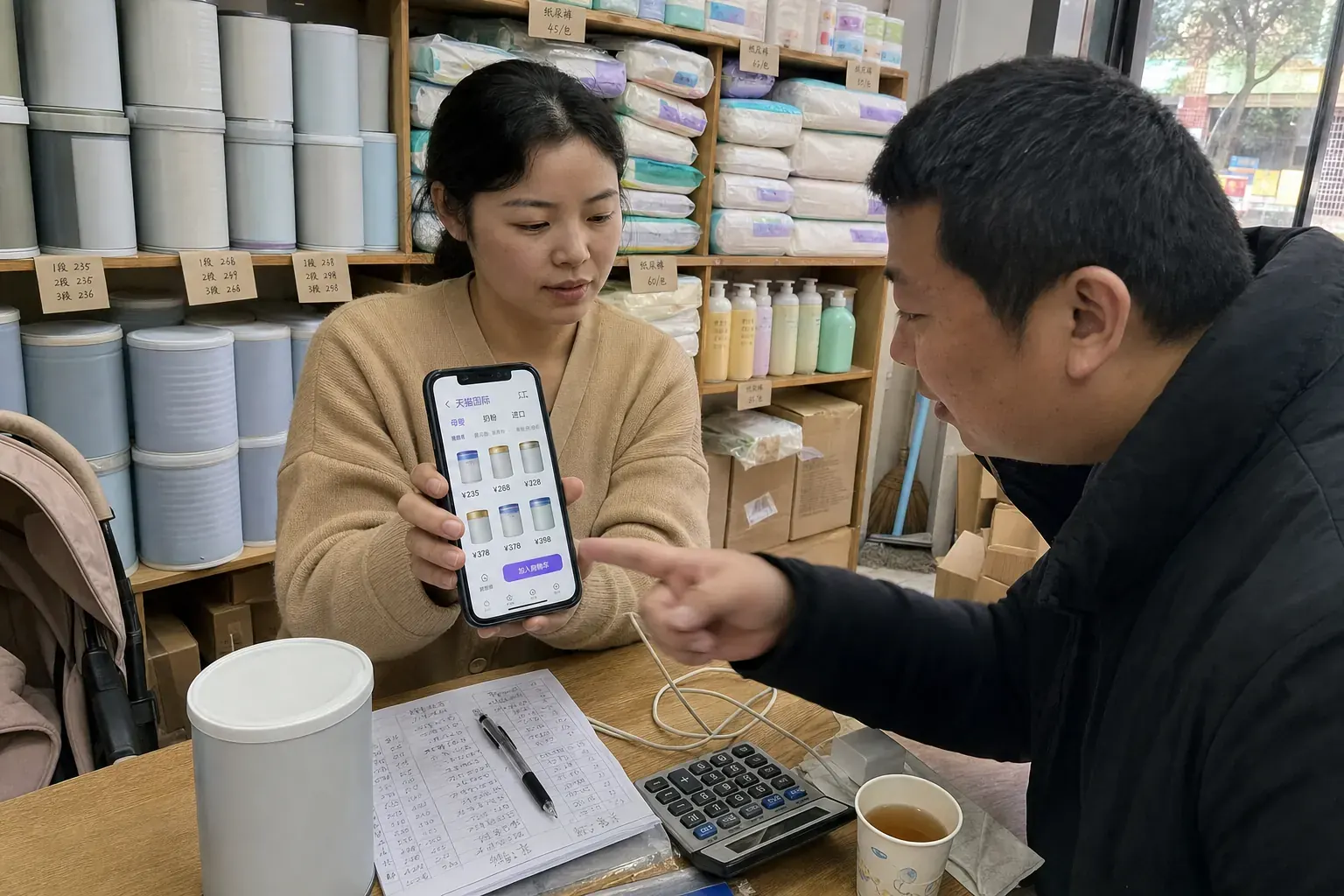
No resale means a distributor has nothing to do with cross-border stock. It can’t take bonded cartons and put them on a counter in Chengdu. And the pack you ship stays the pack the shopper gets.
The order page must tell the shopper the goods are bought directly from overseas and may carry no Chinese label, with a Chinese electronic label viewable on the website. Source: Ministry of Commerce and five other departments, 商财发〔2018〕486号, art. 4, November 2018. https://www.gov.cn/zhengce/zhengceku/2018-12/31/content_5437823.htm
General trade: the distributor and the responsible person
Shops are a different job. Here the partner imports the goods, clears them and sells them on, and every product needs its filing or registration in place first. For a general cosmetic that part is quick, once the dossier is ready.
A general cosmetic is filed once the filer submits the filing materials through the NMPA information platform before launch or import. Source: State Administration for Market Regulation (市场监管总局), Measures for the Administration of Cosmetics Registration and Filing (化妆品注册备案管理办法), Order No. 35, art. 34, January 2021. https://www.gov.cn/gongbao/content/2021/content_5595926.htm
A special cosmetic waits longer. Technical review takes up to 90 working days, the NMPA then has 20 to decide, and the review clock starts again each time it asks for more material (Order No. 35, arts. 39 and 40). Plan a sunscreen launch around that, not around the distributor’s sales calendar.
The bigger question is who the domestic responsible person will be. Many distributors offer to take the role. It comes with legal liability.
The domestic responsible person files and registers in the name of the overseas registrant or filer, helps it monitor adverse reactions and carry out recalls, and bears quality and safety liability for products on the Chinese market under its agreement with the registrant or filer. Source: State Administration for Market Regulation, Order No. 35, art. 8, January 2021. https://www.gov.cn/gongbao/content/2021/content_5595926.htm
So the filing sits in your name, and the distributor handles it. That’s convenient while the deal runs. It’s a lever in the distributor’s hands when the deal ends, which is why the authorization letter should list the products, set a term and say what happens at the end. The role can be moved to another company later, as the responsible person piece linked above explains, and an exit clause in the letter makes the move simpler.
Chains are often why a brand wants a distributor in the first place. They can’t stock a product without paperwork, and the law tells them to look.
Cosmetics retailers must keep a purchase inspection record, checking the supplier’s business registration, the product’s registration or filing and its factory inspection certificate. Source: State Council Gazette, Decree No. 727, art. 38, June 2020. https://www.gov.cn/gongbao/content/2020/content_5525087.htm
A distributor that already sells into the chains has done this many times. Ask which chains it supplies today and for which foreign brands. And size the channel honestly before you pay for it.
Watsons ran 3,227 stores in mainland China at the end of June 2026, down from 4,179 in 2021. Its China revenue rose 7% in the first half of 2026, to 7.12 billion HKD. Source: Jiemian (界面新闻), September 2026. https://www.jiemian.com/article/15088061.html
That is still more than three thousand counters. A chain that is closing stores adds few new foreign lines, and its buyers will ask what your online sales already look like.
What to ask any beauty partner before you sign
Start with the route, in writing. Which of your SKUs go cross-border, which get filed for general trade, and who pays for the filing work. A partner that can’t answer per product hasn’t read your range.
Then test the claims. A distributor that says it holds filings for other foreign brands can show you the filing numbers, and you can check the filer and the responsible person on the NMPA’s public database, where every completed filing is published within five working days (Order No. 35, art. 9). A TP or DP can show you stores it runs today, in your category. Our guide to finding a distributor in China sets out eight checks that separate a real importer from a trading company. The two partner guides above do the same job for TPs and DPs.
Timing matters too. The March 8 promotions come about four weeks after Chinese New Year, which falls on February 6 in 2027. A partner chosen in January has a holiday in the middle of its setup.
Compass builds shortlists from distributors, TPs and DPs we have met, matched to the route your range takes.
Questions beauty brands ask about China partners
Does a cosmetics distributor in China need my NMPA filing?
Yes, for anything it sells through shops or domestic online stores. Imported general cosmetics are filed before import, and special cosmetics such as sunscreen are registered first. A Chinese company you name as domestic responsible person handles the filing in your name. Cross-border sales on Tmall Global, JD Worldwide or Douyin need no filing.
Should my distributor be my domestic responsible person?
It can be, and many are. The role files in your name and shares quality and safety liability for products on the market. If the distributor holds it, set the product list, the term and the exit in the authorization letter, so the filings don’t become a bargaining chip when the deal ends.
Can I sell cross-border and through a distributor at the same time?
Yes, with separate stock. Cross-border goods go straight to shoppers, within 5,000 RMB a transaction and 26,000 RMB a year, and can’t be resold in China. A distributor’s stock comes in under general trade, filed and labeled in Chinese. Keep each partner’s product list and prices clear.
Get a Compass shortlist of beauty distributors, Tmall Partners and Douyin Partners
Updated November 5, 2026
Working on China? Let's grab a coffee.
Tell us where you are now and where you want to get to.