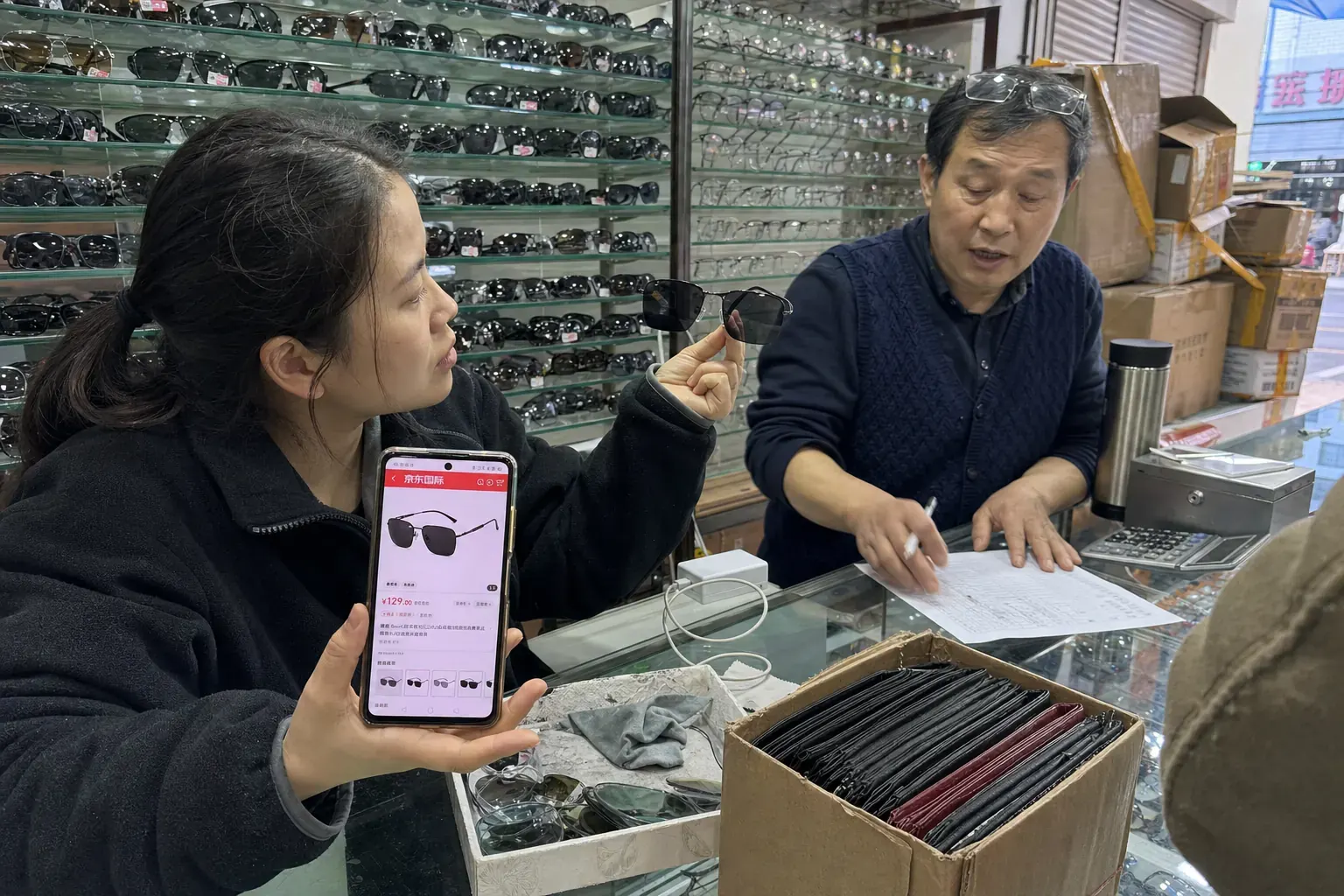
Open sunglasses and frames on JD Worldwide first. A flagship there costs a US$5,000 refundable deposit, no annual fee and 6.9% of each sale. Tmall Global wants a 50,000 RMB deposit, and it waives its 60,000 RMB annual fee for new eyewear stores until March 31, 2027. Contact lenses are a medical device and a far bigger bill: 300,000 RMB in deposit on Tmall Global, plus insurance.
Eyewear is three products that share a shelf. Sunglasses and fashion frames are accessories. Spectacle lenses sit in between. Contact lenses, and the solution they sit in, are medical devices. Platforms price them separately, and so do China’s regulators. With an operating partner, the fixed bill for year one comes to about 430,000 RMB on JD Worldwide and 490,000 on Tmall Global at the full annual fee, before stock and ads (TheChinaPath calculator data, November 2026).
| First year (RMB unless stated) | Tmall Global, sunglasses and frames | JD Worldwide, eyewear | Douyin cross-border, eyewear | Tmall Global, contact lenses | Douyin cross-border, contact lenses |
|---|---|---|---|---|---|
| Security deposit, refundable | 50,000 | US$5,000 flagship (about 35,500) | 500 to 5,000 | 300,000 | 500 to 5,000 |
| Annual fee | 60,000; none for a new store until March 31, 2027 | none | none | 30,000 | none |
| Commission per sale | 5%, plus 1% Alipay | 6%, plus 0.9% transaction fee | 6%, plus 4% on Douyin Mall and Doubao orders | 3%, plus 1% Alipay | 5%, plus 5% on Douyin Mall and Doubao orders |
| Cash in before the first sale | 110,000; 50,000 for a new store until March 31, 2027 | about 35,500 | 500 | 330,000 | 500 |
Rates as posted on each platform’s rule pages, checked November 8, 2026. Dollar deposits at 7.1 RMB to the dollar. JD Worldwide’s fee schedule has no contact lens line.
The cost to sell eyewear in China, platform by platform
Tmall Global files glasses with lighters and Swiss army knives, on the dearer of its two annual-fee tiers. Contact lenses sit with the health categories, on the cheaper one.
Tmall Global charges the glasses category (ZIPPO/瑞士军刀/眼镜) a 5% technical service fee and a 60,000 RMB annual fee, and contact lenses and care solutions (隐形眼镜/护理液) 3% and 30,000 RMB, under the schedule in force from September 9, 2026. Source: Tmall Global (天猫国际), category annual fee and technical service fee rates, September 2026. https://rule.tmall.hk/?type=detail&ruleId=11005909&cId=625
The deposit for clothing and accessories is 50,000 RMB for a flagship or brand store and 100,000 RMB for a multi-brand store. Contact lenses and care solutions take 300,000 RMB in every store type. Source: Tmall Global (天猫国际), platform deposit rules, May 2026. https://rule.tmall.hk/?type=detail&ruleId=8942&cId=625
Tmall’s general discount on the 60,000 RMB fee this year leaves new eyewear stores out.
Stores in the 60,000 RMB tier that open between April 1, 2026 and March 31, 2027 pay 30,000 RMB a year for that period, unless their main category is clothing and accessories, a list that names the glasses category. Source: Tmall Global (天猫国际), 2026 annual fee incentive for new and second-year merchants, July 2026. https://rule.tmall.hk/?type=detail&ruleId=20010439&cId=625
That’s because those categories get a better deal: no annual fee at all.
New stores whose main category is clothing and accessories, a list that names the glasses category, and that open between April 1, 2026 and March 31, 2027 pay no annual fee inside that period. Outside it, the standard fee applies. Source: Tmall Global (天猫国际), 2026 annual fee special incentive for new apparel, mother and baby and home stores, July 2026. https://rule.tmall.hk/?type=detail&ruleId=20010440&cId=625
An eyewear store that opens in December 2026 pays no annual fee for its first four months. From April 2027 it pays 60,000 RMB a year.
JD files glasses next to watches, at the 6% most watches pay.
JD Worldwide charges eyewear (眼镜) a 6% operating support fee plus a 0.9% transaction fee. A brand flagship deposits US$5,000; other store types deposit US$8,000 to US$15,000 depending on monthly sales. Source: JD Worldwide (京东全球购), category fee standard, revised September 24, 2026, effective October 1, 2026. https://jdw-rule.jd.hk/detail?ruleId=950583665543483392
Douyin is the cheapest door and the most expensive per order.
Douyin’s cross-border stores pay a 6% base rate on watches and eyewear, plus a 4% supplement on orders from specified channels. Clear contact lenses and contact lens solution pay 5% plus 5%. Source: Douyin E-commerce (抖音电商), cross-border technical service fee standard, July 2026. https://school.jinritemai.com/doudian/web/articlev0/aHMYyFoqESKn
The specified channels are the Douyin Mall app and Doubao. Source: Douyin E-commerce (抖音电商), cross-border merchant rules, section 5.2.2, September 2026. https://school.jinritemai.com/doudian/web/article/108056
The cross-border base deposit is 500, 2,000 or 5,000 RMB, set each month by the store’s paid GMV the month before. If after-sales payouts outrun it, a store selling special categories tops up an experience deposit of ten times the base; other stores pay twice the base. Source: Douyin E-commerce (抖音电商), cross-border deposit rules, June 2025. https://school.jinritemai.com/doudian/web/articlev0/107821
The route: three products, one list
Start with the cross-border list, because every kind of eyewear is on it.
The cross-border retail import list covers contact lenses, spectacle lenses of glass and of other materials, plastic and metal frames, frame parts, sunglasses and other spectacles. Frames of natural materials are excluded when the species is on China’s wildlife import and export list. Source: Ministry of Finance (财政部) and 12 other departments, list annexed to Announcement 2019 No. 96, December 2019, as published by the Ministry of Commerce. https://images.mofcom.gov.cn/cws/202001/20200110143527533.pdf
Cross-border orders are treated as personal imports, and that matters most for lenses.
Cross-border retail imports are supervised as goods for personal use, without the first-import license, registration or filing requirements that apply to the same goods in general trade. Source: Ministry of Commerce (商务部) and five other bodies, 商财发〔2018〕486号, November 2018. https://www.gov.cn/zhengce/zhengceku/2018-12/31/content_5437823.htm
So, as a rule, a lens with a CE mark at home can sell cross-border with no Chinese device registration. Put the same lens in a distributor’s warehouse and it needs one.
Soft, colored and rigid contact lenses, and contact lens care solutions, are Class III medical devices, the highest risk class. Source: China Food and Drug Administration (now the National Medical Products Administration, 国家药监局), Medical Device Classification Catalogue, August 2017, in force August 2018, as published by the Zaozhuang Administration for Market Regulation (枣庄市市场监督管理局). http://scjg.zaozhuang.gov.cn/wsfw/wsbs/bszn/201809/P020190717643664144085.docx
Class II and Class III devices need product registration. A foreign maker files through a Chinese legal entity it designates, and imported devices must be registered or filed. Source: State Council (国务院), Regulations on the Supervision and Administration of Medical Devices, articles 13, 16 and 57, Order 739, March 2021, in force June 1, 2021. https://www.gov.cn/zhengce/content/2021-03/18/content_5593739.htm
Then the tax. Eyewear pays duty, unlike furniture.
The 2026 most-favored-nation duty is 7% on sunglasses, spectacle frames and spectacle lenses. Contact lenses carry a provisional rate of 6%. Source: State Council Tariff Commission (国务院关税税则委员会), Customs Tariff of the PRC (2026), January 2026, as published by the Wuxi Finance Bureau (无锡市财政局). https://cz.wuxi.gov.cn/doc/2026/01/04/4711263.shtml
A general-trade pair pays 7% duty and then 13% VAT on the duty-paid value, about 20.9% in all.
Imported goods carry value-added tax at 13%, on the dutiable value plus duty and consumption tax. Source: VAT Law (增值税法), articles 10 and 14, in force January 1, 2026, State Taxation Administration (国家税务总局) policy database. https://fgk.chinatax.gov.cn/zcfgk/c100009/c5237365/content.html
Cross-border, the shopper pays 9.1%: no duty, and 70% of the 13%.
The cross-border retail import tariff rate is set at 0%, and import VAT and consumption tax are levied at 70% of the statutory payable amount. Source: Ministry of Finance (财政部), 财关税〔2016〕18号, March 2016. http://www.mof.gov.cn/gp/xxgkml/gss/201603/t20160324_2510682.htm
Standards split the same way. Sunglasses sold through general trade must meet a mandatory national standard. Spectacle lenses no longer have one.
GB 39552.1-2020, general requirements for sunglasses and sunglass lenses, is mandatory and has been in force since December 1, 2021. Source: State Administration for Market Regulation (市场监管总局), national standards register, November 2020. https://std.samr.gov.cn/gb/search/gbDetailed?id=B4866A4E6CE13F70E05397BE0A0A9A77
The mandatory spectacle lens standard GB 10810.1-2005 was repealed on March 1, 2026 and replaced by the recommended standard GB/T 10810.1-2025. Source: State Administration for Market Regulation (市场监管总局), national standards register, checked November 2026. https://std.samr.gov.cn/gb/search/gbDetailed?id=71F772D77FEDD3A7E05397BE0A0AB82A
On the label, a cross-border order may arrive without Chinese, provided the order page warns the shopper first. Distributor stock needs the product name and the maker’s name and address in Chinese.
Cross-border goods meet the standards of their origin but may differ from China’s, and may carry no Chinese label; the order page must say so before the shopper buys. Source: Ministry of Commerce (商务部) and five other bodies, 商财发〔2018〕486号, article 4, November 2018. https://www.gov.cn/zhengce/zhengceku/2018-12/31/content_5437823.htm
Product labels must give the product name and the maker’s name and address in Chinese. Source: Product Quality Law (产品质量法), article 27, as amended December 2018, published by the China National Intellectual Property Administration (国家知识产权局), July 2019. https://www.cnipa.gov.cn/art/2019/7/31/art_104_67810.html
The last trap is the claim set. Blue light, UV and polarization are the words that sell glasses online, and a listing is advertising under Chinese law. Check every claim against a test report before anyone writes the product page.
A Shanghai seller listed glasses as blocking 98% of harmful blue light and preventing myopia. Tests found 30% blocking in the 415 to 445 nm band. The Putuo market regulator ruled it false advertising and fined the seller 50,000 RMB. Source: China News Service (中国新闻网), citing the Shanghai Administration for Market Regulation, June 2022, as carried by the Beijing Chaoyang District credit portal (信用朝阳). http://www.bjchy.gov.cn/xychy/xxgs/xyfxts/4028805a811a47da01813858da460cd3.html
Contact lens ads sit under tighter rules again.
Medical device advertising may not claim efficacy or safety, cite cure rates or use endorsers, and must be reviewed by the authorities before it runs. Source: Advertising Law (广告法), articles 16 and 46, as amended April 2021, published by the State Administration for Market Regulation (市场监管总局). https://www.samr.gov.cn/zw/zfxxgk/fdzdgknr/fgs/art/2023/art_5474cf75173c45d6a0379730fb4e8d97.html
What one eyewear order costs
Glasses are light and sell for far more than it costs to move them, so freight barely shows. Our cross-border models price the warehouse and delivery work on one order at about 17 RMB at their defaults: 4 RMB to pick and pack, 11 RMB for the last mile, 1.60 RMB of storage and 0.75 RMB of return handling at a 5% return rate. On the model’s default 250 RMB basket, that’s 6.9% of the sale. On an assumed 1,200 RMB pair of sunglasses, it’s 1.4%.
| Assumed basket | Warehouse and delivery per order (RMB) | Tmall Global fees per order (RMB) | JD Worldwide fees per order (RMB) | Tmall Global breakeven | JD Worldwide breakeven |
|---|---|---|---|---|---|
| 250 RMB | 17.35 | 15 | 17.25 | about 2.70 million RMB, 10,800 orders | about 2.50 million RMB, 9,980 orders |
| 1,200 RMB pair of sunglasses | 17.35 | 72 | 82.80 | about 2.07 million RMB, 1,730 orders | about 1.89 million RMB, 1,580 orders |
Breakeven GMV at the calculators’ defaults: 75% gross margin, a 35,000 RMB monthly operating partner plus 10% of sales, 60% of sales from paid media at a return on ad spend of 2, 20% through creators at 20% commission, a 25,000 RMB store build written off over three years, and each platform’s annual fee and commission for the glasses line. Source: TheChinaPath calculator data, November 2026.
The pricier pair needs a sixth of the orders. On both platforms the breakeven lands between about 1.9 and 2.7 million RMB of sales, because the operating partner and the media budget cost far more than any platform fee.
The real cost at onboarding is paper. Every store opens on a trademark certificate, and registering the name in China as well is cheap. Waiting for it is not.
Filing a trademark application online costs 270 RMB per class, for up to 10 goods. Source: China National Intellectual Property Administration Trademark Office (国家知识产权局商标局), fee list, in force since July 1, 2019. https://sbj.cnipa.gov.cn/sbj/sbsq/sfbz/
The average trademark examination period held at four months. Source: China National Intellectual Property Administration (国家知识产权局), 2026 national work report, January 2026. https://www.cnipa.gov.cn/art/2026/1/7/art_53_203564.html
Tmall Global takes a pending application, with a note. A store selling someone else’s brand also needs a paper trail back to the owner.
A store must file the brand’s trademark registration certificate, or the application receipt with a note explaining the unregistered mark. A multi-brand store selling glasses must show an authorization chain, or purchase vouchers, running back to the trademark owner within three levels. Source: Tmall Global (天猫国际), merchant qualification standards, in force September 28, 2026. https://rule.tmall.hk/?type=detail&ruleId=11000442&cId=624
Contact lenses add a stack of their own. Tmall Global and Douyin ask for the same file.
A contact lens store must supply a product liability insurance policy with 10 million RMB of cover, the brand’s company registration, its contact lens manufacturing license, a home-market medical device registration (or FDA registration or EU CE certification) for every product, and proof of at least one main sales channel at home. Source: Tmall Global (天猫国际), merchant qualification standards, in force September 28, 2026. https://rule.tmall.hk/?type=detail&ruleId=11000442&cId=624
Douyin’s cross-border rules ask contact lens merchants for the same policy, licenses, per-product registrations and channel proof. Source: Douyin E-commerce (抖音电商), cross-border merchant rules, September 2026. https://school.jinritemai.com/doudian/web/article/108056
Which platform first
JD Worldwide, for sunglasses and frames. It holds less cash than Tmall and never charges an annual fee. Tmall’s waiver buys a store opening now four or five fee-free months. From April 2027, Tmall’s lower rate, 6% against 6.9%, only earns back its 60,000 RMB fee above about 6.7 million RMB of sales a year. That’s our arithmetic on the posted rates, and it’s more than double the breakeven above. Below that line, JD is cheaper.
Two cases change the order. A brand whose sales come from livestreams and short videos belongs on Douyin, where the 500 RMB deposit is the cheapest entry and the 10% fee on Douyin Mall orders is the price of the traffic. And contact lenses can’t go to JD Worldwide at all, since its schedule has no line for them. Tmall Global charges less per order but holds 300,000 RMB of deposit; Douyin holds 500 RMB and takes up to 10%. A brand with steady reorders gets more from Tmall’s rate. A brand testing demand risks less on Douyin.
Our cross-border setup team opens the store and files the paperwork.
Our record in this category
Eyewear isn’t a category our team has worked in, so there’s no case to show here.
Run your own numbers
Open the Tmall Global setup and run calculator with “Fashion jewellery” selected. Its 50,000 RMB deposit, 5% commission and 60,000 RMB annual fee match the glasses line. The calculator charges the full fee, so a new store comes out 5,000 RMB a month too high until March 2027. In the JD Worldwide calculator, “Fashion jewellery” carries the same 35,500 RMB deposit and 6% as eyewear; the 0.9% transaction fee is already loaded. In both, replace the 250 RMB basket with your own average price. For contact lenses on Tmall Global, pick Custom and type 300,000 RMB, 3% and 30,000 RMB.
Questions we get asked
Do contact lenses need NMPA registration to sell in China?
Only through general trade. Contact lenses and their care solutions are Class III medical devices, so a distributor’s stock needs a Chinese registration filed through a designated Chinese company. Cross-border orders are personal imports and skip it. Tmall Global and Douyin still ask for a home-market registration, such as a CE certificate, for every product.
What duty does imported eyewear pay in China?
The 2026 tariff sets 7% on sunglasses, frames and spectacle lenses, and a 6% provisional rate on contact lenses. Through general trade, 13% VAT then lands on the duty-paid value, about 20.9% in all. A cross-border order pays 9.1% instead, with no duty.
Can I say my lenses block blue light?
Only if a test report backs the exact claim. In a case reported in 2022, a Shanghai regulator fined a seller 50,000 RMB for advertising 98% blue-light blocking when tests measured 30%. Treat UV and polarization claims the same way, and get the report before the listing copy is written.
Why does Tmall Global cost more for eyewear than for some categories?
Glasses sit in the 60,000 RMB annual-fee tier, the dearer of Tmall’s two. A new eyewear store pays none of it until March 31, 2027, under a waiver for clothing and accessories stores. After that, the full fee applies. Contact lenses sit in the 30,000 RMB tier but carry a 300,000 RMB deposit, six times the deposit for sunglasses.
Send us your range, price points and certificates, and we’ll tell you which store to open first: cross-border setup for eyewear brands.
Updated November 9, 2026
Working on China? Let's grab a coffee.
Tell us where you are now and where you want to get to.