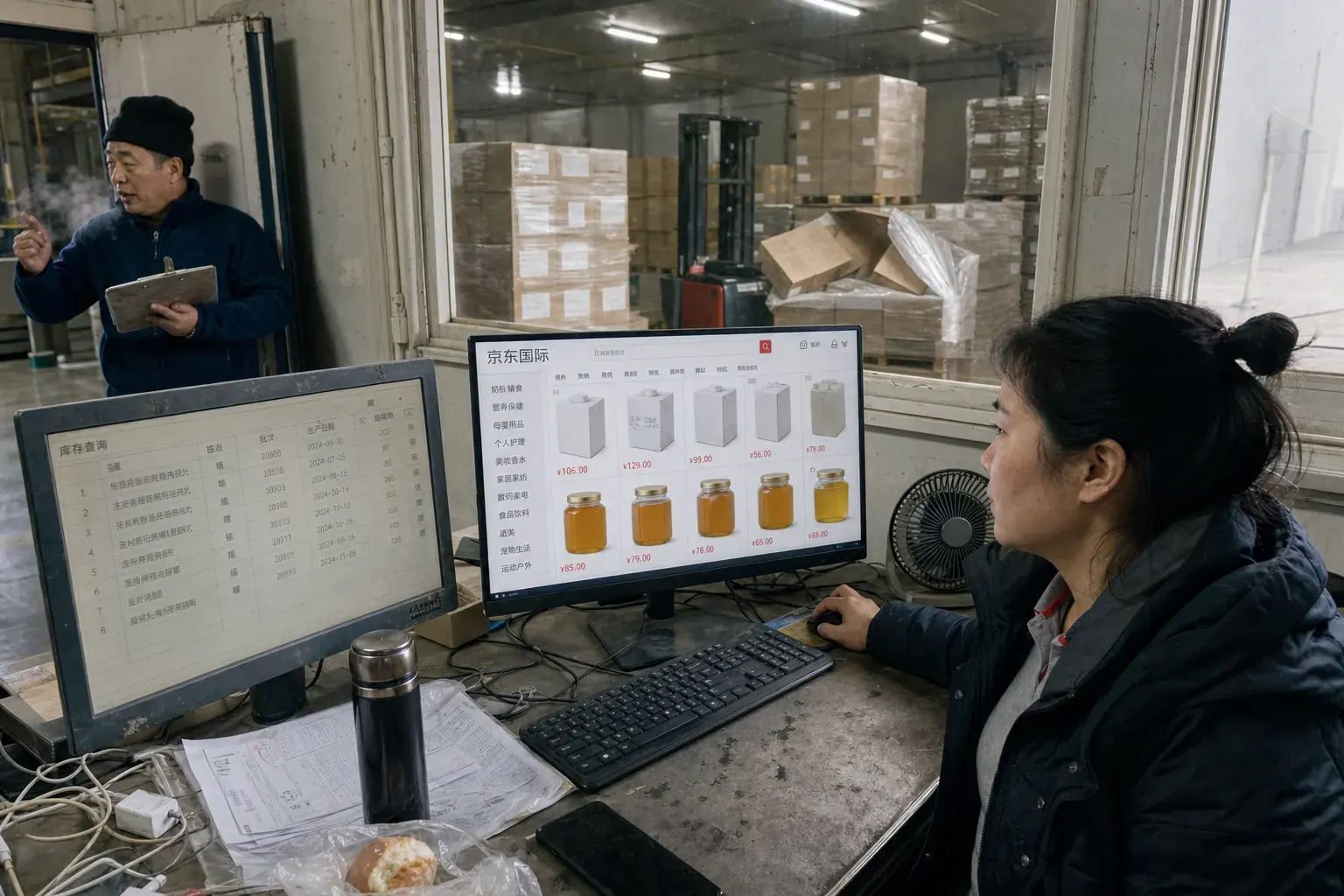
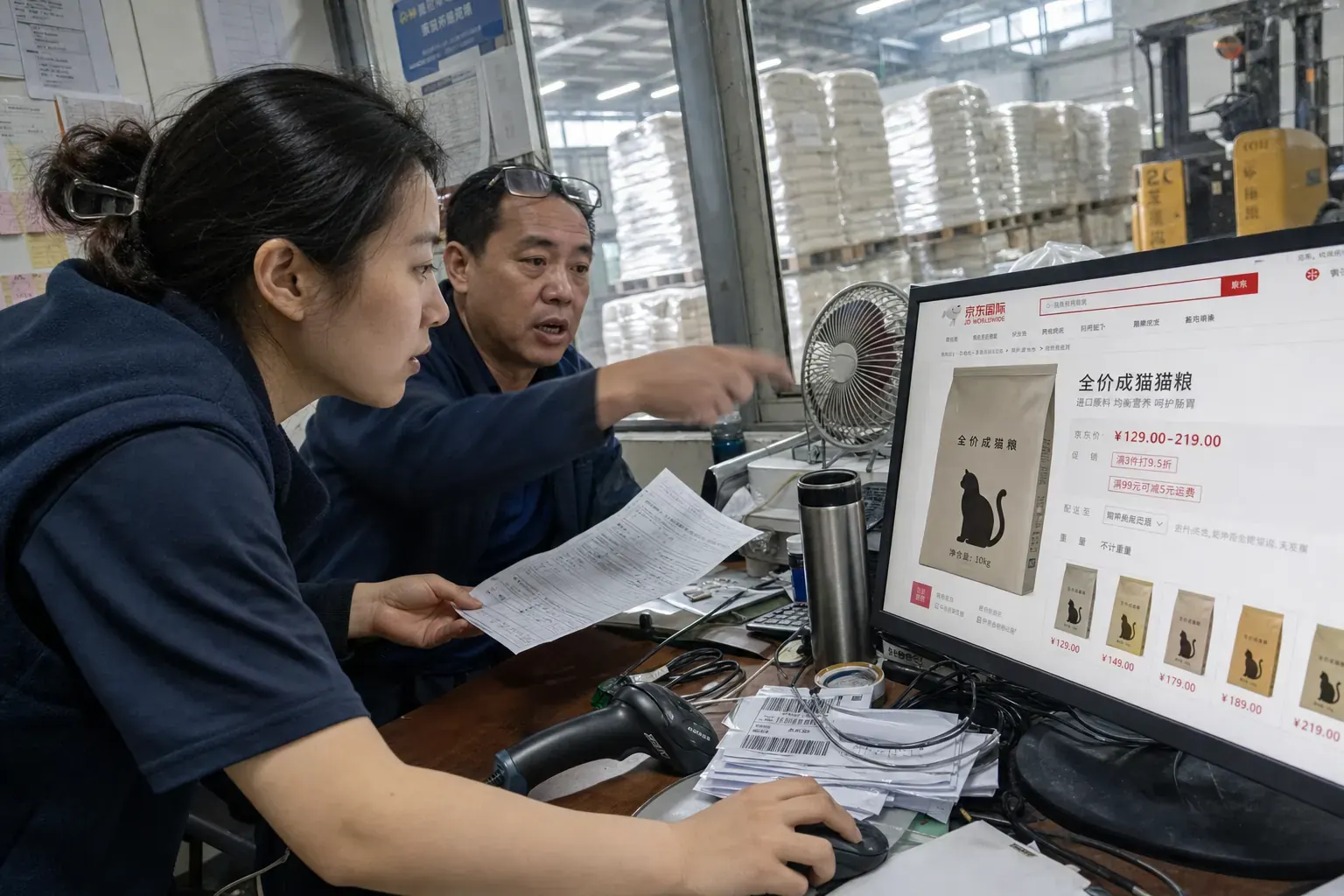
Start on JD Worldwide. Cat and dog food opens there for a US$5,000 deposit, no annual fee, and 2.5% of each sale plus a 0.9% transaction fee. Tmall Global takes the same 2.5% but wants 80,000 RMB up front. Break-even sits near 1 million RMB of year-one sales. Before any of that, China has to register your factory.
Pet food is a factory question before it’s a store question. Chinese customs treats it as animal feed, and imported feed has to come from a plant customs has already registered. A brand can’t apply for that itself, and money doesn’t speed it up.
The prize is real.
China’s urban dog and cat owners spent 312.6 billion RMB in 2025, up 4.1%, and food took 53.7% of it. Source: CCTV.com (央视网), on the 2026 China Pet Industry White Paper (《2026年中国宠物行业白皮书》), January 2026. https://business.cctv.com/2026/01/05/ARTIdmv2AWmVeRVodaZYLOvQ260105.shtml
Imports are going the other way. They fell in 2025, and Chinese brands now crowd the top of the festival charts.
China imported US$474.1 million of packaged pet food in 2025, down 5.2% from 2024, according to China Customs. Source: USDA Foreign Agricultural Service, ATO Shanghai, Pet Food Market Update 2026 (GAIN CH2026-0046), April 2026. https://apps.fas.usda.gov/newgainapi/api/Report/DownloadReportByFileName?fileName=Pet+Food+Market+Update+2026_Shanghai+ATO_China+-+People%27s+Republic+of_CH2026-0046.pdf
Of the pet brands that passed 10 million RMB in sales on the first day of Tmall’s Double 11 in 2025, 68% were Chinese. Source: Huanqiu.com (环球网), via Sina Finance, November 2025. https://finance.sina.com.cn/roll/2025-11-08/doc-infwsynp1202307.shtml
What it costs to open a pet food store in China
| Cat and dog food, first year (RMB) | Tmall Global | JD Worldwide | Douyin cross-border |
|---|---|---|---|
| Security deposit, refundable | 50,000 | 35,500 (US$5,000) | 5,000 |
| Annual platform fee | 30,000 | none | none |
| Commission on each sale | 2.5% | 2.5% | 3.5% |
| Other fee on each order | 1% payment fee | 0.9% transaction fee | 4.6% on Douyin Mall and Doubao orders |
| Cash in before the first sale | 80,000 | 35,500 | 5,000 |
Deposits, annual fees and per-order fees for cat and dog food on the three cross-border platforms, with JD’s dollar deposit at 7.1 RMB. Source: TheChinaPath calculator data, October 2026.
All three platforms put pet food in a low band. Tmall Global charges 2.5% on dog food, cat food and treats alike, with the 30,000 RMB annual fee that food categories pay.
犬主粮, 猫主粮, 狗零食 and 猫零食 pay a 2.5% technical service fee and a 30,000 RMB annual fee. Source: Tmall Global (天猫国际), 《天猫国际各类目年费、技术服务费率》, effective September 9, 2026. https://rule.tmall.hk/?type=detail&ruleId=11005909&cId=625
JD Worldwide matches the 2.5% on dry and wet food but charges 5% on dog and cat treats. It quotes its deposit in dollars and bills no annual fee.
猫狗主粮 (cat and dog staple food) pays a 2.5% operating support fee plus a 0.9% transaction fee, and a brand flagship deposits US$5,000. Source: JD Worldwide (京东全球购), category fee standard, revised September 24, 2026, effective October 1, 2026. https://jdw-rule.jd.hk/detail?ruleId=950583665543483392
Douyin costs least to open and can cost the most per order. Its deposit follows last month’s sales, from 500 RMB to a top tier of 5,000 RMB. Its base rate on dog and cat food is 3.5%, and orders that arrive through the Douyin Mall app or Doubao (ByteDance’s AI assistant app) pay another 4.6%. That’s 8.1% on those orders.
狗食品 and 猫食品 carry a 3.5% base technical service fee and a 4.6% supplementary fee on orders from specified channels (the Douyin Mall app and Doubao). Source: Douyin E-commerce (抖音电商), 《【全球购】技术服务费费率标准》, July 15, 2026, with 《【全球购】招商管理规则》 5.2.2. https://school.jinritemai.com/doudian/web/articlev0/aHMYyFoqESKn
Douyin Global’s base deposit is 500 RMB for a prior-month paid GMV up to 50,000 RMB, 2,000 RMB up to 100,000 RMB, and 5,000 RMB above that. Source: Douyin E-commerce (抖音电商), 《【全球购】保证金管理规范》, latest revision effective June 5, 2025. https://school.jinritemai.com/doudian/web/articlev0/107821
The route in: a registered plant first, a store second
Here’s the rule that sets your timeline. Under the customs regulation on imported feed, pet food and chews count as feed. Feed has to come from a plant on the customs register, and your company can’t put itself on it. The exporting country’s own authority reviews the plant and recommends it to China. Registration then runs five years.
Imported feed must come from a registered overseas producer, recommended to the General Administration of Customs by the exporting country’s competent authority after its own review. Registration is valid for five years. The definition of feed includes 宠物食品及咬胶 (pet food and chews). Source: General Administration of Customs (海关总署), Measures for the Inspection, Quarantine and Supervision of Imported and Exported Feed and Feed Additives, as amended by Decree No. 262, March 2023, arts. 10 to 13 and 68. https://policy.mofcom.gov.cn/claw/clawContent.shtml?id=97519
Your country also needs a pet food protocol with China, and each protocol spells out the paperwork. When the UK got access in November 2025, every lot needed a health certificate. The outer packaging needed the plant’s name, its registration number, and Chinese wording saying the goods are bound for China and are for pets only.
Pet food exported from the UK must come from plants registered with China on the UK’s recommendation, carry a health certificate with every lot, and show the plant name, its registration number, 输往中华人民共和国 and 仅用于宠物食用 on the outer packaging. Source: General Administration of Customs Announcement 2025 No. 230 (海关总署公告2025年第230号), November 2025, via the Ministry of Commerce. https://www.mofcom.gov.cn/zcfb/zgdwjjmywg/art/2026/art_2c3ecb1ff8354d818fe48d7d56539092.html
So if your contract manufacturer has never shipped to China, you’re waiting on two governments. No budget shortens that.
Bonded cross-border doesn’t change it. Both pet food lines sit on the cross-border retail import list, but only as bonded stock, so you can’t ship single bags by direct mail from Europe.
23091010 (retail-packed dog or cat food, canned) and 23091090 (other retail-packed dog or cat food) are on the cross-border retail import list, 仅限网购保税商品 (bonded online stock only). Source: Ministry of Finance and 12 other departments, Announcement 2019 No. 96, December 2019. http://gss.mof.gov.cn/gzdt/zhengcefabu/201912/t20191227_3451448.htm
The 2018 cross-border rules waive the first-import registration that general trade demands. Quarantine is the exception.
Cross-border retail imports are supervised as personal-use goods without first-import permit, registration or filing requirements, except for goods from epidemic areas whose import is suspended. Customs applies necessary quarantine before sale. Source: Ministry of Commerce and five other bodies, 商财发〔2018〕486号, November 2018. https://www.gov.cn/zhengce/zhengceku/2018-12/31/content_5437823.htm
Customs reads pet food straight into that exception.
Customs applies quarantine access control to the countries and products allowed to export pet food to China, and imported pet food must come from registered overseas producers. Source: Chengdu Customs (成都海关), via the Shanghai Cross-border E-commerce Association (上海跨境电子商务行业协会), November 2023. https://www.scea.co/trends/show/id/2552.html
Tax is the good news. Pet feed sits in China’s 9% VAT band, so a cross-border shopper pays 70% of that: 6.3%, with no duty and no consumption tax.
宠物饲料,属于饲料的征税范围 (pet feed falls within the scope of feed), which the VAT Law taxes at 9%. Source: Ministry of Finance and State Taxation Administration (财政部 税务总局), Announcement 2026 No. 9, Annex 1, January 2026. https://hainan.chinatax.gov.cn/xxgk_6_1/30163239.html
Within the limits, cross-border retail imports carry a 0% tariff, and import VAT and consumption tax are levied at 70% of the statutory amount. Source: Ministry of Finance (财政部), 财关税〔2016〕18号, March 2016. http://www.mof.gov.cn/gp/xxgkml/gss/201603/t20160324_2510682.htm
The limits are 5,000 RMB an order and 26,000 RMB a shopper a year. Two big bags fit with room to spare.
The single-transaction limit for cross-border retail imports is 5,000 RMB and the annual limit 26,000 RMB. Source: Ministry of Finance, General Administration of Customs and State Taxation Administration, 财关税〔2018〕49号, November 2018. https://www.gov.cn/zhengce/zhengceku/2018-12/31/content_5440499.htm
General trade stacks more on top. A provisional 10% duty in 2026, then 9% VAT. And complete foods need a product registration from the Ministry of Agriculture and Rural Affairs, filed through a Chinese agent or a China office, with verification testing that can take three months. Treats are exempt.
Retail-packed dog or cat food (23091010 and 23091090) carries a 15% most-favored-nation duty and a 10% provisional rate for 2026. Source: State Council Tariff Commission (国务院关税税则委员会), Announcement 2025 No. 11, Annex 1, December 2025. https://gss.mof.gov.cn/gzdt/zhengcefabu/202512/P020251229510521217364.pdf
The ministry reviews the dossier within 10 working days, the testing laboratory completes verification testing within three months, and the import registration certificate is valid for five years. Source: Ministry of Agriculture (农业部), Administrative Measures for the Registration of Imported Feed and Feed Additives, arts. 9, 10 and 14, as amended November 2017. https://www.moa.gov.cn/gk/nyncbgzk/gzk/202210/t20221013_6413266.htm
Imported 宠物配合饲料 (complete pet food) and 宠物添加剂预混合饲料 (pet additive premix) need an import registration certificate. Other pet feed, treats included, does not. Source: Ministry of Agriculture and Rural Affairs (农业农村部), Pet Feed Administrative Measures, Announcement No. 20, arts. 2 and 14, republished June 2025. https://www.moa.gov.cn/ztzl/sqxzjcgs/xzjcbz/202506/t20250630_6475260.htm
The Chinese label for general trade is its own small project. It names the product type in set words (全价宠物食品 for a complete food, 宠物零食 for a treat). It also carries the guaranteed analysis, the registration number, the country of origin in Chinese and the Chinese company selling it.
Imported complete pet food and premix labels must show the registration number matching the import certificate, the producer and site, the country of origin in Chinese, and the name, address and contact details of the product’s registered sales entity in China. Source: Ministry of Agriculture and Rural Affairs (农业农村部), Pet Feed Labeling Regulations (《宠物饲料标签规定》), arts. 3, 5 and 15, republished June 2025. https://www.moa.gov.cn/ztzl/sqxzjcgs/xzjcbz/202506/t20250630_6475269.htm
Rules above checked October 2026.
What one order of kibble actually costs
Start with a real shelf price.
A 5.4 kg bag of an imported premium cat kibble sold for 502.55 RMB after coupons on Tmall Global’s own direct store. Source: SMZDM (什么值得买), January 2025. https://www.smzdm.com/p/139914873/
So take three baskets around that bag: a 1.8 kg bag at 180 RMB, the 5.4 kg bag at 500, and two of them at 1,000.
| Per 100 parcels shipped, JD Worldwide (RMB) | 1.8 kg bag, 180 | 5.4 kg bag, 500 | Two 5.4 kg bags, 1,000 |
|---|---|---|---|
| Orders kept at a 5% return rate | 95 | 95 | 95 |
| Commission at 2.5% | 428 | 1,188 | 2,375 |
| Transaction fee at 0.9% | 154 | 428 | 855 |
| Pick, pack and last mile | 1,500 | 1,500 | 1,500 |
| Return handling and the leg back | 130 | 130 | 130 |
| Cost per kept order | 23 | 34 | 51 |
| Share of the order value | 12.9% | 6.8% | 5.1% |
| Tax the shopper pays at 6.3% | 11 | 32 | 63 |
Cost per kept order for three pet food baskets on the per-order defaults in the JD Worldwide model (4 RMB pick and pack, 11 RMB last mile, 15 RMB return handling, 5% returns). Tmall Global lands within 1 RMB of each figure. Source: TheChinaPath calculator data, October 2026.
The small bag is the trap. Couriers and the warehouse take 1,630 RMB of every hundred parcels whatever’s in the box, which is 74% of the store cost on the 180 RMB bag. On the two-bag order it falls to a third.
One honest caveat. Our calculator prices the parcel, not the kilo, at 11 RMB for the last mile. A 10.8 kg box costs more to deliver than that. Put your warehouse’s real quote for the heavy box into the shipping field before you believe the right-hand column.
Even so, the shape holds. Pet food wants a big bag and a two-bag offer.
Break-even, at the 500 RMB bag on a 50% gross margin: each kept order leaves about 216 RMB after store cost. Against a 25,000 RMB store build over three years and a partner retainer at the calculator’s default 35,000 RMB a month, JD Worldwide needs about 2,000 kept orders. That’s roughly 1 million RMB of year-one sales, near US$140,000, before advertising. Tmall Global’s annual fee pushes it to about 2,130 orders.
Which platform first
JD Worldwide, for a first year. At every basket in our model it lands within 1 RMB of Tmall Global per order. What it doesn’t ask for is 44,500 RMB of first-year cash: 14,500 RMB more deposit and the 30,000 RMB annual fee.
Two things flip it. If your year-one plan runs to several million RMB, the annual fee shrinks to a rounding error. At that size we’d put an imported brand on Tmall Global, because in our experience it’s the store a Chinese distributor pulls up first when you start talking. Go there.
And if you can film in Chinese and have a host, Douyin opens for 500 to 5,000 RMB. Pet is growing fast there.
Douyin e-commerce’s pet category GMV has risen 95% year on year since the start of 2025, and new brands’ GMV 75%. Source: Douyin E-commerce (抖音电商), 2025 Pet Consumption Trend Report, via Paidai (电商派), August 2025. https://www.pai.com.cn/p/01k3ga6n37f0qszmxpfc0yr77g
Watch the channel fee, though. If every order on the 500 RMB bag came through Douyin Mall at 8.1%, store cost would run about 58 RMB an order.
None of it matters if your plant isn’t registered. Then no platform is first.
What we have and haven’t done
We haven’t run a pet food store or a pet food distributor in China. This page is built from the platforms’ rule pages, the regulators’ texts and our own calculators.
Run your own numbers
Run the JD Worldwide setup and run calculator with “Cat and dog food” selected. Then set the cross-border tax to 6.3%, because the default is the 9.1% general rate, and type your warehouse’s quote for the heavy box into last-mile shipping.
For the Tmall Global side, the Tmall Global setup and run calculator has no pet food row yet. Pick Custom and enter 50,000 RMB, 2.5% and 30,000 RMB. For the general-trade route, the importer and the agriculture ministry registration sit with distribution in China.
Questions we get asked
Can I sell pet food in China through cross-border without registering my factory?
No. Customs applies quarantine access to pet food on every route, so the product has to come from an approved country and a plant on the customs register. The 2018 cross-border waiver of first-import registration stops at quarantine. Your own government recommends the plant to China, and that step sets your timeline.
What tax does a Chinese shopper pay on imported pet food?
6.3% on the cross-border route. Pet feed is taxed at 9% VAT in China, and cross-border shoppers pay 70% of it, with no duty and no consumption tax. On a 500 RMB bag that’s about 32 RMB. General trade is heavier: a 10% provisional duty in 2026, then the full 9% VAT.
Do pet treats need the same paperwork as kibble?
Partly. Treats count as feed, so the plant still needs customs registration. But the agriculture ministry’s import registration covers complete foods and premixes only, so treats skip it under general trade. On JD Worldwide they pay 5% commission against 2.5% for kibble.
Send us your plant’s China registration number, or tell us it doesn’t have one yet, and we’ll map the route and the year-one cost on all three platforms. Start with cross-border setup
Updated October 11, 2026
Working on China? Let's grab a coffee.
Tell us where you are now and where you want to get to.