No cross-border store sells a hotel room. A room night isn’t goods, so Tmall Global and China’s import list don’t apply. Hotel groups reach Chinese travelers through Ctrip first, then Fliggy, Meituan and Douyin, and pay roughly 8% to 15% of each booking for it. The guest a group keeps is the one who joins its loyalty program.
So the plan has two halves. Rent reach from the booking platforms, then use every stay to sign up a member. Here’s what each channel reaches and costs, and who ends up owning the guest.
| Channel | What it reaches | Cost to run | Cost of a booking | Who owns the guest |
|---|---|---|---|---|
| Ctrip | About 56% of China’s online travel bookings by value | No public rate card found | 15% reported by one top-tier hotel; 12% to 18% per a trade group | Ctrip |
| Fliggy flagship store | About 8% of bookings, inside Alibaba’s apps | 21,000 RMB a year; deposit of 50,000 or 140,000 RMB | 10% on calendar rooms; 4.5% to 5.5% on packages | Fliggy, though stays can earn the hotel’s own points |
| Meituan | About 13% of bookings | No published figure | No published figure | Meituan |
| Douyin | About 3% of bookings | Ad budget set by the advertiser | 8% in the main app; 11.4% plus 0.6% through Doubao | Douyin |
| WeChat mini programme | The group’s own followers and members | US$99 one-off to verify an overseas account | No published figure | The hotel group |
| Xiaohongshu (RedNote) | 230 million-plus monthly users with an interest in travel | 600 RMB to verify a business account, 600 RMB a year after | No published figure | The account, until the booking moves elsewhere |
| Loyalty program | Members: 68% of Marriott’s room nights worldwide | The group’s own program costs | None on a direct booking | The hotel group |
Figures are cited below, channel by channel, and were checked against their sources in November 2026. Where a cell says no published figure, we found none we could stand behind.
How hotel groups reach Chinese travelers, channel by channel
Start with the size of the crowd.
Mainland Chinese residents made 335 million border crossings in 2025, up 15.1% from the year before. Source: National Immigration Administration (国家移民管理局), via China Daily (中国日报网), January 2026. https://cn.chinadaily.com.cn/a/202601/28/WS69799fefa310942cc499d236.html
That figure counts each exit and each return. Whatever the trip, one company sells most of the online bookings.
Ctrip held about 56% of China’s online travel agency market by booking value in 2024, and close to 70% counting Qunar and Tongcheng, two platforms it has invested in. Meituan had about 13%, Fliggy 8% and Douyin 3%. Source: China News Service (中国新闻网), citing BOCOM International, May 2026. https://www.chinanews.com.cn/cj/2026/05-16/10622329.shtml
We found no public Ctrip rate card. What exists is hoteliers talking to reporters.
A hotel owner in Xi’an on Ctrip’s top partner tier said the commission is 15%. A homestay association in Yunnan said commissions rose from 8% to 10% a few years ago to between 12% and 18%. Source: China News Service, May 2026. https://www.chinanews.com.cn/cj/2026/05-16/10622329.shtml
A global chain negotiates its own contract, so read those as the going rate for an independent hotel.
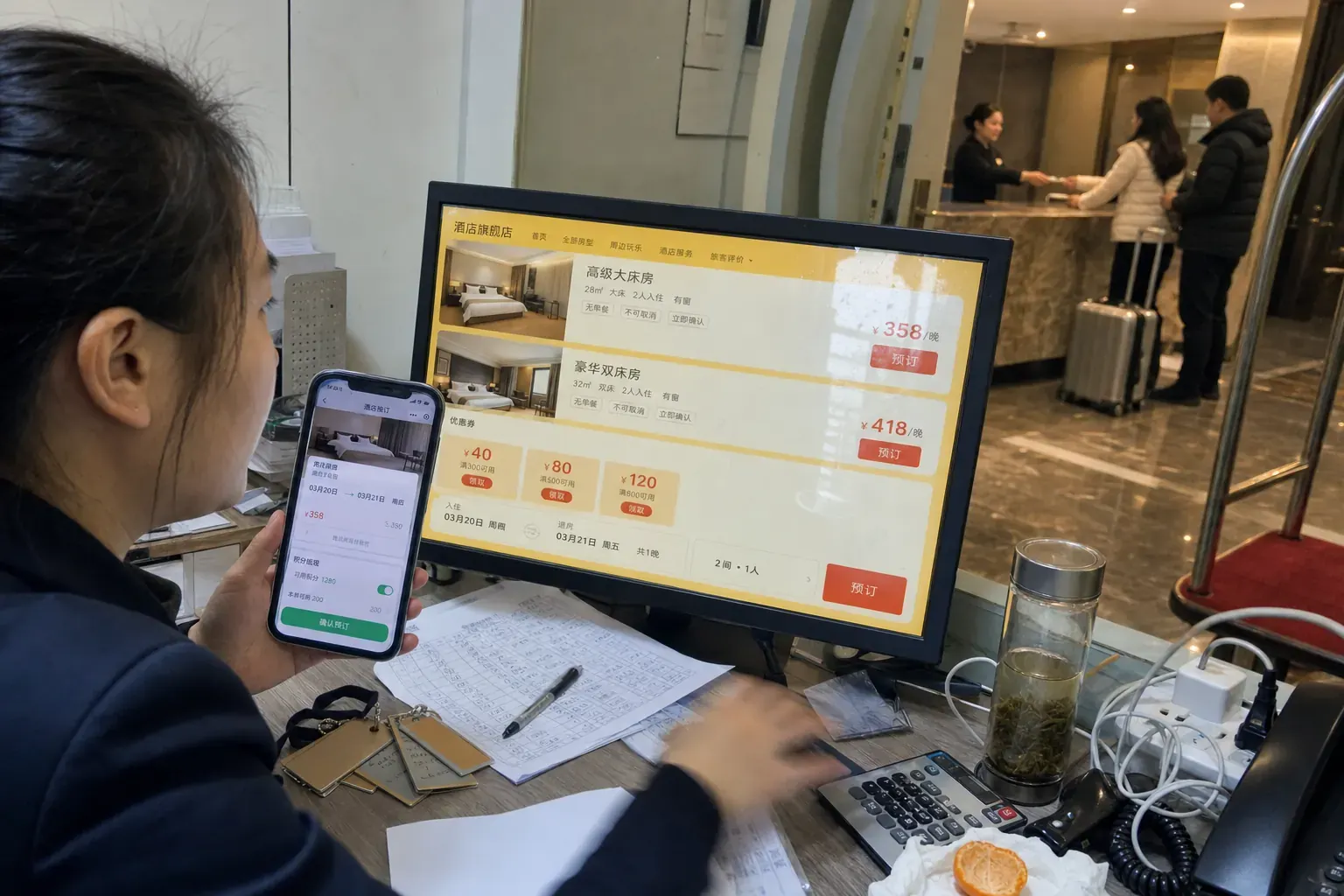
Fliggy, Alibaba’s travel platform, is the one place a hotel group can open a store of its own. It’s the marketplace part of this category, and it does publish its fees.
Fliggy’s 2026 fee table for international merchants sets a 10% software service fee on calendar room bookings and 4.5% to 5.5% on hotel packages. The annual fee is 21,000 RMB. The deposit is 50,000 RMB for a single hotel and 140,000 RMB for other merchants selling calendar rooms. Source: Fliggy (飞猪), 2026 fee table for international merchants, November 2025. https://rule.fliggy.hk/search?ruleId=20008819&type=content
Marriott went in through a joint venture.
Alibaba and Marriott formed a joint venture in August 2017 to run Marriott’s Chinese-language channels, its Fliggy flagship store among them, and linked Marriott’s loyalty programs to Alibaba’s 88 membership. Source: People’s Political Consultative Daily (人民政协报) website, August 2017. https://www.rmzxw.com.cn/c/2017-08-08/1706344.shtml
The store sells rooms the way Tmall sells sneakers. During Double 11, China’s biggest shopping festival, travelers buy vouchers now and pick dates later.
Fliggy opened its 2026 Double 11 sale on October 15. Marriott sold a three-night voucher from 259 RMB a night, and the stays count toward member points and nights. Source: DoNews, October 2026. https://www.donews.com/news/detail/4/6741778.html
Douyin sells hotel stays through short video and livestreams. Its main-app rate sits below Fliggy’s room rate.
Douyin charges an 8% software service fee on hotel orders in its main app. From August 10, 2026, hotel orders that arrive through Doubao, ByteDance’s AI assistant, pay 11.4% plus a 0.6% payment fee. Source: China News Service, August 2026. https://www.chinanews.com.cn/cj/2026/08-14/10677420.shtml
Meituan publishes no hotel rate we could find. Marriott treats it as a place to recruit members.
Marriott Bonvoy and Meituan launched a joint membership on May 28, 2025. Meituan and Dianping members can match their tier to a Bonvoy tier. Source: Jiemian News (界面新闻), May 2025. https://www.jiemian.com/article/12837673.html
Before any of those bookings comes the looking. A lot of it happens on Xiaohongshu (RedNote).
Xiaohongshu counts more than 230 million monthly active users with an interest in travel. Source: China Daily, reporting Xiaohongshu’s 2026 travel summit, May 2026. https://ex.chinadaily.com.cn/exchange/partners/82/rss/channel/cn/columns/sz8srm/stories/WS69fc221aa310942cc49ab047.html
A business account on Xiaohongshu costs 600 RMB to verify, and 600 RMB a year to re-verify. Source: Xiaohongshu Juguang Help Center (小红书聚光帮助中心), October 2026. https://ad.xiaohongshu.com/next_help/docs/195c5fe505c71b4b0335a2fe0d61d8e0
The creator posts that fill those searches are a content job. That work sits with TheRedScroll, the group’s China social media agency.
WeChat is the direct channel. A mini programme takes the booking and the enrollment with no platform in between, and the account is cheap to open.
An overseas entity pays a one-off review fee of US$99 for each WeChat verification application. Source: WeChat Open Community (微信开放社区), June 2025. https://developers.weixin.qq.com/community/develop/article/doc/000e64388c0f107faf739efcd66813
Building the mini programme itself is a job for ChinaWebFoundry, the group’s China web and hosting practice.
Then the part a hotel group owns outright.
About 68% of Marriott’s hotel room nights worldwide were booked by loyalty program members in 2025. Marriott had 684 properties in Greater China at year-end. Source: Marriott International, annual report on Form 10-K, February 2026. https://www.sec.gov/Archives/edgar/data/1048286/000104828626000007/mar-20251231.htm
Marriott Bonvoy ended 2025 with nearly 271 million members, after adding about 43 million in the year. Source: Marriott International, fourth-quarter 2025 results, February 2026. https://www.sec.gov/Archives/edgar/data/1048286/000104828626000005/mar-2025q4xex99earningsrel.htm
The rules: a freed room rate and a border for guest data
The fees are the easy part. The rules took more reading.
China’s cross-border retail import list is what lets a foreign brand sell through Tmall Global, JD Worldwide or a Douyin cross-border store without a Chinese company. It’s a list of physical goods.
The cross-border retail import list is a schedule of goods by tariff line, last expanded in the 2019 edition. Source: Ministry of Finance (财政部) and 12 other departments, Announcement 2019 No. 96, December 2019. https://gss.mof.gov.cn/gzdt/zhengcefabu/201912/t20191227_3451448.htm
A room night has no tariff line. A hotel sells a service, and the service is booked on travel platforms.
Fliggy sets its own gate. No trademark, no flagship.
Fliggy doesn’t accept a store application from a brand without a trademark registration or filing receipt. A flagship store runs on the merchant’s own brand or an exclusive authorization, one per brand. Source: Fliggy, 2026 entry standards for international merchants, November 2025. https://rule.fliggy.hk/search?ruleId=20008821&type=content
The biggest rule change of the year came from the market regulator, and it went the hotels’ way.
On July 25, 2026, the State Administration for Market Regulation fined Ctrip a total of 5.179 billion RMB for abusing its dominant position. It found Ctrip had required top-tier hotels to work with it exclusively and had forced other hotels to give it the lowest price anywhere online. Ctrip was ordered to stop. Source: People’s Daily (人民日报), via Guangming Online (光明网), July 2026. https://m.gmw.cn/2026-07/25/content_1304537769.htm
Ctrip’s parent says it has changed how it works.
Trip.com Group reported second-quarter 2026 accommodation revenue of 6.6 billion RMB, up 6%, partly offset by a contra-revenue imposed by the regulator. It cited operational adjustments to meet compliance standards. Source: Trip.com Group, second-quarter 2026 results, September 2026. https://www.sec.gov/Archives/edgar/data/0001269238/000119312526392473/d167816dex991.htm
For a hotel group, that hands the room rate back. The best price can now sit in the group’s own app or mini programme, where the member is.
Guest data is the last constraint, and it cuts two ways.
Personal data that has to leave China to conclude or perform a contract with the individual, hotel booking included, is exempt from a security assessment, a standard contract and certification. Source: Cyberspace Administration of China (国家网信办), Provisions on Promoting and Regulating Cross-Border Data Flows, article 5, March 2024. https://www.cac.gov.cn/2024-03/22/c_1712776611775634.htm
A person in China booking a hotel in China doesn’t fall under that exemption. The hotel company has to pass a security assessment, sign a standard contract or get certified before sending that data abroad. Source: Cyberspace Administration of China, data export policy Q&A, October 2025. https://www.cac.gov.cn/2025-10/31/c_1763633376984070.htm
So a Shanghai guest booking your Paris hotel is covered. The same guest booking your Shanghai hotel, with the record landing in a head-office database, needs one of those three routes first. The individual’s separate consent is required either way.
What a booking costs, and how long the sale takes
Nobody publishes a cost per qualified lead for hotels in China. The honest unit is the booking, and the commission is its price.
Take a 1,000 RMB room night. On our arithmetic, Douyin’s main app keeps 80 RMB and Fliggy keeps 100 RMB. At the rate the Xi’an owner reported, Ctrip keeps 150 RMB. A member who books in your mini programme next time pays none of the three.
So the first stay is the acquisition cost. The money is in the second one.
How long does it take? We found no dated figure for how far ahead Chinese travelers book. The closest thing to a sales cycle is the status challenge, which Marriott runs on Fliggy.
In October 2026, Marriott offered eligible Fliggy members a 120-day platinum trial. Guests who stay eight nights inside the 120 days keep the tier for a calendar year. Only stays booked in Marriott’s Fliggy flagship store counted. Source: Sina Finance (新浪财经), October 2026. https://cj.sina.com.cn/articles/view/1644983660/620c756c02001wgiu
Four months and eight nights to turn a deal hunter into an elite member. Plan the budget around that.
The verdict: rent the reach, enroll the guest
Ctrip comes first because the travelers are there. You can’t skip it, and you shouldn’t let it be the whole plan. Treat its commission as media spend that buys a first stay.
Open the Fliggy flagship next. It’s a storefront under your own trademark. It sells vouchers during the shopping festivals, and its stays can feed your own program (Marriott’s do).
Then put the member rate in your own channel. The July ruling makes room for that. Our campaigns team plans the festival moments that fill a store like that. The work is project-based and quoted after the first call.
What our Marriott work shows, and what it doesn’t
We ran Marriott’s first Tmall Super Brand Day campaign. The hero offer was a black card with privileges across Marriott’s hotels, a membership sold like merchandise. It delivered eight-figure RMB GMV on the day and six-figure Bonvoy enrollments in 24 hours (published case figures).
Look at the second number. Sales like that last a day. Those members are still Marriott’s.
What the case doesn’t show: a cost per enrollment, or how many of those new members stayed again. The case page publishes neither, so neither appears here. It was also one day, for a group with 684 properties in Greater China. A 30-hotel group shouldn’t expect the same line.
Where to start
Get the trademark paperwork in order first. Fliggy won’t open a flagship without a registration or a filing receipt. Then decide who runs the store day to day. If that’s a local operator, Compass, our partner directory, is where we start the shortlist.
FAQ
Can a foreign hotel group sell rooms on Tmall Global?
No. Tmall Global sells goods that sit on China’s cross-border retail import list, and a room night isn’t on it. Hotels sell on Fliggy, Alibaba’s travel platform, where a group can open a flagship store under its own trademark. Fliggy’s 2026 fee table charges international merchants 10% on calendar room bookings.
What commission do Chinese booking platforms charge hotels?
Fliggy publishes 10% on calendar rooms and 4.5% to 5.5% on packages. Douyin charges 8% in its main app, more through Doubao. Ctrip publishes no rate card we could find. A Yunnan trade group told China News Service in May 2026 that commissions run 12% to 18%, and one top-tier hotel owner said 15%.
Can a hotel group send Chinese guests’ data to its head office?
For a guest in China booking a hotel abroad, yes. That transfer is exempt under the 2024 cross-border data rules, though separate consent still applies. For a guest in China booking a hotel in China, the regulator said in October 2025 the exemption doesn’t apply. The group needs a security assessment, a standard contract or certification.
Talk to us about your hotel group’s Fliggy store and member campaign in China.
Updated November 25, 2026
Working on China? Let's grab a coffee.
Tell us where you are now and where you want to get to.