Samsonite entered China in 1997 by buying its Hong Kong distributor and setting up a joint venture in Ningbo. The main brand then sold only offline for 17 years, until its JD and Tmall flagships opened in 2014 and 2015. China net sales peaked at $306.1 million in 2019 and were about $283.9 million in 2025, roughly 8% of the group.
In 1997 Samsonite acquired its former distributor in Hong Kong and established a joint venture in mainland China, with operations in Ningbo. The Chinese business later became a wholly owned subsidiary. Source: Samsonite International S.A., global offering prospectus, June 2011. https://corporate.samsonite.com/on/demandware.static/-/Sites-InvestorRelations-Library/default/dwa68533ea/PDF/announcements/2011/20110602100852_Samsonite_Final_Prospectus_en.pdf
This teardown is for luggage and bag brands working out how to enter China and how fast to move online. Samsonite is useful because it has been listed in Hong Kong since 2011 and reports China net sales as its own line, year after year. Few brands in the category publish that.
Figures come from Samsonite’s annual and interim reports and dated Chinese reporting, checked on November 12, 2026. Where a line is our reading rather than the record, we say so. Samsonite has no commercial tie to our group.
Where Samsonite stands in China today
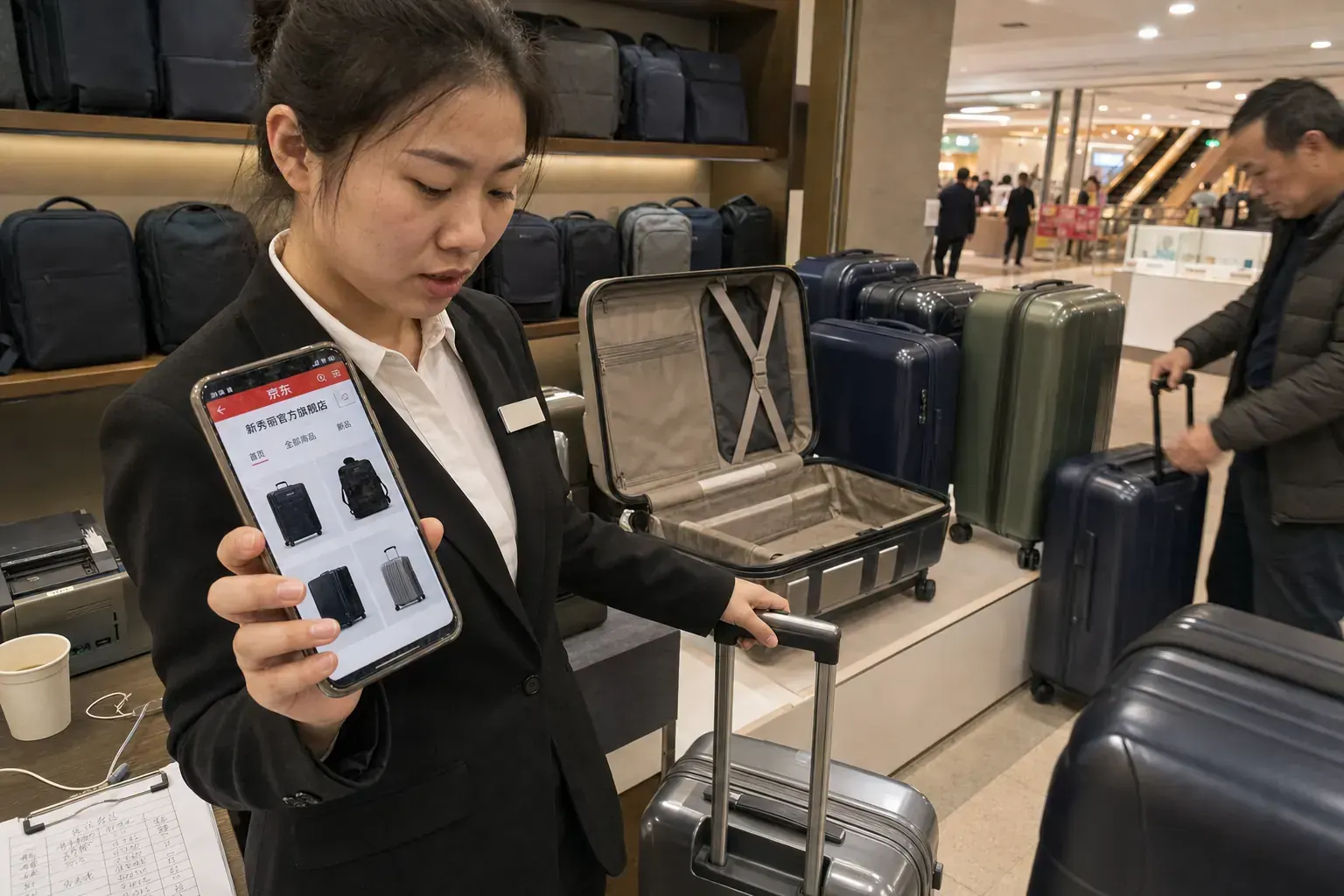
The JD flagship, 新秀丽官方旗舰店, is live. On November 12, 2026 it listed 862 items across 36 pages: hard-shell suitcases, laptop backpacks, crossbody bags, toiletry kits and stretch luggage covers. JD’s store panel scored it 9.8 for user reviews, 9.8 for delivery, 9.3 for after-sales and 10.0 for customer service. Prices and review counts didn’t load for a logged-out visitor, so we don’t quote them.
The Tmall flagship has been open since 2015; its pages sit behind a login, so we didn’t count it. Tumi and American Tourister sell in China too.
Samsonite has stores in more than 170 large and medium-sized Chinese cities, with over 800 points of sale in department stores, shopping malls and airports. Besides its main brand, it has brought TUMI and American Tourister to the Chinese market. Source: Yicai Global (第一财经), December 2023. https://www.yicaiglobal.com/news/worlds-biggest-luggage-maker-samsonite-gains-new-momentum-in-china-as-tourism-recovers
China is no longer shrinking. Net sales rose 14.3% in the first half of 2026, and direct online sales grew faster than the business as a whole.
For the six months ended June 30, 2026, net sales in China increased by US$19.6 million, or 14.3% (+8.2% constant currency), fueled by a US$5.9 million, or 20.5%, increase in DTC e-commerce. Source: Samsonite Group S.A., 2026 Interim Report, August 2026. https://corporate.samsonite.com/on/demandware.static/-/Sites-InvestorRelations-Library/default/dw3917699f/PDF/reports/2026/E_Samsonite%202026%20Interim%20Report.pdf
How Samsonite entered China, step by step
| Date | What happened | Where it is recorded |
|---|---|---|
| 1997 | Hong Kong distributor bought; mainland joint venture set up in Ningbo | 2011 prospectus |
| End of 2010 | 719 points of sale in China | 2011 prospectus |
| June 2011 | Listing in Hong Kong | 2011 prospectus |
| October 2014 | Samsonite flagship opens on JD | China Business Network |
| April 23, 2015 | First Tmall flagship launched in Shanghai | Samsonite press release |
| 2020 | China net sales fall 45.5% | 2020 Annual Report |
| 2023 | China net sales up 78.7% as travel reopens | 2023 Annual Report |
| First half of 2026 | China net sales up 14.3% | 2026 Interim Report |
The order matters. For its first 17 years in the mainland, the Samsonite brand sold offline, through 719 points of sale by the end of 2010. American Tourister, the cheaper brand, tested ecommerce first.
American Tourister sold online for five years before Samsonite put its main brand online. The official flagships opened on JD in October 2014 and on Tmall in April 2015. By 2017, ecommerce was 18% of Samsonite’s China sales. Source: China Business Network (中国经营网), via Sina Finance (新浪财经), June 2018. http://finance.sina.com.cn/roll/2018-06-05/doc-ihcqccin5186376.shtml
Buying the distributor first, and what that implied
The prospectus doesn’t name the joint venture partner or the split. What it records is the move: Samsonite took out the middleman in Hong Kong and put its own company on the mainland in the same year.
Buying out a distributor costs more up front than signing one. Our reading, not the company’s: it also handed Samsonite the price list, the counter contracts and the sales data from day one. Fourteen years later it listed in Hong Kong and could report China as its own line. Not every brand that enters through a distributor can say that.
And Ningbo was never a big factory. The 2011 prospectus lists it as “an office and small warehouse,” on land in Beilun district. Samsonite’s own plants were in Belgium, Hungary and India.
The early numbers grew fast.
| Year | China net sales (US$ million) | Change |
|---|---|---|
| 2008 | 60.5 | |
| 2009 | 66.4 | +9.7% |
| 2010 | 91.8 | +38.4% |
| 2011 | 144.6 | +57.4% |
| 2012 | 178.0 | +23.1% |
| 2019 | 306.1 | |
| 2020 | 166.8 | -45.5% |
| 2022 | 166.5 | |
| 2023 | 297.6 | +78.7% |
| 2024 | 291.6 | -2.0% |
| 2025 | 283.9 | -2.6% |
China net sales were US$60.5 million in 2008, US$66.4 million in 2009 and US$91.8 million in 2010, with 719 points of sale in China at the end of 2010. Source: Samsonite International S.A., global offering prospectus, June 2011. https://corporate.samsonite.com/on/demandware.static/-/Sites-InvestorRelations-Library/default/dwa68533ea/PDF/announcements/2011/20110602100852_Samsonite_Final_Prospectus_en.pdf
China net sales were US$144.6 million in 2011 and US$178.0 million in 2012, up 23.1%. Group net sales were US$1,771.7 million in 2012. Source: Samsonite International S.A., 2012 Annual Report, March 2013. https://corporate.samsonite.com/on/demandware.static/-/Sites-InvestorRelations-Library/default/dw874607b0/PDF/reports/2012/20130428204656_E%20-%202012%20Annual%20Report.pdf
The 2009 to 2011 changes are ours, worked from the filed figures. In 2012, China was about 10% of group sales.
What the China entry visibly cost
No filing gives a China launch budget. Samsonite doesn’t break out China marketing or rent either, so any answer here is partial.
Here’s what is on the record. Group marketing ran at $189.5 million in 2019. When travel stopped in 2020, Samsonite cut it to $73.3 million, and China lost $139.3 million of sales in the same year.
Net sales in China decreased by US$139.3 million, or 45.5% (-46.0% constant currency), in 2020. The Group spent US$73.3 million on marketing in 2020, compared to US$189.5 million in 2019. Source: Samsonite International S.A., 2020 Annual Report, March 2021. https://corporate.samsonite.com/on/demandware.static/-/Sites-InvestorRelations-Library/default/dwbd3c635f/PDF/reports/2020/20210415085325_E%20Samsonite%202020%20Annual%20Report%20(FINAL%202021-04-16).pdf
A brand coming in now doesn’t have to buy a distributor or open a Ningbo office to test demand. A cross-border store does that job with no Chinese company. On our “Bags and luggage” rows, a Tmall Global store asks for a 50,000 RMB deposit, a 60,000 RMB annual fee and a 5% commission; JD Worldwide asks for 35,500 RMB, no annual fee and 6%. Those are TheChinaPath calculator data, November 2026, not Samsonite’s costs. The Tmall Global setup and running cost calculator works through them with “Bags and luggage” selected.
Where Samsonite lost time, and what it cost
Three stretches stand out. A fourth cost is still running.
The first is ecommerce. The main brand reached JD in late 2014, five years after American Tourister went online. By then growth had slowed. The China Business Network’s tally of China sales growth runs from 57.4% in 2011 down to 13.0% in 2015, -0.4% in 2016 and 7.2% in 2017. We can’t prove the late start caused the slowdown. But the timing lines up.
The second is travel. Luggage sells when people fly, so 2020 took out nearly half of China sales in one year. The rebound waited until 2023, once restrictions lifted.
Net sales in China increased by US$131.1 million, or 78.7% (+88.4% constant currency), to US$297.6 million in 2023, from US$166.5 million in 2022. Source: Samsonite International S.A., 2023 Annual Report, March 2024. https://corporate.samsonite.com/on/demandware.static/-/Sites-InvestorRelations-Library/default/dwc664e9bc/PDF/reports/2023/E_Samsonite%202023%20Annual%20Report.pdf
The third is the last two years. China slipped in 2024, and the company called that “a good outcome considering soft Chinese consumer sentiment.” It slipped again in 2025.
Net sales in China decreased by US$6.0 million, or 2.0%, in 2024. Source: Samsonite Group S.A., 2024 annual results announcement, March 2025. https://corporate.samsonite.com/on/demandware.static/-/Sites-InvestorRelations-Library/default/dwe9d026a4/PDF/announcements/2025/Mar%202025/E%202024%20Annual%20Results%20Announcement%20(2025-03-12%20FINAL).pdf
Net sales in China decreased by US$7.7 million, or 2.6%, in 2025. Group net sales were US$3,497.6 million. Source: Samsonite Group S.A., 2025 Annual Report, March 2026. https://corporate.samsonite.com/on/demandware.static/-/Sites-InvestorRelations-Library/default/dwdd30714d/PDF/reports/2025/E_Samsonite%202025%20Annual%20Report.pdf
On our arithmetic, 2025 China sales were about $283.9 million, 7% below 2019 and about 8% of the group. Six years on, China still hasn’t caught up with its pre-pandemic peak.
That fourth cost is counterfeits, and it’s close to home. In 2024, police in Ningbo’s Beilun district, home to the China office in the 2011 prospectus, closed a ring that sold fake Samsonite bags across seven provinces.
The ring ran 10 counterfeiting sites, used 25 online shops, had sold more than 8,000 bags and involved more than 13 million RMB. From August 2021 it bought parts from the supply chain around Samsonite’s authorised contract factories. Source: TMTPost (钛媒体), via Sina Finance (新浪财经), May 2024. https://finance.sina.cn/stock/relnews/hk/2024-05-15/detail-inavinqn2631322.d.html
What another luggage brand should copy, and what to avoid
Copy the control. Samsonite owned its China business early. Our view: that’s a big part of why it can tell investors, line by line, what China sells. If a local distributor is the only realistic start, write the reporting and the price rules into the contract. Our China distribution service handles that contract work.
Copy the second brand. American Tourister, the cheaper label, went online years ahead of the main brand. Our reading: that let Samsonite learn ecommerce without undercutting its own counter prices.
Don’t copy the wait. Seventeen years between entry and a main-brand flagship is a long time to leave the online shelf to others. A brand starting now should open its online store in the same year as its first counter, or before it.
Plan for fakes before launch. In the Ningbo case, the parts came from suppliers around Samsonite’s own contract factories. If you manufacture in China, treat your supplier base as the likeliest leak, and register every mark you sell under before the first shipment. The Allbirds teardown shows the other route, where a brand handed China to a licensee instead.
Questions about Samsonite in China
When did Samsonite enter China?
In 1997. That year it bought its former distributor in Hong Kong and set up a joint venture in mainland China, with operations in Ningbo, according to its 2011 listing prospectus. The joint venture later became wholly owned. The JD flagship opened in October 2014 and the first Tmall flagship in April 2015.
How big is China for Samsonite?
China net sales were about $283.9 million in 2025, down 2.6% on the year and roughly 8% of the group’s $3.5 billion. The best year on record is 2019, at $306.1 million. Sales rose 14.3% in the first half of 2026, helped by a 20.5% jump in direct online sales.
Does Samsonite make its suitcases in China?
Its 2011 prospectus lists owned plants in Belgium, Hungary and India and describes the Ningbo site as an office and small warehouse. A 2024 Ningbo police case refers to Samsonite’s authorised contract factories in China, whose parts suppliers the counterfeiters used.
Which Samsonite brands are sold in China?
Samsonite, Tumi and American Tourister are all sold there, according to Yicai in December 2023. American Tourister went online first, about five years before the main brand opened its JD and Tmall flagships in 2014 and 2015.
Plan your China entry channel by channel, before you sign a distributor.
Updated November 12, 2026
Working on China? Let's grab a coffee.
Tell us where you are now and where you want to get to.