Start with the provider that can treat the patient
Telehealth in China cannot use the cross-border retail-import route for physical goods. The same applies to wellness services. Clinical care needs an authorized medical provider and an eligible visit. Nonmedical wellness needs a defined service scope. Start with those limits, then choose patient channels and measure what it costs to reach a completed appointment.
Rules and sources checked October 24, 2026.
A Tmall Global store cannot supply a clinical license. Establish who delivers the service and who handles an inquiry that needs an in-person appointment before buying media.
Telehealth in China: which channels to budget for
Monthly costs depend on contracts and staffing. The sources checked provide no comparable price sheet for foreign telehealth businesses.
| Channel to assess | What it can reach | Monthly cost components | Cost per qualified inquiry | Contact access and clinical records |
|---|---|---|---|---|
| Medical platforms and hospital portals | People seeking a clinician or a follow-up | Contracted platform charges; intake staff | Measure from the provider’s own funnel | Contract governs contact access; provider retains clinical duties |
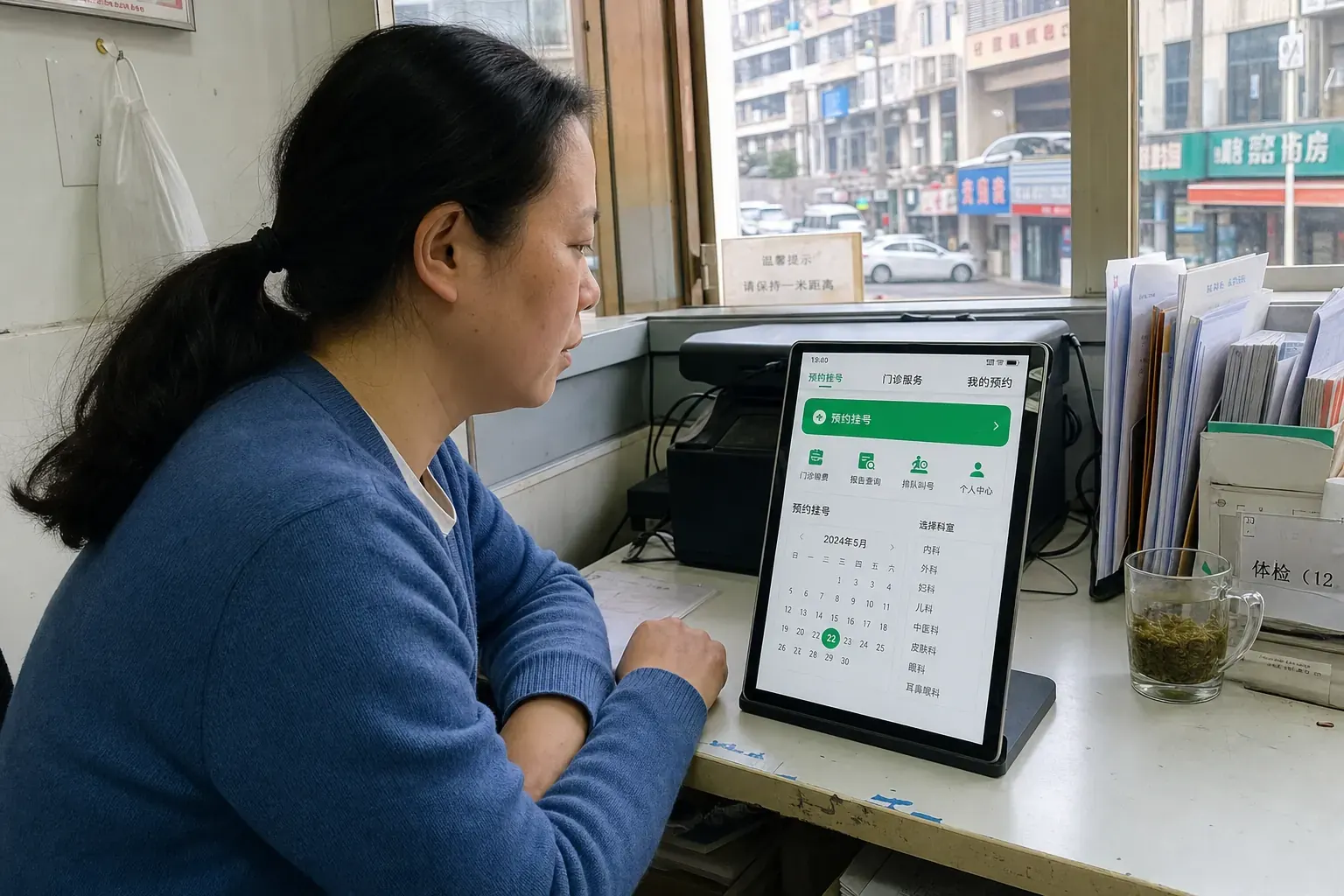
| WeChat appointment mini program | People booking or returning to the provider | Software support; appointment administration | Running cost divided by eligible inquiries | Verify institution account control and access rights |
| Douyin and Xiaohongshu (RedNote) | People researching symptoms or wellness services | Approved media; content review; inquiry handling | Count eligible patients separately | Platform controls initial reach; consent governs onward contact |
| Employers and benefits intermediaries | Staff covered by specified clinical or nonmedical services | Account management; procurement work | Calculate per signed employer and activated patient | Contract defines service access and permitted reporting |
| Offline clinics and events | Local residents and prospective institutional buyers | Venue or clinic overhead; staff time | Attribute appointments separately from event attendance | Treating institution holds the care relationship |
Confirm platform eligibility in writing before committing money. A distributor contact does not establish a medical institution’s authorization. Any intermediary agreement also needs a review of referral payments; the 2022 rules prohibit patient referrals made for medical staff’s personal gain.
Specify permitted access to appointment data separately from marketing contacts. The provider retains its clinical responsibilities.
The license limits the offer and the advertisement
An overseas consultation product may need a different intake process. Start with the medical institution’s permitted activities. Internet diagnosis rules require the clinician to assess whether a patient qualifies for a repeat visit; a new symptom can send that patient back to an in-person service.
Patients must provide records with a clear diagnosis. If the clinician judges the visit to be a first diagnosis, or otherwise unsuitable for internet care, the online consultation must stop and the patient must be directed to a physical medical institution. Source: National Health Commission (国家卫生健康委员会) and National Administration of Traditional Chinese Medicine, February 2022 rules, republished by CHIMA, June 2022, article 18. https://www.chima.org.cn/Html/News/Articles/15589.html
A qualifying operator can consider the foreign-owned hospital pilot. Its hospital approvals do not authorize an offshore app to treat patients. A mental-health business needs particular care when reading its exclusions. They do not amount to a blanket ban on all mental health outpatient care.
The pilot permits qualifying wholly foreign-owned tertiary hospitals in specified locations. It excludes psychiatric hospitals and psychiatric inpatient treatment, and requires electronic-medical-record servers in China. Source: National Health Commission and other departments, November 2024 work plan, government republication December 2024. https://app.www.gov.cn/govdata/gov/202412/01/522300/article.html
Nonmedical wellness should describe the service it actually provides. Write separate offers and intake procedures for a sleep-education class and a psychiatric consultation. Calling treatment “wellness” does not settle its regulatory classification.
Medical promotion also has a review boundary. A neutral appointment page can be treated differently from a promotional video. Putting a booking link beside disease education can change how the page is classified.
The 2025 guide distinguishes neutral institution information from medical advertising. Health education that promotes a specific medical service, including through related booking links, can be disguised advertising. Source: State Administration for Market Regulation (国家市场监督管理总局), National Health Commission, and National Administration of Traditional Chinese Medicine, July 2025. https://www.samr.gov.cn/zt/ndzt/2025n/ggf/zyfb/art/2025/art_8daf3ed052d749fcbee6eb3909b29e10.html
Internet medical advertising subject to review must receive that review before publication. Health education cannot be used to disguise medical advertising. Source: State Administration for Market Regulation, Order 72, February 2023, published March 2023, articles 7 and 8. https://www.samr.gov.cn/zw/zfxxgk/fdzdgknr/fgs/art/2023/art_d93a579afd45413e8576e4623fab348f.html
Record storage continues after a campaign ends.
| Clinical record | Minimum retention under the 2022 rules |
|---|---|
| Internet consultation medical record | 15 years |
| Consultation process records, including text and audiovisual material | 3 years |
Article 19 sets the 15-year and 3-year minimums above. Source: NHC and SATCM, February 2022 rules, CHIMA republication, June 2022. https://www.chima.org.cn/Html/News/Articles/15589.html
Limit what enters the marketing database. A booking request can contain health information before the patient ever meets a clinician.
Medical and health information is sensitive personal information under China’s Personal Information Protection Law. Its processing requires a specific purpose, sufficient necessity, and strict safeguards; separate consent requirements apply. Overseas transfers have additional conditions. Source: National People’s Congress (全国人民代表大会), August 2021, articles 28 to 30 and 38 to 39, text published by the Cyberspace Administration of China. https://www.cac.gov.cn/2021-08/20/c_1631050028355286.htm
Map overseas access before connecting a customer-management system. The transfer review must cover the applicable rules beyond consent.
Count completed visits before judging acquisition cost
For planning, define a qualified inquiry as a consenting person the provider can legally serve, whose request fits its scope and who can reach an available appointment. The clinician determines eligibility for care; reception staff do not diagnose. Count attendance separately.
TheChinaPath calculation below uses hypothetical inputs, not market benchmarks or agency prices. Assume a provider spends 20,000 RMB on permitted media and 10,000 RMB on campaign intake during one month. Assume those are all acquisition costs for this example; add any other acquisition work to your real calculation.
| Illustrative monthly funnel | Count or calculation | Result (RMB) |
|---|---|---|
| Total acquisition spending | 20,000 + 10,000 | 30,000 |
| All inquiries | 200; spending divided by inquiries | 150 each |
| Qualified inquiries | 80; spending divided by qualified inquiries | 375 each |
| Completed appointments | 40; spending divided by attendance | 750 each |
| Lower-attendance case | 20 appointments, same spending | 1,500 each |
Halving attendance doubles the cost per appointment. The 750 RMB figure excludes clinical delivery and other operating costs, including licensing and platform maintenance. Compare it with collected revenue after clinician pay and other delivery costs. Keep forecast repeat visits in a separate scenario until patients return and pay.
Track inquiry-to-appointment days separately from employer or hospital procurement. Use the median and longest cases from your own pipeline; no verified sales-cycle benchmark supports a general range here.
Test the route before increasing the budget
Walk through the authorized provider’s booking flow, including its referral route for an unsuitable online patient. Test one acquisition channel against completed appointments before increasing spending.
A nonmedical wellness offer needs limits that staff can explain. Give them a referral process for anyone asking for diagnosis or treatment. Pause campaigns that bring inquiries the provider cannot serve.
What our SohoMD work can establish
TheChinaPath’s published SohoMD case documents a search program covering 150 keywords for a US telepsychiatry provider. Checked in October 2026, the case does not provide China patient-acquisition costs or mainland clinical authorization.
Its conversion rate is not reported. Budget around the Chinese provider’s permitted activities and contact permissions.
Build the plan around the clinical partner
China market-entry consulting can frame the route and commercial responsibilities. Compass is a commercial partner resource; a listing is not a clinical credential. Check the medical provider’s authorization independently before buying patient leads.
Can an overseas app treat a mainland patient?
The app alone establishes no clinical permission. Identify the authorized medical provider and the scope of care it can deliver. For internet diagnosis, the clinician must check repeat-visit eligibility. The foreign hospital pilot has separate conditions; it does not settle an offshore app’s right to treat someone.
What should a qualified patient inquiry cost?
Use a measured figure from your own campaign. Divide its acquisition spending by inquiries that meet the provider’s agreed criteria, then calculate cost per attended appointment separately. In the hypothetical example above, those figures are 375 RMB and 750 RMB. Neither is a China market average.
Can health education include a booking link?
The 2025 guide treats health education with links to related medical services as a possible form of disguised advertising. A neutral institution information page has different conditions. Have the actual page classified before publication, including its links. A useful article can still become medical promotion because of its booking path.
Updated October 24, 2026
Working on China? Let's grab a coffee.
Tell us where you are now and where you want to get to.