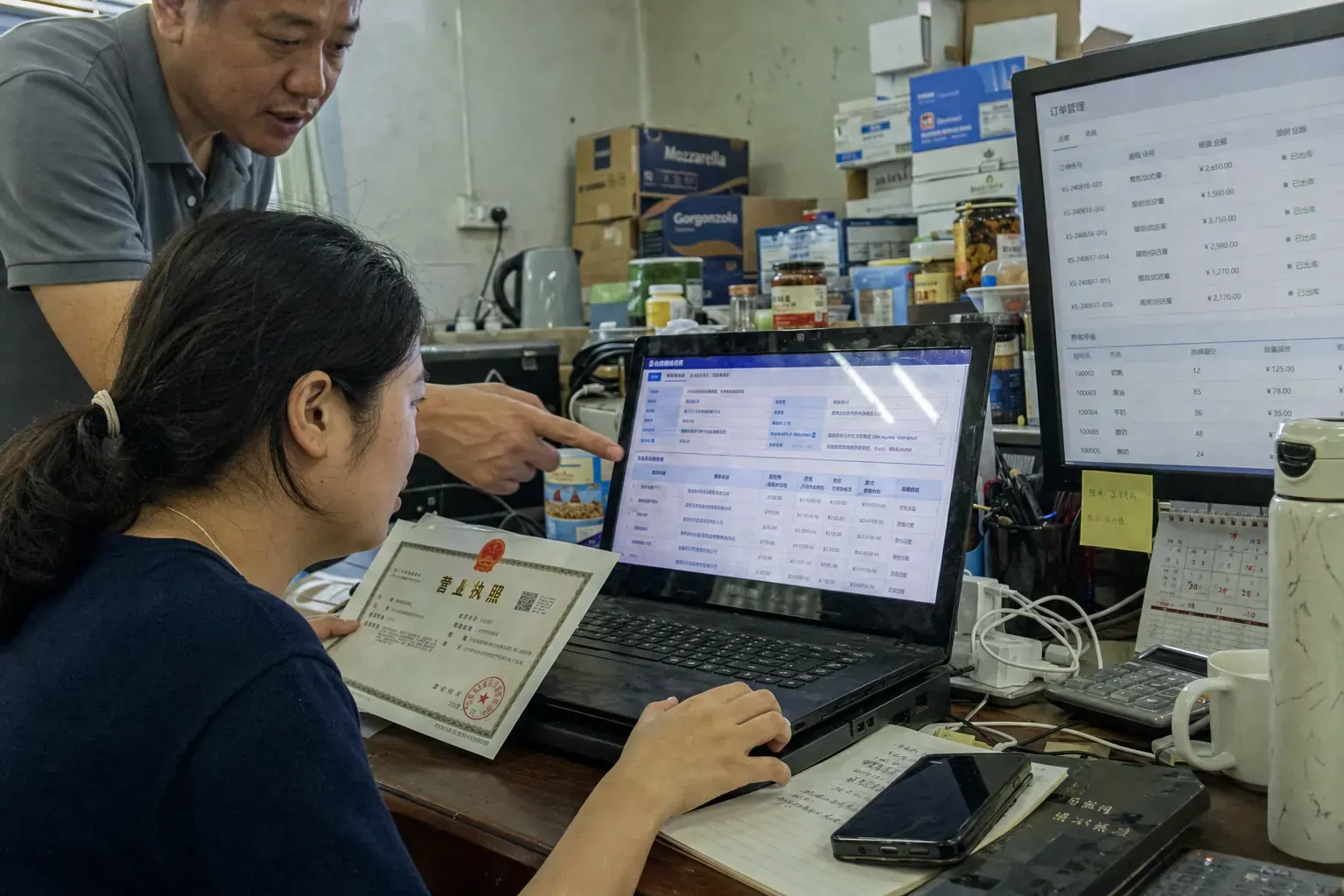
To verify a Chinese company, pull its record from the national credit system (GSXT) and from one commercial database, Qichacha or Tianyancha. Then read eight fields: registration date, registered and paid-in capital, business scope, shareholders, branches, court judgments, the dishonest-debtor list and administrative penalties. A candidate that fails here doesn’t need a call.
You met the company at a fair. You have a business card and a WeChat contact. Neither is a legal fact.
The registry is. It holds the date the company was set up, who owns it, what it may sell and whether a court has already chased it for money. It also holds the legal name in Chinese and the unified social credit code (统一社会信用代码), the one identifier that follows the company through every record below. Get the code first. Put it in the contract.
Plenty of the companies you’ll meet are young.
China registered 9.5 million new enterprises in 2025, out of 25.745 million new market entities of all kinds. Source: Science and Technology Daily (科技日报), citing the State Administration for Market Regulation (市场监管总局), February 2026. https://www.stdaily.com/web/gdxw/2026-02/26/content_477158.html
Every rule cited below was checked against its source on September 24, 2026. A printable version of the eight checks, with a pass or stop box for each, is at the Chinese company report checklist.
GSXT or Qichacha: where to verify a Chinese company
GSXT is the National Enterprise Credit Information Publicity System (国家企业信用信息公示系统), run by the market regulator. It’s the legal record. The regulator posts registration data and its own penalties there, and other departments add the licenses they grant. The company files its own annual report there in the first half of each year.
The market regulator publishes registration and filing data, chattel mortgages, equity pledges and administrative penalties. Companies file an annual report between January 1 and June 30 each year, and disclose changes such as paid-in capital within 20 working days. Source: State Administration for Market Regulation (市场监管总局), Interim Regulation on Enterprise Information Disclosure (企业信息公示暂行条例), articles 6, 8 and 10, as revised March 10, 2024. https://www.samr.gov.cn/xyjgs/flfg/art/2024/art_be55c2e3a54a43e5ab12794c9dc87600.html
Getting in is the hard part, from abroad at least. When we tried from outside mainland China on September 24, 2026, GSXT refused the request and asked for a different IP address or a real-name login. The Supreme People’s Court’s enforcement site refused too. China Judgements Online loaded, then said search and download need a registered account.
That’s the job Qichacha (企查查) and Tianyancha (天眼查) do. They copy the registry and the court systems onto one page per company and keep the change history, so a former name or a departed shareholder stays visible. Use one, as a copy. When it disagrees with GSXT, GSXT wins. The “risk score” at the top is the database’s own model, not an official rating.
Reading the license and the ownership
Registration date (成立日期). Set it next to the story you were told. A company that has “imported wine for ten years” and was set up in 2025 may simply be a new vehicle for an old team. Ask.
Check the status line next. You want 存续 or 在业 (active), never 吊销 (license revoked) or 注销 (deregistered).
Look at the annual reports too. A company set up in 2021 should show one for every year since. Gaps are how firms end up on the abnormal operations list.
A company that misses its annual report goes on the abnormal operations list. One that misses two years in a row and can’t be reached at its registered address has its business license revoked. Source: State Administration for Market Regulation (市场监管总局), 企业信息公示暂行条例, article 18, as revised March 10, 2024. https://www.samr.gov.cn/xyjgs/flfg/art/2024/art_be55c2e3a54a43e5ab12794c9dc87600.html
Registered and paid-in capital (注册资本, 实缴资本). Registered capital is what the shareholders promised. Paid-in is what they put in. Since July 2024 the gap has a legal deadline.
An LLC’s shareholders must pay in their full subscribed capital within five years of the company’s founding. Companies must publish subscribed and paid-in amounts, method and date on GSXT. Source: PRC Company Law (公司法), 2023 revision, articles 40 and 47, in force July 1, 2024, via the Ministry of Commerce (商务部) policy database. https://policy.mofcom.gov.cn/claw/clawContent.shtml?id=98771
Older companies got a runway, and it ends soon.
Companies registered before June 30, 2024 must bring any remaining subscription period down to five years by June 30, 2027. The registrar flags companies that don’t on GSXT. Source: State Council (国务院), rules on registered capital under the Company Law, July 2024. https://www.gov.cn/yaowen/liebiao/202407/content_6960452.htm
Be wary of 10 million RMB subscribed with nothing paid in, especially when the balance isn’t due until 2050. Paid-in capital tells you what the owners once put at risk. Whether the money is still there is another question.
Business scope (经营范围). The list of what the company may do.
Business scope includes general items and licensed items; a licensed item that needs approval before registration requires the approval documents. Source: State Council (国务院), Regulation on the Registration of Market Entities (市场主体登记管理条例), article 14, in force March 1, 2022, via the Ministry of Commerce (商务部) policy database. https://policy.mofcom.gov.cn/claw/clawContent.shtml?id=90465
Read it against your product. A company that will import your goods itself should list 货物进出口 (import and export of goods). A food distributor needs food sales covered, by a permit or, for prepackaged food only, a filing.
Selling only prepackaged food moved from a license to a filing under article 35 of the Food Safety Law as amended in April 2021. Source: Government of China (中国政府网), explainer on the Food Business Licensing and Filing Measures (食品经营许可和备案管理办法), July 2023. https://www.gov.cn/zhengce//202307/content_6891674.htm
A scope that reads “technology development and consulting” on a company that says it moves cheese is the easiest stop sign on this page.
Now the owners. Match the shareholder names (股东) to the people you met, and if the boss across the table isn’t in the registry, find out who is. An equity pledge (股权出质) means the shares back someone’s loan. It’s registered on GSXT like any other filing, so it’s easy to spot.
Branches (分支机构) are the last field in this half. A distributor that claims offices in Shanghai and Chengdu should show them as branches or subsidiaries, and the difference matters when you sign.
A branch has no legal personality; the company bears its civil liability. Source: PRC Company Law (公司法), 2023 revision, article 13, via the Ministry of Commerce (商务部) policy database. https://policy.mofcom.gov.cn/claw/clawContent.shtml?id=98771
Sign with the legal entity that holds the licenses and the assets, not with a branch office, and not with the sister company whose name happens to be on the invoice.
Reading the court and penalty record
This half is where a company’s history with money shows up.
Court judgments (裁判文书). China Judgements Online (中国裁判文书网) is the Supreme People’s Court’s public archive of rulings. It’s huge, and it has holes that move from year to year.
Courts posted 9.69 million new documents to China Judgements Online in 2024, up 92.73% on 2023. Source: People’s Daily (人民日报), citing the Supreme People’s Court, January 2025. http://cpc.people.com.cn/n1/2025/0108/c64387-40397363.html
Read that figure backward: 2023 posted roughly half as many. A thin record from that year proves very little. And cases closed by mediation aren’t published at all.
Cases closed by mediation are not published online, unless publication is needed to protect the public interest or someone else’s rights. An unpublished case still shows its case number, court, date and the reason it was withheld. Effective judgments go online within seven working days. Source: Supreme People’s Court (最高人民法院), Provisions on Publishing Judgments on the Internet (法释〔2016〕19号), articles 4, 6 and 7, carried by China News Service (中国新闻网), August 2016. https://www.chinanews.com.cn/gn/2016/08-31/7989135.shtml
Read two things in each case: who sued whom, and over what. A distributor suing retailers for unpaid invoices is doing its job. A distributor sued again and again by suppliers in sale-of-goods disputes (买卖合同纠纷) pays its suppliers late, and you’re about to become one.
The dishonest-debtor list (失信被执行人) comes next. It’s the Supreme People’s Court’s blacklist of parties who owe money under a court ruling and didn’t pay. Every court feeds one national database, published through the China Enforcement Information Disclosure site (中国执行信息公开网).
A debtor is listed on one of six grounds, from refusing to pay when able to hiding assets or dropping a settlement. Listings on five of the six grounds run two years, extendable by one to three. A court deletes a listing within three working days once the debt is paid. Source: Supreme People’s Court (最高人民法院), Provisions on Publishing the List of Dishonest Judgment Debtors, 2017 amendment, articles 1, 2 and 10. https://www.court.gov.cn/fabu/xiangqing/37182.html
That deletion clause is the catch. Today’s search covers today. The commercial databases keep past listings, so look there for history.
The list is busy.
2,339,800 listings were added to the dishonest-debtor list in 2025, and 2,669,600 came off through credit repair. Source: Jiemian (界面新闻), reporting a Supreme People’s Court press conference, January 26, 2026. https://www.jiemian.com/article/13933520.html
Two other lists on the same site deserve a look. Search the consumption restriction list (限制消费) for the company and for its legal representative. Look up “enforcement terminated for this round” (终结本次执行) as well. That entry is easy to miss, and it matters: the creditor won, and the court found nothing to seize.
The enforcement site publishes, among other records, the consumption restriction list and cases closed for this round of enforcement. Source: Supreme People’s Court (最高人民法院), June 2018. https://www.court.gov.cn/shenpan/xiangqing/101002.html
Back on GSXT, the last field is administrative penalties (行政处罚). Fines from the market regulator land there, and so do other departments’. They don’t stay long.
A market-regulation penalty is published on GSXT within 20 working days. Penalties that were only a public criticism or a lower-band fine come off after three months; all others come off after three years. Source: State Council Gazette (国务院公报), Provisions on Publicizing Market Regulation Administrative Penalty Information, SAMR Order 45, articles 9 and 13, in force September 1, 2021. https://www.gov.cn/gongbao/content/2021/content_5647362.htm
Read each penalty against your category. A fine for selling expired food, or for misleading labels, tells you how this company treats goods like yours.
Eight fields, and what should stop you
Here’s the whole check on one screen. Keep it open while you read the record.
| Field | Where to find it | What a real distributor’s record shows | What should stop you |
|---|---|---|---|
| Registration date and status | GSXT basic information; annual reports | Active status, an annual report for every year since founding (filed January 1 to June 30) | Revoked or deregistered status, missing annual reports, or a set-up date that contradicts the story |
| Registered and paid-in capital | GSXT annual report and instant disclosures | Paid-in capital on file, any unpaid balance due within five years | Large subscribed capital with nothing paid in and a due date decades away, or a GSXT flag after June 30, 2027 |
| Business scope | GSXT basic information; license and filing records | The activities you need, including 货物进出口 if it imports, and the category permit or filing | A scope with no trading or sales activity, or “our partner holds the license” |
| Shareholders | GSXT shareholder and change records; the database’s history tab | The people you met, stable ownership, no pledged shares | Owners you’ve never heard of, a change of owner in the last few months, or an equity pledge |
| Branches | GSXT branch records; subsidiaries in the database | A branch or subsidiary in each city it claims to cover | “National coverage” with no branch or subsidiary outside one city |
| Court judgments | China Judgements Online; the database’s legal tab | A few cases, mostly as plaintiff collecting receivables | Repeated sale-of-goods suits brought by suppliers |
| Dishonest-debtor list | China Enforcement Information Disclosure site; the database’s history | No current listing, no past listing, no consumption restriction on the legal representative | Any listing, current or past, or a case closed because the court found no assets |
| Administrative penalties | GSXT penalty records; other departments’ records | None in the last three years, or minor ones outside your category | A penalty in your category, such as expired goods or a labeling breach |
What the report can’t tell you, and the call that covers it
The registry has blind spots, and some of them are by design.
It can’t tell you who really controls the company. China now collects beneficial-owner data, and it doesn’t publish it.
Beneficial-owner information is filed through the registration system and passed to the People’s Bank of China. State bodies, and financial and designated non-financial institutions doing anti-money-laundering checks, may obtain it, and must keep it confidential. In force November 1, 2024. Source: State Council Gazette (国务院公报), Measures on Beneficial Owner Information (受益所有人信息管理办法), April 2024. https://www.gov.cn/gongbao/2024/issue_11386/202406/content_6955755.html
Nor does it show disputes settled in mediation, penalties older than three years, or whether the warehouse exists. And it says nothing about sell-out, which is what you’ll care about once your stock is theirs to sell.
So the report becomes your agenda for the first call. Start with a scan of the business license, and match its credit code to the party named in the contract. Bring every judgment you found, by case number, and let them explain each one. If the registry names an owner you haven’t met, ask who that is. Get two brands they carry now and call those brands yourself, without the distributor on the line. Then book the warehouse visit.
The calls and the contract terms that follow are in our guide on how to find a distributor in China. Still unsure a distributor is the right route? Read China distributor vs own store first. Brands that want the search run for them use our distributor sourcing and management work, or start from Compass, our database of China partners we have met.
The printable checklist
It’s one page: the eight fields with a pass or stop box each, plus a line for the credit code. Print one per candidate and fill it in before you book a call: the Chinese company report checklist.
Questions buyers ask
Is Qichacha enough on its own?
For a first screen, usually. It’s still a copy of someone else’s record. Before you sign, check the credit code and the capital figures on GSXT itself, or have a colleague in China pull them for you.
What does it mean if a company is on the dishonest-debtor list?
A court ordered it to pay, and it didn’t, on one of six grounds such as refusing to pay when able or hiding assets. Most grounds carry a two-year listing. A company that pays comes off within three working days, so check past listings in a commercial database too.
How far back does the record go?
Registration data goes back to founding. Market-regulation penalties drop off GSXT after three years, or three months for small fines. Court judgments go back years, but coverage varies by year and mediated cases never appear.
Get a Compass shortlist of vetted distributors for your category
Updated September 24, 2026
Working on China? Let's grab a coffee.
Tell us where you are now and where you want to get to.