Localizing a brand for China starts at the trademark office. File your Latin mark and your Chinese name there before you announce anything; online, it costs 270 RMB a class. Then fix what Chinese law reads: the label on the pack, the product pages, ad copy stripped of “best” and a seven-day return policy.
Updated October 1, 2026. The February 2023 version of this page was a seven-point checklist with no figures and no sources. This one puts the steps in the order Chinese law and the platforms enforce them. It adds the official fees and the cross-border exemption, plus two court cases that show what a late filing costs.
| Step | The rule | Who it binds | Cost |
|---|---|---|---|
| Latin mark and Chinese name | First to file wins | Every route into China | 270 RMB a class online (official fee), about 4 months of examination |
| Chinese label on the pack | Chinese name, maker and contents on the package | General trade; cross-border goods may ship without one | Printing or relabeling, by range |
| Product pages and ad copy | No “national-level,” “highest-level” or “best” | Every platform, every route | Fines of 200,000 to 1,000,000 RMB |
| Returns | Seven days, no reason needed, for goods sold online | Online sales; custom-made and perishable goods are exempt | Buyer pays return shipping unless agreed otherwise |
| Store build and launch content | Chinese store pages and product detail | Tmall Global, JD Worldwide, Douyin | 25,000 RMB in our calculators |
Only the first row is something a competitor can take from you.
Register the name before anyone sees it
China’s trademark system rewards whoever files first. If two companies file the same or a similar mark for the same goods, the earlier application goes through, even if the other company sold under the name for years.
When two applicants file identical or similar marks for the same or similar goods, the trademark office approves the earlier application; a same-day tie goes to the earlier user. Source: China National Intellectual Property Administration (国家知识产权局), Trademark Law (2019 amendment), article 31, July 2019. https://www.cnipa.gov.cn/art/2019/7/30/art_95_28179.html
Filing is cheap. The official fee covers one class and ten goods or services.
An online trademark application costs 270 RMB per class for up to ten items, plus 27 RMB for each extra item. A paper filing costs 300 RMB and 30 RMB. Source: CNIPA Trademark Office (国家知识产权局商标局), fee list in force since July 1, 2019. https://sbj.cnipa.gov.cn/sbj/sbsq/sfbz/
So a brand that files its Latin mark and its Chinese name in, say, three classes pays 1,620 RMB in official fees. Agent fees come on top. Then it waits.
The average examination period for a trademark registration has held at four months. Source: CNIPA, 2026 national work report, January 2026. https://www.cnipa.gov.cn/art/2026/1/7/art_53_203564.html
New Balance found out what waiting costs. It sold in China under the name 新百伦. A Chinese businessman, Zhou Lerong, already owned the registered marks 百伦 and 新百伦, the second approved in January 2008, and sued.
A Guangzhou court ordered New Balance to pay 98 million RMB, half its estimated profit from the name. The Guangdong High People’s Court cut the award to 5 million RMB on June 23, 2016. Source: Yangcheng Evening News (羊城晚报), carried by People’s Daily Online (人民网), June 2016. http://finance.people.com.cn/n1/2016/0624/c1004-28477265.html
Michael Jordan was on the other side of the same problem, and spent four years on it. He began challenging Qiaodan Sports, a Chinese sporting goods company, in 2012. In December 2016 China’s Supreme People’s Court ruled that its registration of 乔丹, the characters for “Jordan,” violated his prior right to his name. The pinyin version, QIAODAN, stayed with the company.
The court ordered the Chinese-character 乔丹 marks re-examined because they harmed Jordan’s prior name right, and upheld the seven cases over the pinyin QIAODAN, in which he held no name right. Source: China National Radio (央广网), December 2016. http://china.cnr.cn/xwwgf/20161208/t20161208_523312598.shtml
The lesson is narrow. Chinese shoppers search for the characters and say them out loud. Own them, and own the Latin spelling, in every class you sell in.
The 2026 revision of the law helps a little. From January 1, 2027, it spells out that filings not meant for use, and far beyond normal business needs, are refused, and it puts a number on the fine for bad-faith filers: up to 100,000 RMB. The window to oppose someone else’s published mark also shrinks, from three months to two. Somebody on your side has to watch the gazette.
The revised law keeps the first-to-file rule word for word as Article 35, refuses registration where a filing is not made for use and clearly exceeds normal business needs (Article 19), fines bad-faith filers up to 100,000 RMB (Article 54) and takes effect January 1, 2027. Source: CNIPA, Trademark Law (2026 revision), June 2026. https://www.cnipa.gov.cn/art/2026/6/26/art_95_206942.html
Pick a Chinese name shoppers can say
A foreign name reaches Chinese through its sound, its meaning, or some of each. Coca-Cola’s 可口可乐 (roughly “tasty and fun”) does both. A name built only on sound can land on characters that read badly, or on characters someone else already registered.
Reverse the order most naming projects use. Clear the trademark register first, in your classes, for every shortlisted name. Then test the survivors with shoppers in the city tiers you plan to sell in. That’s how our Chinese naming and trademark screening work runs. An uncleared shortlist is a list of names you might not be allowed to use.
Labels: where cross-border saves a step
The route you choose decides what goes on the box. Goods sold through Tmall Global or JD Worldwide under China’s cross-border retail import rules are treated as personal imports, and they can ship in their home-market packaging.
Cross-border retail imports are supervised as goods for personal use, and first-import permits, registration and filing requirements do not apply. Source: Ministry of Commerce (商务部) and five other bodies, notice 商财发〔2018〕486号, November 2018. https://www.gov.cn/zhengce/zhengceku/2018-12/31/content_5437823.htm
The exemption has a condition. The seller and the platform must warn the buyer that the goods may carry no Chinese label, and show a Chinese electronic label on the product page. So the translation still gets done. It lives online.
The risk notice must state that the goods are bought directly from overseas, may have no Chinese label and that the consumer can view the product’s Chinese electronic label on the website. Source: MOFCOM and five other bodies, 商财发〔2018〕486号, article 4, November 2018. https://www.gov.cn/zhengce/zhengceku/2018-12/31/content_5437823.htm
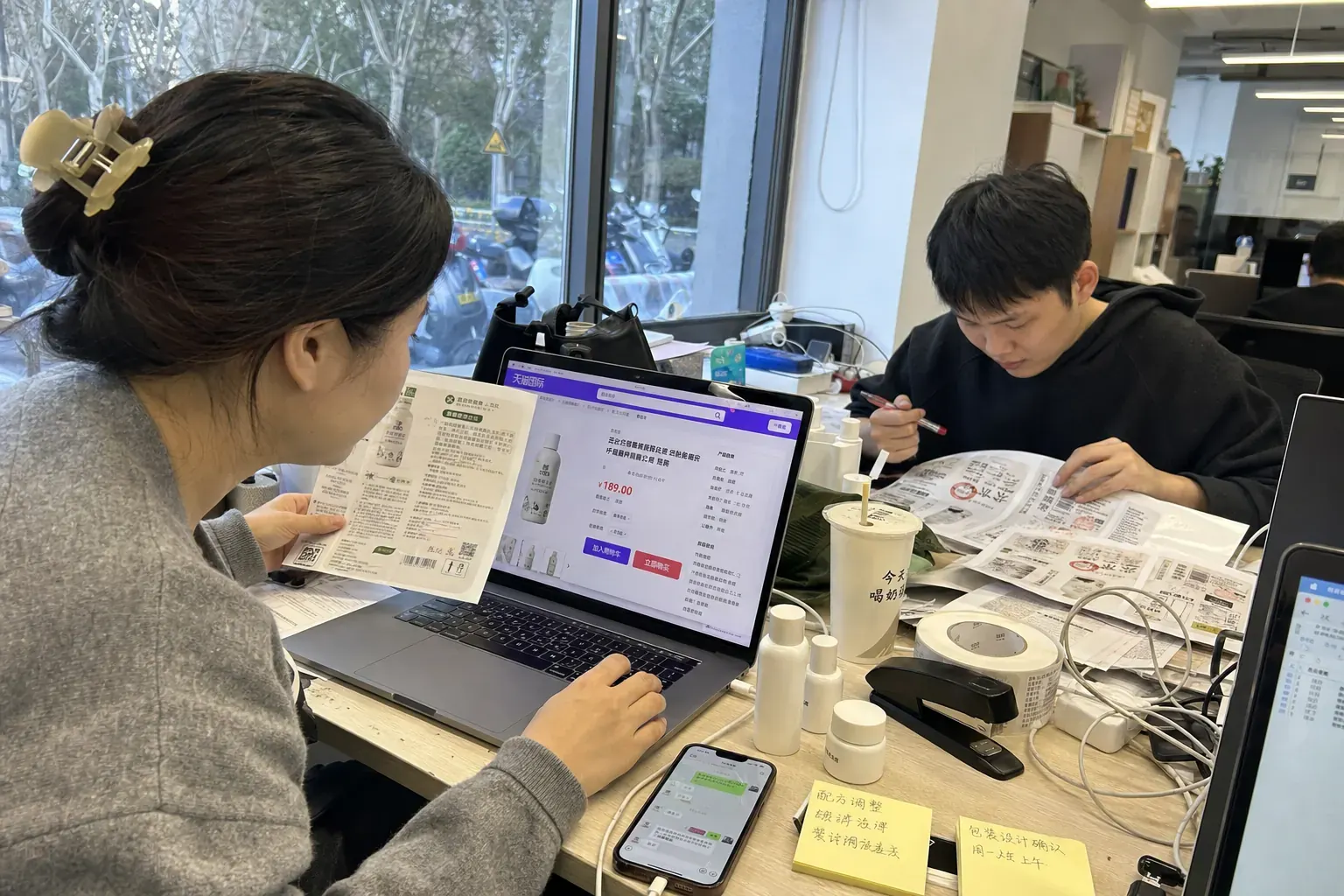
General trade is different. Once a distributor or your own China entity imports the goods and sells them inside the country, the Chinese label goes on the pack. The Product Quality Law asks for the product name and the maker’s name and address in Chinese, and category rules add more. Cosmetics need the full ingredient list, the filing number and the domestic responsible person, for a start.
Product labels must carry the product name and the maker’s name and address in Chinese. Source: CNIPA, repost of the Product Quality Law, article 27, July 2019. https://www.cnipa.gov.cn/art/2019/7/31/art_104_67810.html
Cosmetics sold in China must carry a Chinese label showing the Chinese product name, the registration or filing details, the full ingredient list, net content and use-by date, and for an overseas registrant the name and address of its domestic responsible person. Source: National Medical Products Administration (国家药监局) announcement 2021 No. 77, in the State Council Gazette (国务院公报), May 2021. https://www.gov.cn/gongbao/content/2021/content_5631831.htm
It’s one reason to test China cross-border first and move to a distributor under general trade once a product proves itself. The relabeling bill waits until the volume justifies it. Our cross-border setup work covers the first route. Start the label file for the second one early anyway.
Copy the Advertising Law will read
Global taglines are where this goes wrong. “The world’s best serum.” “No. 1 in Europe.” Translated faithfully, both break Chinese advertising law. SAMR’s own guideline applies the rule to a seller’s own website as well as to paid media.
Advertisements may not use terms such as “national-level,” “highest-level” or “best.” Advertisers who do face fines of 200,000 to 1,000,000 RMB, and in serious cases the loss of their business license. Source: State Administration for Market Regulation (国家市场监督管理总局), Advertising Law as amended April 2021, articles 9 and 57. https://www.samr.gov.cn/zw/zfxxgk/fdzdgknr/fgs/art/2023/art_5474cf75173c45d6a0379730fb4e8d97.html
There’s some room for a first mistake. SAMR’s 2023 enforcement guideline lets regulators waive the penalty when a first use does little harm and is fixed quickly. The same guideline says ads for health food, drugs and medical devices generally don’t count as minor, so supplement and device brands should expect no grace period.
A first use of an absolute term that causes minor harm and is promptly corrected may go unpunished; ads for health food, drugs and medical devices are generally not treated as minor violations. Source: SAMR, Guidelines on Enforcement Against Absolute Terms in Advertising, announcement No. 6, February 2023. https://www.samr.gov.cn/ggjgs/tzgg/art/2023/art_183b5cb48d9e4f0dba67f9f912a913ba.html
These fines get issued. In April 2024 a market regulator in Anyang, Henan, fined a company 109,600 RMB for an online cosmetics ad that claimed to be first in sales across the whole internet.
The ad used absolute terms such as “first in sales, nationwide, across the whole internet,” and the claims did not match the facts. The Anyang market regulator fined the company 109,600 RMB in April 2024. Source: SAMR release, carried by the Shanghai Medical Products Administration (上海市药品监督管理局), January 2025. https://yjj.sh.gov.cn/zjyw/20250117/e9ebc3d76a4146d2aa2cc5b2a5035918.html
Brief your translator on this list before the first product page goes up. Ranking claims need proof you can hand to a regulator, with a source and a date.
Store pages and the seven-day rule
Chinese shoppers expect a store that works like the domestic stores they already use, down to Chinese-speaking service in the platform chat. The return policy is set by law.
Consumers who buy online may return goods within seven days of receipt without giving a reason. Custom-made goods, fresh and perishable goods, unsealed digital products and delivered newspapers are excluded. Source: SAMR, Consumer Rights Protection Law, article 25, as amended October 2013. https://www.samr.gov.cn/zw/zfxxgk/fdzdgknr/fgs/art/2023/art_0a323e046fba43f0b6e9e977f1e8d5fc.html
For the store build, our three calculators each carry one localization line: 25,000 RMB for store setup and launch content on Tmall Global and JD Worldwide, and the same figure as a brand setup contribution on Douyin, written off over three years. The trademark line in all three defaults to zero (TheChinaPath calculator data, October 2026). The Tmall Global model also assumes a registered mark: its 50,000 RMB deposit baseline is for a flagship store with a registered (R) mark, and a pending (TM) application raises it.
That zero is an assumption, and it’s ours. The model expects you to own your Chinese marks before the store opens, since a store selling under a name another company registered can be ordered to stop, and the reviews and search history it built under that name stay behind when it does. If you don’t own the marks yet, put the filing in. Change both inputs in the Tmall Global setup and run calculator and watch the cost per order move.
It barely moves. At the official fee, two marks in three classes add about 540 RMB a year over the three-year write-off.
What sits with the rest of the group
The 2023 version of this page also told brands to open WeChat and Weibo accounts and hire influencers. Those are content and community jobs, and they come after the legal groundwork above. For them, talk to TheRedScroll, the group’s China social media agency. A Chinese website hosted inside the country needs an ICP filing first; ChinaWebFoundry, the group’s China web and hosting practice handles that.
FAQ
How long does it take to register a trademark in China?
Examination averages about four months, according to CNIPA. A mark that passes is then published, and other parties have three months to oppose it under the current law. From January 1, 2027, the revised Trademark Law shortens that window to two months. File early, because the first filer wins and nothing you do in another country reserves the name in China.
Do cross-border products need a Chinese label?
Not on the pack. Goods sold under China’s cross-border retail import rules, on Tmall Global or JD Worldwide, can ship in their original packaging. The seller and the platform must warn the buyer the goods may have no Chinese label and show a Chinese electronic label online. Goods sold through a distributor under general trade need the Chinese label on the package.
Can I say “best” in Chinese advertising?
No. The Advertising Law bans terms such as “national-level,” “highest-level” and “best,” with fines of 200,000 to 1,000,000 RMB. SAMR may waive a first, minor, quickly fixed breach, though health food, drugs and medical devices are generally not treated as minor. Ranking claims need evidence you can show a regulator, with a source and a date.
What does localization cost before the first sale?
The official trademark fee is 270 RMB per class online, so two marks in three classes is 1,620 RMB before agent fees. Our calculators budget 25,000 RMB for store setup and launch content. Naming research, packaging and translation depend on the range and are scoped as a project after a first call.
Plan your Chinese name and trademark filing with our branding and localization team
Updated October 1, 2026
Working on China? Let's grab a coffee.
Tell us where you are now and where you want to get to.


