
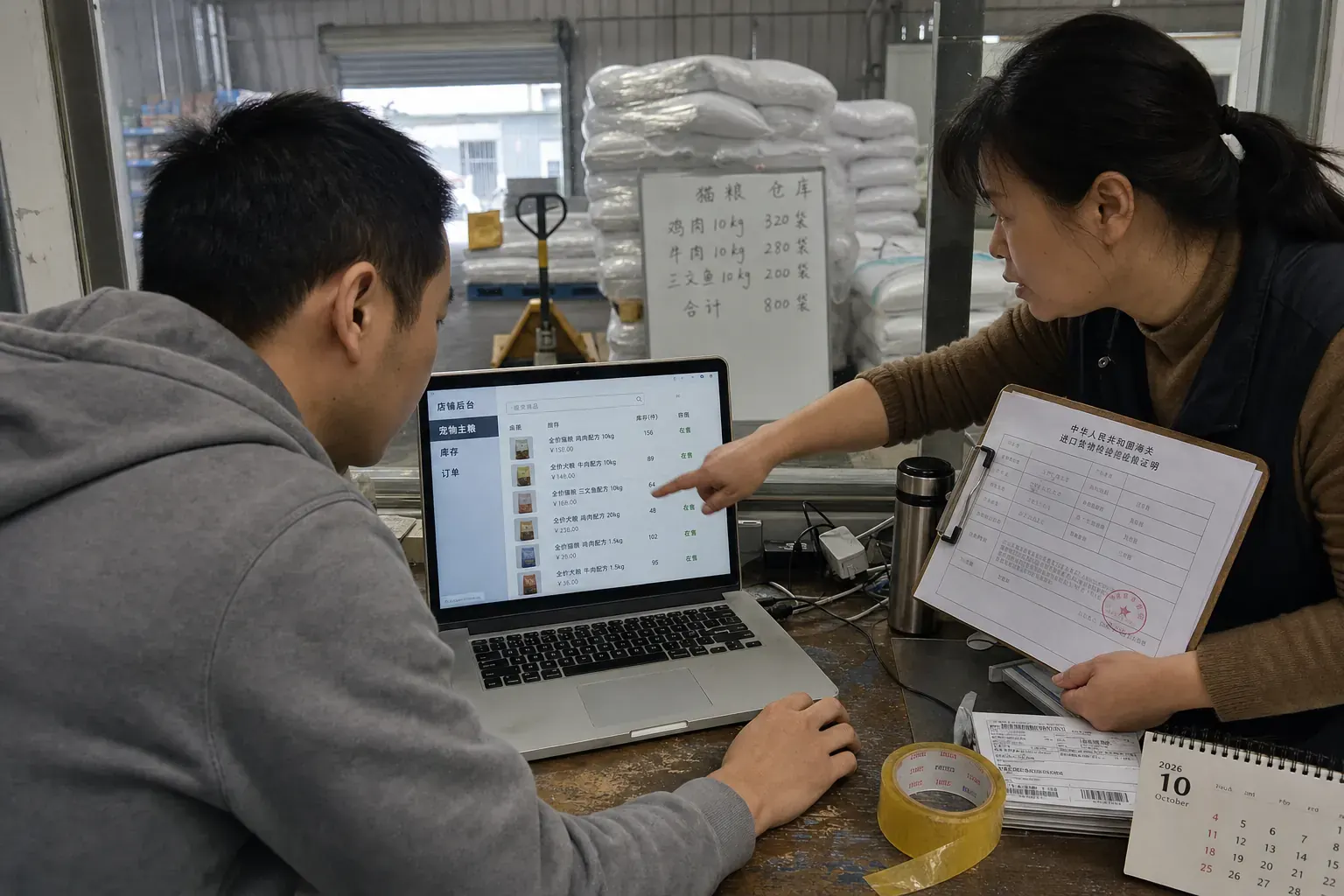
China raised the duty on imported dog and cat food from 4% to 10% on January 1, 2025, and imports fell. A pet food distributor in China now earns its margin from what it holds: an importer filing with customs, your sales-agent filing with the agriculture ministry, a warehouse that fits your product, and online pet stores you can open and check. Check those before you compare prices.
Imports were already sliding before the duty went up, and they kept sliding after.
China imported 75,281 metric tons of retail-packed dog and cat food in 2024, down 13.41% on 2023, according to customs data. Source: The Paper (澎湃新闻), Pengpai account 宠经说, February 2025. https://m.thepaper.cn/newsDetail_forward_30220350
China imported US$474.1 million of packaged pet food in 2025, down 5.2% from 2024, according to China Customs. Source: USDA Foreign Agricultural Service, ATO Shanghai, GAIN report CH2026-0046, April 2026. https://apps.fas.usda.gov/newgainapi/api/Report/DownloadReportByFileName?fileName=Pet+Food+Market+Update+2026_Shanghai+ATO_China+-+People%27s+Republic+of_CH2026-0046.pdf
Most of the top pet brands on the first day of Double 11 are now Chinese.
Of the pet brands that passed 10 million RMB in sales on the first day of Tmall’s Double 11 in 2025, 68% were Chinese. Source: Huanqiu.com (环球网), via Sina Finance (新浪财经), November 2025. https://finance.sina.com.cn/roll/2025-11-08/doc-infwsynp1202307.shtml
So a distributor that imports your food funds a bigger duty bill, then sells it next to the local brands that lead Double 11.
What the 10% adds to every 100 RMB
Both dog and cat food lines carry a 15% most-favored-nation duty. A lower provisional rate replaces it, and that’s the rate that moved.
Retail-packed dog and cat food carried a 4% provisional duty in 2024. Source: Customs Tariff Commission of the State Council (国务院关税税则委员会), 2024 Tariff Adjustment Plan, Annex 1, December 2023. https://gss.mof.gov.cn/gzdt/zhengcefabu/202312/P020231221539934847465.pdf
The same two lines carry a 10% provisional duty under the 2025 plan, in force January 1, 2025. Source: Customs Tariff Commission of the State Council, 2025 Tariff Adjustment Plan, Annex 2, December 2024, via the Guangdong Department of Finance (广东省财政厅). https://czt.gd.gov.cn/shuishou/content/post_4641813.html
The 2026 plan keeps both lines at 10%. Source: Customs Tariff Commission of the State Council, Announcement 2025 No. 11, Annex 1, December 2025. https://gss.mof.gov.cn/gzdt/zhengcefabu/202512/P020251229510521217364.pdf
Work it on 100 RMB of customs value. Duty at 10% is 10 RMB. Import VAT for pet feed is 9% of the value plus the duty, so another 9.90 RMB, and the importer hands over 19.90 RMB before the goods leave the port. At the old 4%, with the same VAT, the bill would be 13.36 RMB (our arithmetic, on the cited rates).
That’s 6.54 RMB more on every 100 RMB. Paid up front.
Pet feed falls in the 9% VAT band from January 1, 2026. Source: Ministry of Finance and State Taxation Administration (财政部 税务总局), Announcement 2026 No. 9, Annex 1, January 2026. https://hainan.chinatax.gov.cn/xxgk_6_1/30163239.html
Import VAT is charged on the dutiable value plus duty and consumption tax. Source: National People’s Congress (全国人大), VAT Law of the People’s Republic of China (中华人民共和国增值税法), art. 14, December 2024. https://fgk.chinatax.gov.cn/zcfgk/c100009/c5237365/content.html
Where your food is made can change the rate.
Where a provisional rate exists it applies instead of the most-favored-nation rate; goods eligible for an agreement rate take the lower of the two. Source: Tariff Law of the People’s Republic of China (中华人民共和国关税法), art. 13, April 2024, via the Chinese government portal (中国政府网). https://www.gov.cn/yaowen/liebiao/202404/content_6947843.htm
China applies agreement rates to eligible goods from 34 trading partners, New Zealand and Australia among them. Source: Customs Tariff Commission of the State Council, 2026 Tariff Adjustment Plan, December 2025. https://gss.mof.gov.cn/gzdt/zhengcefabu/202512/P020251229510520940591.pdf
The EU, the UK, the US, and Canada aren’t on that list. US-origin food also pays China’s additional duty on US goods, reset several times since early 2025.
From May 14, 2025, China’s additional duty on US-origin goods was cut from 34% to 10%, with 24% suspended for 90 days. Source: Customs Tariff Commission of the State Council, Announcement 2025 No. 7, May 2025. https://gss.mof.gov.cn/gzdt/zhengcefabu/202505/t20250513_3963684.htm
Ask a candidate to show the rate in force on a recent customs declaration.
Bonded cross-border stock sits outside the duty. The shopper pays 70% of the VAT, which comes to 6.3% of the price.
Within the limits, cross-border retail imports carry a 0% tariff, and import VAT and consumption tax are levied at 70% of the statutory amount. Source: Ministry of Finance (财政部), 财关税〔2016〕18号, March 2016. http://www.mof.gov.cn/gp/xxgkml/gss/201603/t20160324_2510682.htm
Three kinds of pet food distributor in China
| Partner type | What it holds | Tax on 100 RMB of goods (RMB) | Fits |
|---|---|---|---|
| Importer-distributor (general trade) | Customs importer filing, your sales-agent filing, Chinese labels, a warehouse, pet store and vet accounts | 19.90 at the border, paid by the importer | A registered complete food with volume and an offline plan |
| Online pet specialist (general trade) | Duty-paid stock, domestic stores on Tmall, JD, and Douyin, ad accounts | 19.90, inside what it pays the importer | A registered food whose buyers shop online |
| Cross-border store partner (bonded) | Bonded stock, a Tmall Global, JD Worldwide, or Douyin cross-border store | 6.30 per 100 RMB of retail price, paid by the shopper | Testing demand, food not yet registered |
The tax figures are our arithmetic on the rules cited above, checked October 25, 2026, before any agreement rate or US additional duty. When offers come in, compare them on the shelf price your food ends up at. If the importer route fits, our China distribution team can set up the importer and its filings with you.
Both pet food lines are on the cross-border list as bonded stock only.
23091010 and 23091090 are on the cross-border retail import list, 仅限网购保税商品 (bonded online stock only). Source: Ministry of Finance and 12 other departments, Announcement 2019 No. 96, December 2019. http://gss.mof.gov.cn/gzdt/zhengcefabu/201912/t20191227_3451448.htm
What does the store itself cost? In our calculators, cat and dog food pays a 2.5% commission on Tmall Global and on JD Worldwide, where JD adds a 0.9% transaction fee per order. Douyin cross-border takes 5% on pet goods. On a 500 RMB bag, platform fees plus default packing and delivery come to about 34 RMB per order that stays sold on JD Worldwide, and 35 RMB on Tmall Global (TheChinaPath calculator data, October 2026). The full breakdown is in our piece on what it costs to sell pet food in China.
The filing that ties your brand to one partner
For general trade, a complete food needs an import registration certificate from the Ministry of Agriculture and Rural Affairs. Treats don’t, so a brand can open general trade with treats while its complete food waits.
Imported 宠物配合饲料 (complete pet food) and 宠物添加剂预混合饲料 (pet additive premix) need an import registration certificate. Other pet feed, treats included, does not. Source: Ministry of Agriculture and Rural Affairs (农业农村部), Pet Feed Administrative Measures, Announcement No. 20, arts. 2 and 14, republished June 2025. https://www.moa.gov.cn/ztzl/sqxzjcgs/xzjcbz/202506/t20250630_6475260.htm
The certificate is yours. Read that line twice if a distributor has offered to “handle the registration.” Your company applies, through its own China office or a Chinese agent it appoints. Selling is a separate filing, and that’s the one that moves.
A foreign company applies through its China office or an appointed Chinese agent. It may not sell imported feed directly; within six months of the certificate it files a China sales entity or sales agent with the ministry, and refiles any change within one month. The certificate runs five years. Source: Ministry of Agriculture (农业部), Administrative Measures for the Registration of Imported Feed and Feed Additives, arts. 3, 4, 14, 21, and 22, as amended November 2017. https://www.moa.gov.cn/gk/nyncbgzk/gzk/202210/t20221013_6413266.htm
The label carries the sales entity’s name too.
Imported complete pet food labels must show the registration number and the name, address, and contact details of the registered sales entity in China. Source: Ministry of Agriculture and Rural Affairs, Pet Feed Labeling Regulations (《宠物饲料标签规定》), arts. 3, 5, and 15, republished June 2025. https://www.moa.gov.cn/ztzl/sqxzjcgs/xzjcbz/202506/t20250630_6475269.htm
A distributor that filed your registration and also sits on your label as the sales entity is hard to replace. It’s the first clause we’d read in a pet food distribution contract. Keep the registration agent and the sales agent as separate decisions if you can. Write into the contract that the distributor signs the change filing when the deal ends, and budget for a relabel. Our piece on replacing a distributor in China covers the rest of the exit.
Ask to see the importer’s records
Pet food counts as feed under the customs rules, and a feed importer has obligations you can check.
Feed, as defined, includes pet food and chews. Feed importers file with customs before or at the first declaration, keep records of each lot and where it went for at least two years, and must recall feed that may harm animals or people. Source: General Administration of Customs (海关总署), Measures for the Inspection, Quarantine and Supervision of Imported and Exported Feed and Feed Additives, arts. 26, 27, 29, and 68, as amended by Decree No. 262, March 2023. https://policy.mofcom.gov.cn/claw/clawContent.shtml?id=97519
An importer with a few years of pet food has that archive. Ask for a redacted page from another brand’s file. If it can’t show where a lot ended up, don’t count on it to run a recall for you.
Then the warehouse. Ask where your stock will sit and who runs the building. And ask what happens to the best-before dates when a promotion stalls.
Open the partner’s online pet stores
Douyin’s pet sales nearly doubled in 2025, by its own count through August.
Douyin e-commerce’s pet category GMV grew 95% year on year in 2025 to date. Source: Douyin E-commerce (抖音电商), 2025 pet consumption trend report, via Paidai (电商派), August 2025. https://www.pai.com.cn/p/01k3ga6n37f0qszmxpfc0yr77g
Ask a candidate for its pet stores on Tmall, JD, and Douyin, then open them. Count the imported brands and read the review dates. Check the best sellers too: a partner growing its own label will price yours against it.
Store listings you can find yourself are one of the eight checks in our guide to finding a distributor in China. Compass shortlists from distributors we have met.
Questions brands ask about pet food partners
Does the 10% duty apply to cross-border sales?
No. Bonded stock sold through Tmall Global, JD Worldwide, or a Douyin cross-border store pays no duty within the transaction limits, and the shopper pays 6.3% tax. The 10% hits general-trade imports, cleared and paid for by the importer before the food reaches a shelf.
Can my distributor keep my registration when we split?
It stays yours, because the certificate is in your company’s name. The sales agent on file and the name on the label move: refile within a month, relabel new stock, and write both steps into the contract before the first order.
Should I start cross-border or general trade?
Start cross-border if your complete food isn’t registered yet or you want to see demand before you commit to a container. Move to general trade when the registration lands and your volume can carry the 10% duty and a warehouse.
Updated October 26, 2026
Working on China? Let's grab a coffee.
Tell us where you are now and where you want to get to.