Start on Tmall Global if shoppers already search for your brand: an 80,000 RMB cash floor, then 5% a sale. A device that sells on video belongs on Douyin, which asks 5,000 RMB at most to open and up to 10% a sale. Check the classification before either. A radio-frequency device now needs a Class III medical registration.
Here’s the cost to sell beauty devices in China, platform by platform, checked against the three rule pages on November 1, 2026.
| Beauty devices and tools, first year (RMB) | Tmall Global | JD Worldwide | Douyin cross-border |
|---|---|---|---|
| Security deposit, refundable | 50,000 | 35,500 (US$5,000, brand flagship) | 500 to 5,000 |
| Annual platform fee | 30,000 | none | none |
| Commission, facial and body devices | 5% | 3% (filed as a personal-care appliance) | 6% |
| Commission, hair dryers | 5% | 3% | 4% |
| Commission, manual beauty tools | 4% | 5% | 5% (facial massage and hair removal tools) |
| Other fee on each order | 1% payment fee | 0.9% transaction fee | 4% to 5.2% on Douyin Mall and Doubao orders |
| Cash in before the first sale | 80,000 | 35,500 | 500 |
Beauty and body devices (美容美体仪器) pay a 5% technical service fee and a 30,000 RMB annual fee; makeup tools sit in the 4% cosmetics line. A brand flagship in beauty or in digital and home appliances deposits 50,000 RMB. Source: Tmall Global (天猫国际), category fee rates, effective September 9, 2026, and deposit rule, effective May 12, 2026. https://rule.tmall.hk/?type=detail&ruleId=11005909&cId=625 and https://rule.tmall.hk/?type=detail&ruleId=8942&cId=625
Household appliances outside the named lines pay 3% plus a 0.9% transaction fee, with a US$5,000 brand flagship deposit; beauty and skin care pays 5% plus 0.9%. The full category list is on the listing page. Source: JD Worldwide (京东全球购), category fee standard, effective October 1, 2026. https://jdw-rule.jd.hk/detail?ruleId=950583665543483392
Personal-care appliances outside the named lines pay a 6% base fee and a 4% channel supplement; hair dryers pay 4% and 5.2%. The base deposit is 500, 2,000 or 5,000 RMB, set by last month’s sales. Source: Douyin E-commerce (抖音电商), Global Purchase fee schedule, July 2026, and deposit rule, June 2025. https://school.jinritemai.com/doudian/web/articlev0/aHMYyFoqESKn and https://school.jinritemai.com/doudian/web/articlev0/107821
The JD column assumes the device lists under household appliances, which is where JD files personal-care electricals. Check the category when you create the listing (JD’s rule page says the full list lives there, not on the fee sheet).
The route into China for beauty devices
A cleansing brush, an LED mask, an IPL hair remover and a radio-frequency (RF) lifting device don’t share a route. The table shows where each one stands.
| Product | China’s CCC certificate | Medical device status |
|---|---|---|
| Hair dryer, curling iron, facial sauna | Required (heated, up to 250V) | No NMPA ruling found |
| Cleansing brush, scalp massager | Excluded as a beauty device | No ruling found; a massager for healthy people was ruled outside the device rules |
| LED light mask | Excluded as a beauty device | One mask-shaped LED device ruled Class II |
| Handheld IPL hair remover | Not named in the catalogue | Class II since January 1, 2023 |
| RF lifting or tightening device | Excluded as a beauty device | Class III since April 1, 2026 |
The cross-border door first. The import list names hair dryers (line 1201), electric hair removers (1189), massagers (1294) and other household electromechanical appliances (1185), with no remark. It names no “beauty device” line, so the tariff code your broker picks decides which line you sit on.
Line 1295, mechanotherapy appliances, carries the remark “goods managed as medical devices excluded”; lines 1185, 1189, 1201 and 1294 carry none. Source: Ministry of Finance (财政部) and 12 other bodies, cross-border retail import list (2019 edition), December 2019. https://gss.mof.gov.cn/gzdt/zhengcefabu/201912/P020191227607915178053.pdf
On that route the goods count as personal imports. The box can ship without a Chinese label, but the order page has to say so.
Cross-border retail imports are supervised as goods for personal use, with no first-import permit, registration or filing; the risk notice must say the goods may carry no Chinese label and point to a Chinese electronic label on the site. Source: MOFCOM and five other bodies (商财发〔2018〕486号), November 2018. https://www.gov.cn/zhengce/zhengceku/2018-12/31/content_5437823.htm
Certification is the next question. China’s compulsory scheme, CCC, covers heated hair and skin appliances and names its exceptions.
Skin and hair care appliances with a heating element, rated up to 250V (hair dryers, heated combs, curling irons, facial saunas), need CCC. Excluded: electric shavers, beauty devices (美容仪), makeup-removal devices and appliances with a treatment function. Source: State Administration for Market Regulation (市场监管总局), CCC catalogue description table, September 2023. https://www.cnca.gov.cn/zwxx/gg/zjgg/art/2023/art_31ce43f5837d408cb2023ec693615ada.html
So a curling iron needs a certificate under general trade, and an LED mask doesn’t. The mask still has to get past NMPA, the drug and device regulator, which rules product by product.
A mask-shaped LED device giving red and yellow light to improve skin appearance was ruled a Class II medical device; a vibration massager for healthy people, not used to treat disease, was ruled not a medical device. Source: NMPA Center for Medical Device Standards Administration (国家药监局医疗器械标准管理中心), 2020 first-batch classification results, November 2021. https://www.cmdi.org.cn/jg/ylqxcpfljd/202111/t20211104_303420.html
Home IPL hair removers were settled years ago, in plain words.
Handheld intense pulsed light hair removal devices are Class II medical devices; from January 1, 2023, unregistered ones may not be made, imported or sold. Source: NMPA General Office (国家药品监督管理局办公室), 药监办〔2018〕10号, May 2018. https://www.gov.cn/zhengce/zhengceku/2018-12/31/content_5434861.htm
RF crossed into the top class in April, two years later than first planned.
From April 1, 2026, RF therapy and RF skin therapy devices without a medical device registration certificate may not be made, imported or sold. Source: National Medical Products Administration (国家药监局), Announcement 2024 No. 84, July 2024, via the Guangdong Medical Products Administration. https://mpa.gd.gov.cn/xwdt/zjdt/content/post_4452774.html
Few brands hold the paper. A July count found 16 companies with the certificate, and a first Class III registration takes close to three years when nothing goes wrong.
By July 2026, only 16 companies had completed registration of an RF skin therapy device. Source: China Household Electrical Appliances Association news (中国家电网), July 2026. https://m.cheaa.com/n_detail/w_656735.html
A first Class III registration takes about 34 months when the process runs smoothly, according to NMPA’s device evaluation center. Source: Economic Information Daily (经济参考报) via Xinhua, February 2024. https://www.news.cn/20240227/98289b01865b43a18e0de57036e087ad/c.html
The marketplaces cleared their shelves before the clock ran out.
By midnight on April 1, 2026, Taobao and Tmall, Douyin and JD had pulled unregistered RF beauty devices in bulk. Source: Jiemian (界面新闻), carrying FBeauty, April 2026. https://www.jiemian.com/article/14201382.html
Can an unregistered RF device still ship cross-border as a personal import? We found no regulator text that settles it, and the platforms aren’t waiting for one. Our read: if the box makes a skin claim, treat the device as a medical device until NMPA says otherwise. None of this is legal advice.
The cost to sell beauty devices in China, per order
Prices fell hard around the deadline.
Online beauty devices averaged 1,523 RMB in the first quarter of 2026 and 1,198 RMB in April, the first month of RF enforcement (AVC data). Source: China Household Electrical Appliances Association news (中国家电网), May and July 2026. https://info.cheaa.com/2026/0514/654924.shtml and https://m.cheaa.com/n_detail/w_656735.html
A premium device priced above 5,000 RMB can still go cross-border. The shopper just loses the tax break.
An order of one item over the 5,000 RMB single-transaction limit can still come in cross-border, but pays duty and import taxes in full. Source: Ministry of Finance (财政部) and two other bodies, 财关税〔2018〕49号, November 2018. https://policy.mofcom.gov.cn/claw/clawContent.shtml?id=65769
Now returns. We couldn’t find a return rate for beauty devices in China that holds up to checking, so the table runs two scenarios of our own, 5% and 20%, on a 1,500 RMB device sold through Tmall Global.
| Per kept order, 1,500 RMB device on Tmall Global (RMB) | 5% returns | 20% returns |
|---|---|---|
| Commission at 5% | 75 | 75 |
| Payment fee at 1% | 15 | 15 |
| Delivery and return handling, spread over kept orders | 17 | 25 |
| Paid media (60% of sales, bought at a return on ad spend of 2) | 474 | 563 |
| Total per kept order | 581 | 678 |
Our arithmetic on the per-order defaults in the Tmall Global model: pick and pack 4 RMB, last mile 11 RMB, 15 RMB handling plus the 11 RMB leg back on each return, paid media at 60% of sales and a return on ad spend of 2. Return rates are scenarios, not market data. Source: TheChinaPath calculator data, November 2026.
Fifteen points of returns add 97 RMB per kept order. The commission is 75. Most of the damage is media: the ad money that won a returned order is spent either way.
Breakeven moves with it. Take the calculator’s year-one fixed costs: the 30,000 RMB annual fee, 25,000 RMB of store setup and a Tmall Partner retainer at its default of 35,000 RMB a month, 475,000 RMB in all. At an assumed 60% gross margin, a 1,500 RMB device covers that at about 1,490 kept orders (2.2 million RMB of sales) with 5% returns, and about 2,140 (3.2 million RMB) with 20%.
Which platform first
Tmall Global, for a brand-led device with a name Chinese shoppers already type into the search box. The cash floor is higher. The 5% rate holds on every order.
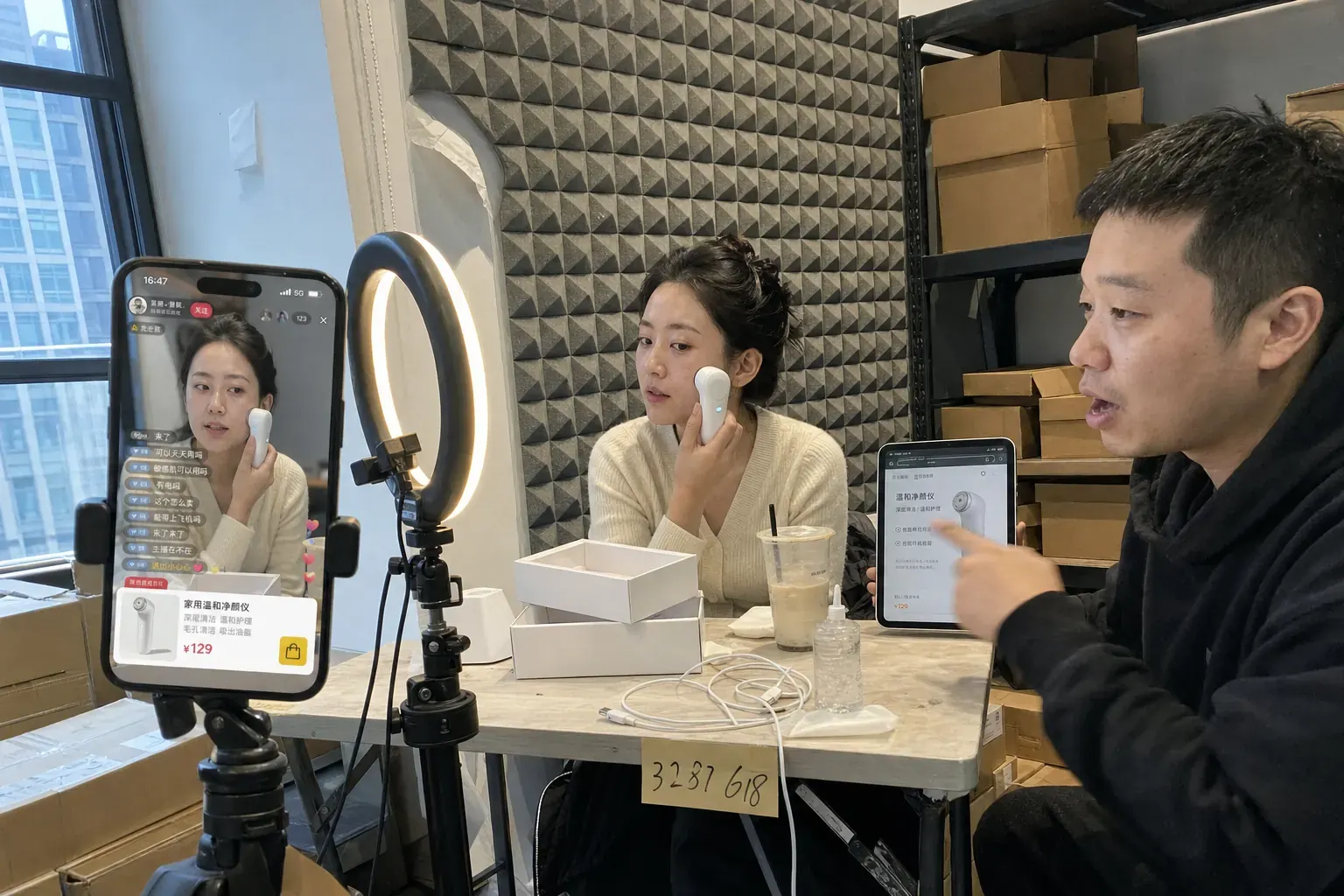
Douyin, when the device shows its effect on camera in under a minute. That’s where most of the category sells now.
Douyin took 0.9 billion RMB of the 1.29 billion RMB of online beauty device sales in the first quarter of 2026; its share fell from 76.3% in January to 61.8% in March (AVC data). Source: China Household Electrical Appliances Association news (中国家电网), May 2026. https://info.cheaa.com/2026/0514/654924.shtml
Budget for two Douyin costs the fee table hides. Mall orders run up to 10% in fees. And money from devices with a warranty can sit in Douyin’s after-sales reserve.
JD Worldwide flips the order for a hair dryer. Its 3% beats Tmall Global’s 5% and Douyin’s 4%, and there’s no annual fee to clear first.
Selling the creams and gels that go with the device? Those follow the skincare rules, covered in what it costs to sell facial skincare in China.
Our proof on beauty devices
Our published case studies include no beauty device store to cite. Every number above comes from public rules or our own calculator.
Run your own numbers
The Tmall Global setup and run calculator has no beauty device row yet. Pick “Custom” and type a 50,000 RMB deposit, 5% commission and 30,000 RMB annual fee. Then put in your own price and margin, plus the return rate you actually expect. On the JD and Douyin calculators, “Small appliances” and “Beauty and personal-care devices” load 3% and 4.5%; the Douyin figure is the midpoint of the group, so type 6% for a facial device.
Beauty device questions we hear most
Does a beauty device need CCC certification in China?
Heated hair and skin appliances such as hair dryers, curling irons and facial saunas, rated up to 250V, are on the CCC list. The same entry names its exclusions, beauty devices and electric shavers among them, along with makeup removers and anything with a treatment function. A device with a skin-treatment claim faces the medical device rules instead.
Can I still sell an RF beauty device in China?
Only with a registration. Since April 1, 2026, RF therapy and RF skin therapy devices without a medical device certificate may not be made, imported or sold. By July 2026, 16 companies had registered one. A first Class III registration takes about 34 months.
How much does it cost to open a beauty device store on Tmall Global?
A 50,000 RMB refundable deposit for a brand flagship and a 30,000 RMB annual fee, so 80,000 RMB before the first sale. Each sale then pays 5% commission and about 1% in payment fees (Tmall Global fee rates, September 2026).
Send us your device list with the claims on each box and we’ll tell you which ones need a registration before we price the store: talk to the cross-border ecommerce team.
Updated November 1, 2026
Working on China? Let's grab a coffee.
Tell us where you are now and where you want to get to.