Comvita entered China in 2004 through one exclusive distributor, which opened its first store in a Shenzhen mall. It took 51% of that business in a deal announced in 2016 and the rest in 2019. Greater China sales peaked at NZ$106.3 million in fiscal 2023, then fell about 31% to NZ$73.6 million by fiscal 2026.
In 2004, Comvita opened its first store in Shenzhen’s Luohu MixC mall. It now has more than 250 stores in 42 Chinese cities and ranks first in manuka honey across all channels. Source: Comvita Food (China) (康维他食品(中国)有限公司), release via FBE China (食品与饮料网), June 2024. http://www.fbe-china.com/sczx/hyzx/3116.html
This teardown is for food and health brands deciding who should hold their China business in the first years. Comvita, the New Zealand manuka honey company, is a clean case. It is listed in New Zealand and reports Greater China, Hong Kong included, as its own segment.
Figures come from Comvita’s annual reports, its stock exchange notices and dated Chinese and New Zealand reporting, all checked on November 20, 2026. Comvita reports in New Zealand dollars, and its fiscal year ends June 30. Where a line is our reading rather than the record, we say so. Comvita has no commercial tie to our group.
Where Comvita stands in China today
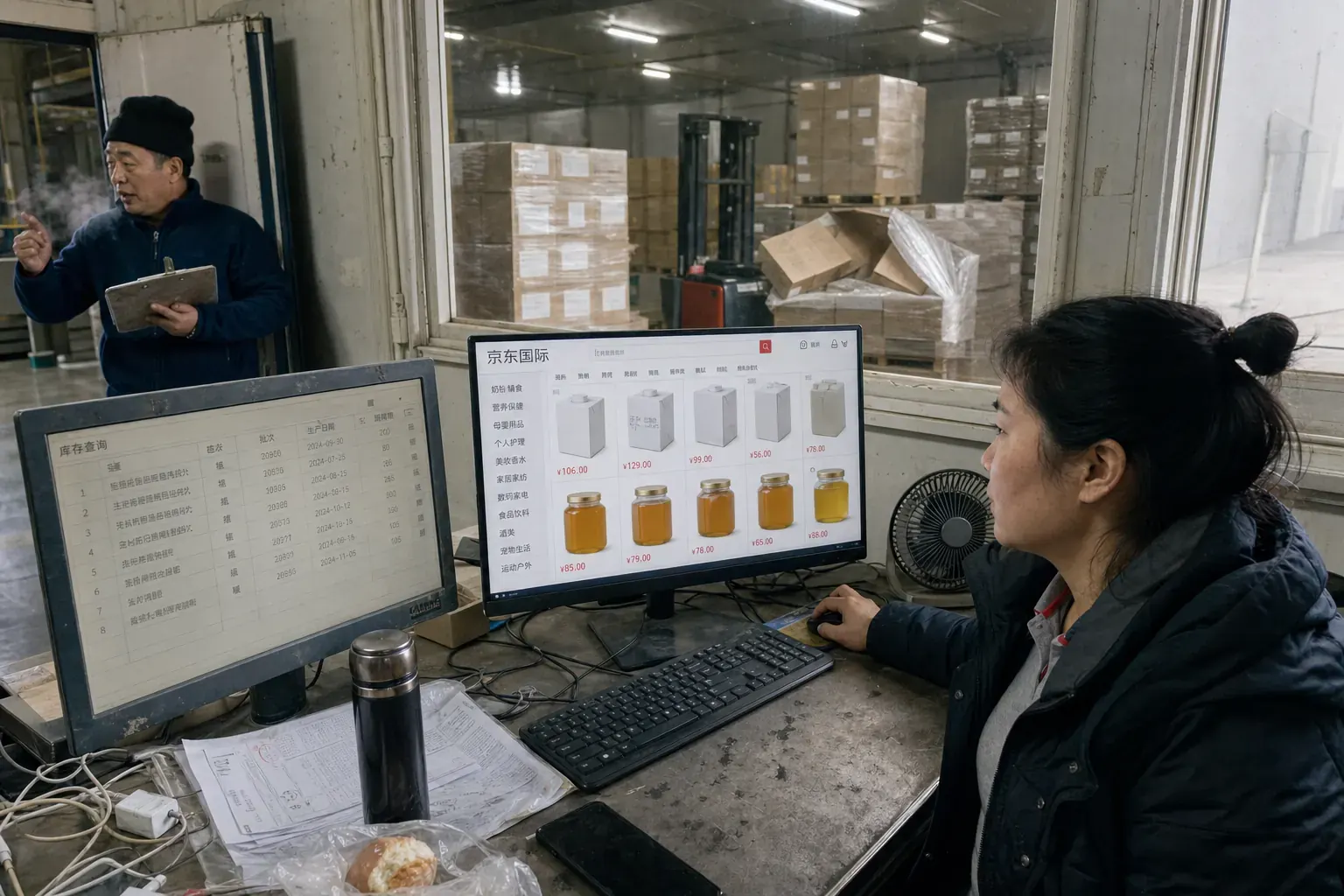
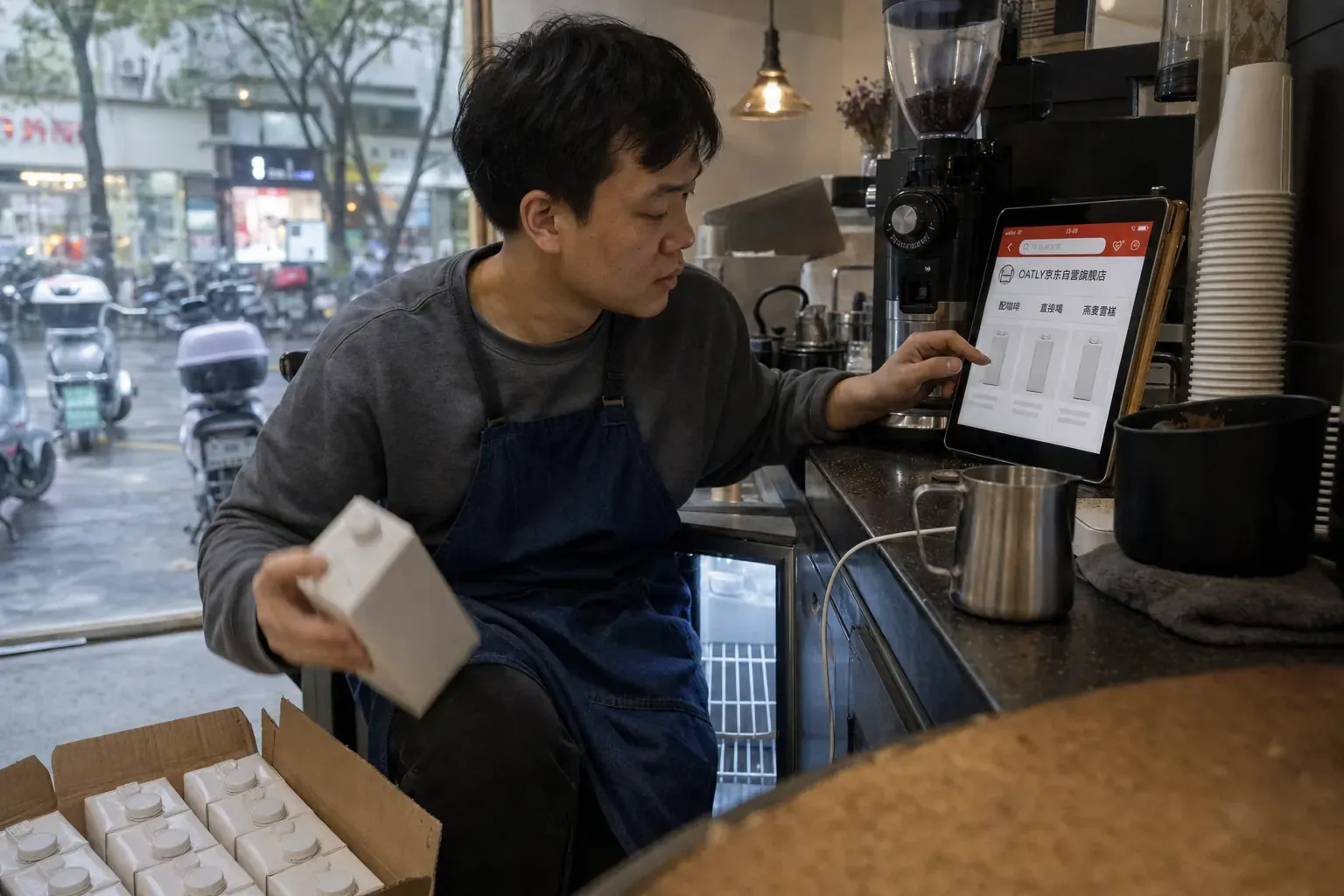
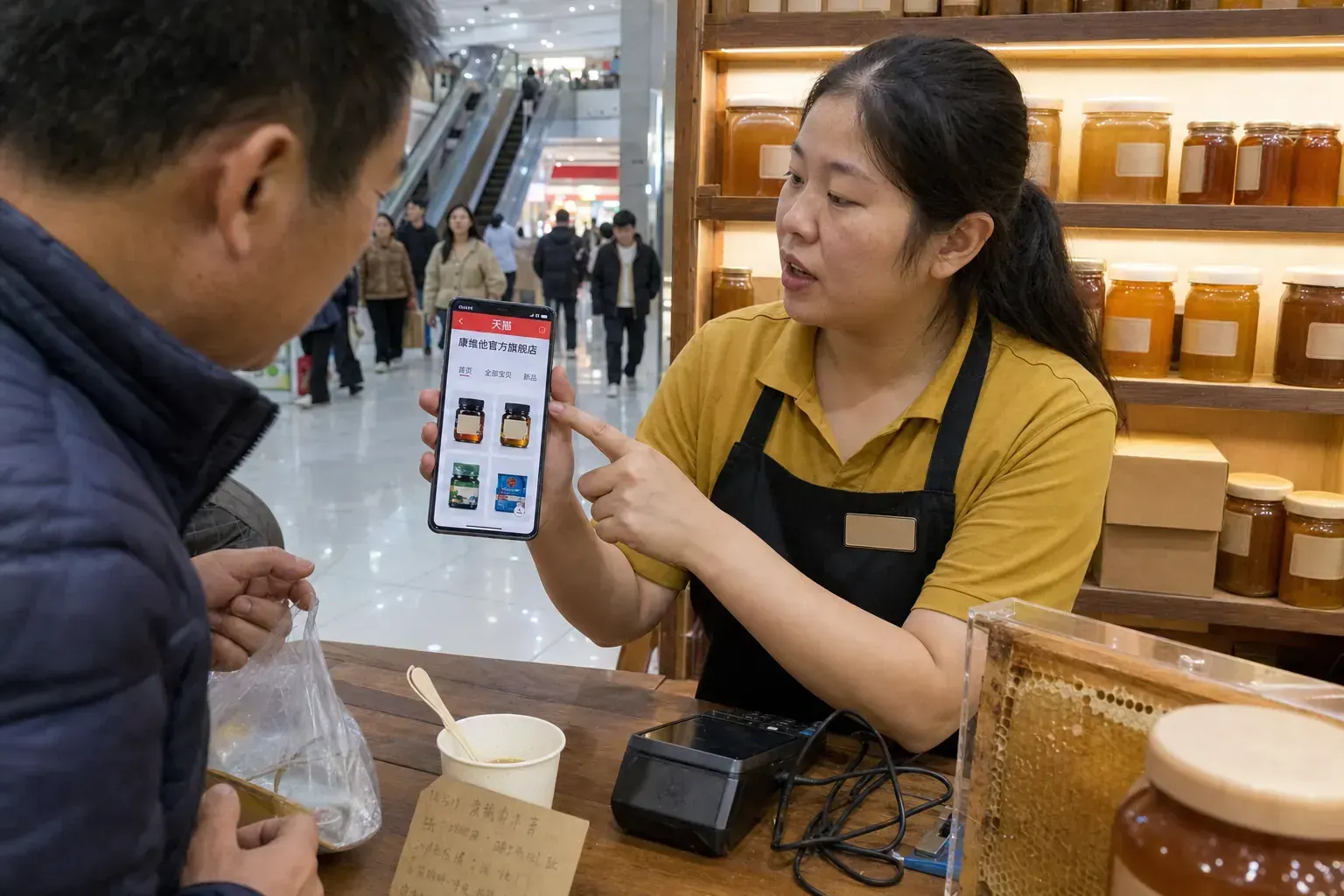
Two official stores were live on November 20, 2026. On JD, the 康维他京东自营旗舰店 is a self-operated flagship, which means JD buys the stock and sells it itself. On Tmall, comvita康维他官方旗舰店 is a domestic flagship, not a Tmall Global store, with a 5.0 product quality score on its store page. JD’s product grid didn’t load for a logged-out visitor and Tmall blocked repeat visits, so we don’t quote prices, review counts or the size of the range.
That setup matters. We read the two store types this way: Comvita doesn’t sell to China mainly from overseas. It sells through a Chinese company, with stock already in the country.
The company still calls itself the category leader. It also calls China its hardest market.
Greater China remains our toughest market. Cautious consumer spending and ongoing commoditisation by brands reliant on the oversupply of Mānuka honey continue to weigh on the category. Even so, we have held our number one position with more than 50% market share and remain the leader in online sales, which we have brought in house in 2026. Source: Comvita Limited, Annual Report 2026, August 2026. https://comvita.co.nz/cdn/shop/files/Annual_Report_2026_WEB_FA.pdf
The share figure is Comvita’s own claim, and the report doesn’t name its source. Greater China sold NZ$73.6 million in fiscal 2026. On our arithmetic, that’s 34.5% of group revenue of NZ$213.0 million.
How Comvita entered China, step by step
| Date | What happened | Where it is recorded |
|---|---|---|
| 2004 | Exclusive distributor starts with two staff; first store in Shenzhen | Newsroom, 2022; Comvita release, 2024 |
| April 2016 | China’s cross-border tax rules take effect; daigou buying falls | Ministry of Finance; Comvita chair, 2017 |
| September 2016 | 51/49 joint venture with the distributor announced | NZ Herald, 2016 |
| Fiscal 2018 | Joint venture sells NZ$46 million | NZX notice, August 2018 |
| May 2019 | Comvita takes full control of the China business | Annual Report 2020 |
| Fiscal 2023 | Greater China sales peak at NZ$106.3 million | Annual Report 2026 |
| December 2024 | Accounting irregularities found in the China subsidiary | Annual Report 2025 |
| August 2025 | Hainan subsidiary deregistered | Annual Report 2025 |
| 2026 | Online sales brought in house | Annual Report 2026 |
The distributor came first and stayed for 12 years. Zhu Guangping, a Chinese businessman who found the brand in a Hong Kong pharmacy, signed on as exclusive distributor in 2004.
In 2004 Zhu became the exclusive distributor of Comvita’s natural health products in China, with a sales force of two. Comvita now has almost 200 people on the ground in China, plus another 74 in Hong Kong. Source: Newsroom, February 2022. https://newsroom.co.nz/2022/02/08/how-comvita-went-from-two-to-200-staff-in-china/
One distributor in premium retail, and what that implied
The first shelves were offline. Food Inc (小食代) traced the early years in 2022 and quoted Zheng Yan, Comvita’s China general manager, on the split today.
In its early years in China, Comvita expanded mainly through high-end supermarkets and department stores. As Chinese ecommerce grew, it followed and built online channels. “Our online and offline sales are now roughly half each,” Zheng said. Source: Food Inc (小食代), November 2022. https://www.foodinc.com.cn/2022/11/19/20221119002/
By 2016 the distributor, Shenzhen Comvita Natural Food (SCNF), ran more than 400 branded department store kiosks and 35 Comvita stores. About a third of its sales already came through Tmall and JD.
SCNF’s network includes more than 400 Comvita-branded department store kiosks and 35 branded Comvita stores in tier-one cities. About one-third of SCNF sales are made through ecommerce platforms such as Tmall and JD.com. Source: Farmers Weekly, September 2016. https://www.farmersweekly.co.nz/news/comvita-takes-lead-in-chinese-distributor/
This route asks for patience and a partner you trust. Comvita got both. In 2016 it said the SCNF business had grown about 30% a year since 2004.
Our reading, not the company’s: the cost was control. For 12 years the price list and the customer data sat with a partner. To get them back, Comvita paid twice.
A second channel ran outside the contract entirely. Daigou resellers bought Comvita honey in New Zealand and Australia and sent it on to customers in China. Comvita didn’t run that trade. It did depend on it.
The SCNF-Comvita business has experienced a compound annual growth rate of 30% since 2004. We estimate that Chinese customers ultimately consume approximately 60% of our total sales, whether sold in Mainland China, or via tourists in Australasia, Hong Kong or other parts of the world. We expect the grey channels used by a number of importing companies will become increasingly difficult to navigate for many product lines over time as China demands compliance with its “Blue Hat” Health Food legislation. Source: Scott Coulter, Comvita CEO, via Export and Trade, September 2016. https://exportandtrade.co.nz/news/comvita-form-distribution-jv-china
What the China entry visibly cost
No filing gives a China launch budget. What’s on the record is the price of taking the business back from the distributor, in two steps.
Comvita and SCNF formed a 51/49 joint venture. Comvita became the controlling shareholder through the issue of 2.83 million shares at NZ$10.60 a share, worth a total of NZ$30 million. Source: NZ Herald, September 2016. https://www.nzherald.co.nz/business/comvita-forms-joint-venture-with-china-distributor/LVBRDKTVNTKZ7JTVZ4C3M6A5DM/
Comvita will acquire the remaining 49% of the joint venture through the issue of 4.05 million new shares and a cash payment of NZ$3.19 million. The joint venture has revenues of about NZ$55 million a year. Source: Comvita Limited, NZX announcement, April 2019. https://www.nzx.com/announcements/333180
In between, the joint venture paid its way. Comvita booked only its share of the profit, not the sales.
Our Chinese joint venture, Comvita Food (China) Ltd., continued its good start. Sales were NZ$46 million and our 51% share of the joint venture’s after-tax profit was NZ$3.3 million. Source: Comvita Limited, NZX announcement, August 2018. https://www.nzx.com/announcements/322500
Once China sat fully on Comvita’s books, the annual reports gave it a line of its own.
| Fiscal year | Greater China sales (NZ$ million) | Net contribution (NZ$ million) | Contribution margin |
|---|---|---|---|
| 2020 | 79.0 | 11.2 | 14.1% |
| 2021 | 93.1 | 19.9 | 21.4% |
| 2022 | 96.9 | 23.0 | 23.7% |
| 2023 | 106.3 | 25.7 | 24.1% |
| 2024 | 86.6 | 15.5 | 17.8% |
| 2025 | 77.2 | 11.6 | 15.0% |
| 2026 | 73.6 | 10.2 | 13.9% |
Greater China sales were NZ$96.9 million in fiscal 2022, NZ$106.3 million in fiscal 2023, NZ$86.6 million in fiscal 2024, NZ$77.2 million in fiscal 2025 and NZ$73.6 million in fiscal 2026, with net contribution falling from NZ$25.7 million at the peak to NZ$10.2 million. Source: Comvita Limited, Annual Report 2026, August 2026. https://comvita.co.nz/cdn/shop/files/Annual_Report_2026_WEB_FA.pdf
The 2020 row needs a footnote. Sales rose 53.6% from NZ$51.4 million in fiscal 2019, mostly because Comvita took full control in May 2019 and the China business came onto its books in full. Like for like, China revenue grew 10.9% that year. The 2021 row comes from the 2025 report, and fiscal 2023 and 2024 are as restated in 2025.
In China, where Comvita took full control of its former joint venture in May 2019, revenue grew (like for like) by 10.9%. Greater China sales were NZ$79.0 million, against NZ$51.4 million the year before, up 53.6%. Source: Comvita Limited, Annual Report 2020, September 2020. https://api.nzx.com/public/announcement/360147/attachment/331206/360147-331206.pdf
Fiscal 2025 brought the write-downs. Comvita booked NZ$53.9 million of impairments across the group and allocated NZ$18.1 million to Greater China. That’s an accounting charge, not cash out the door. It does mean the books now value the China business lower.
The Greater China and South East Asia CGUs have been impacted by a downturn in consumer demand in Asian markets, particularly China. Total impairment was NZ$53.9 million, with NZ$18.1 million allocated to Greater China, and the group recognised a net loss after tax of NZ$104.8 million for fiscal 2025. Source: Comvita Limited, Annual Report 2025, September 2025. https://api.nzx.com/public/announcement/459072/attachment/452470/459072-452470.pdf
Where Comvita lost time, and what it cost
The first hit came from outside China. In April 2016 Beijing changed how cross-border ecommerce imports were taxed: duty at 0%, but import VAT and consumption tax at 70% of the full amount, with a 2,000 RMB cap per order.
Cross-border ecommerce retail imports within the limits carry a 0% tariff for now, with import VAT and consumption tax charged at 70% of the statutory amount. The single-transaction limit is 2,000 RMB. The notice takes effect on April 8, 2016. Source: Ministry of Finance (财政部), 财关税〔2016〕18号, March 2016. http://www.mof.gov.cn/gp/xxgkml/gss/201603/t20160324_2510682.htm
Comvita’s chair, Neil Craig, put a number on the effect a year later.
Daigou through Asian distributors in Australia and New Zealand had been an important route into China, but last April China imposed an 11.9% tariff on daigou goods, and distributors bought less honey. Comvita posted a half-year loss of 7.1 million (710万) and its shares fell 16%. Source: 这才是新西兰, via Sohu (搜狐), April 2017. https://m.sohu.com/n/486738376/
The 11.9% is the chair’s figure; the notice doesn’t print it. Fiscal 2019 was worse: a NZ$27.7 million net loss, which the company tied to Chinese rules on daigou resellers and tighter New Zealand export specifications for manuka.
Sales volume and margin have been directly impacted by the changes to market access rules imposed by the Chinese government on daigou resellers, at the same time as New Zealand’s Ministry for Primary Industries imposed tighter specifications on the export of branded Mānuka honey. Source: Newsroom (RNZ), August 2019. https://newsroom.co.nz/2019/08/23/comvita-profits-hit-from-chinese-market-restrictions/
The second stretch runs from fiscal 2023. Greater China sales fell three years in a row, about NZ$32.7 million in all on our arithmetic, while Comvita still claims more than half the market. Leadership didn’t hold the price. The 2026 report blames cheap manuka from brands riding a supply glut.
Then the books. In December 2024, Comvita found irregularities in sales and receivables at Comvita Food (China) Limited and restated fiscal 2023 and 2024.
In December 2024 historical accounting irregularities were identified related to sales and accounts receivable balances in Comvita Food (China) Limited. Comvita Food (Hainan) Co Ltd was deregistered on August 12, 2025. Source: Comvita Limited, Annual Report 2025, September 2025. https://api.nzx.com/public/announcement/459072/attachment/452470/459072-452470.pdf
A Hainan plan didn’t survive either. In 2022 Comvita told Food Inc it planned an Asia-Pacific supply chain center in the Hainan free trade zone. The Hainan subsidiary was deregistered in August 2025, and the filing gives no reason.
By then the whole company was up for sale. Its board backed a NZ$56 million takeover by Florenz, agreed in August 2025. Shareholders turned it down in November.
The board had pushed shareholders to vote in favour of a NZ$56 million deal with Florenz. To be approved, the scheme needed at least 75 percent of votes cast by shareholders in each interest class. In the second interest class, 54.29 percent voted in favour. Source: RNZ, November 2025. https://www.rnz.co.nz/news/business/579079/comvita-takeover-bid-fails
Comvita raised new money instead and got back to profit.
The raise was completed in May 2026 at NZ$40.5 million, NZ$30 million through a pro-rata rights offer and NZ$10.5 million through a strategic placement to F&N Ventures. The group recorded a net profit after tax of NZ$7.7 million for the year ended June 30, 2026. Source: Comvita Limited, Annual Report 2026, August 2026. https://comvita.co.nz/cdn/shop/files/Annual_Report_2026_WEB_FA.pdf
What another food brand should copy, and what to avoid
Copy the patience with one partner. Zhu’s company started with two staff and had more than 200 by 2016, according to Comvita. A good distributor in China can build a category for you. Our China distribution service handles the search and the contract.
Don’t copy the buyback terms by default. Comvita paid NZ$30 million in shares for 51% of a business built on its own brand, then more shares and cash for the rest. Our view: write the buyout formula and the reporting rules into the first contract, before the business is worth buying.
Plan for the grey channel. If 60% of your sales end with Chinese buyers, some of that volume runs through resellers you don’t control, and one tax notice can move it. The Blackmores teardown shows the same exposure in vitamins.
Owning the subsidiary brings one more job. Comvita’s restatement came five years after it took full control. A brand that buys out its importer is buying its accounting too, and needs its own finance people reading the ledgers. If you are still choosing that importer, our guide to choosing a food importer in China sets out the checks.
Questions about Comvita in China
When did Comvita enter China?
In 2004. That year Zhu Guangping became Comvita’s exclusive distributor in China with a sales force of two, and the first store opened in Shenzhen’s Luohu MixC mall, according to Comvita. A 51/49 joint venture with the distributor was announced in 2016, and Comvita took full control in May 2019.
How big is China for Comvita?
Greater China, Hong Kong included, sold NZ$73.6 million in fiscal 2026, the year to June 30, 2026. That was about 34.5% of group revenue, down from 46% in fiscal 2022. The best year was fiscal 2023, at NZ$106.3 million. Comvita says it holds more than 50% of the manuka honey market in China.
Does Comvita sell on Tmall Global?
Its official Tmall flagship isn’t a Tmall Global store. On November 20, 2026 it was a domestic store, and its JD store was a self-operated flagship, where JD buys and sells the stock. In both, the goods are already in China. Back in 2016, about a third of the distributor’s sales came through Tmall and JD.
What went wrong for Comvita in China?
Three things, on the record. China’s 2016 cross-border tax rules cut daigou buying in New Zealand and Australia. Greater China sales fell about 31% from fiscal 2023 to fiscal 2026 as manuka prices dropped. And in December 2024 the company found accounting irregularities in its China subsidiary and restated two years of results.
Plan your China entry channel by channel, before you sign a distributor.
Updated November 20, 2026
Working on China? Let's grab a coffee.
Tell us where you are now and where you want to get to.