Oatly entered China in 2018 through Shanghai’s specialty coffee shops, after a supermarket launch stalled. Baristas made the oat latte famous and Asia revenue grew fivefold in a year. Then the company built capacity ahead of demand. It wrote off $25.1 million on an unfinished second Chinese plant, and in 2025 it put the whole China business up for review.
Oatly entered China in 2018 through specialty coffee and tea shops and passed 8,000 doors by the end of 2020. Source: Oatly Group AB, prospectus (Form 424B4), May 2021. https://www.sec.gov/Archives/edgar/data/1843586/000119312521168012/d123209d424b4.htm
This teardown is for food and drink brands deciding which China channel to open first, and when to build locally. Oatly is useful because it’s listed: its filings break out China figures that private brands never publish.
Figures come from those filings and dated Chinese reporting, checked on October 28, 2026. Our own conclusions are labeled. Oatly has no commercial tie to our group.
Where Oatly stands in China today
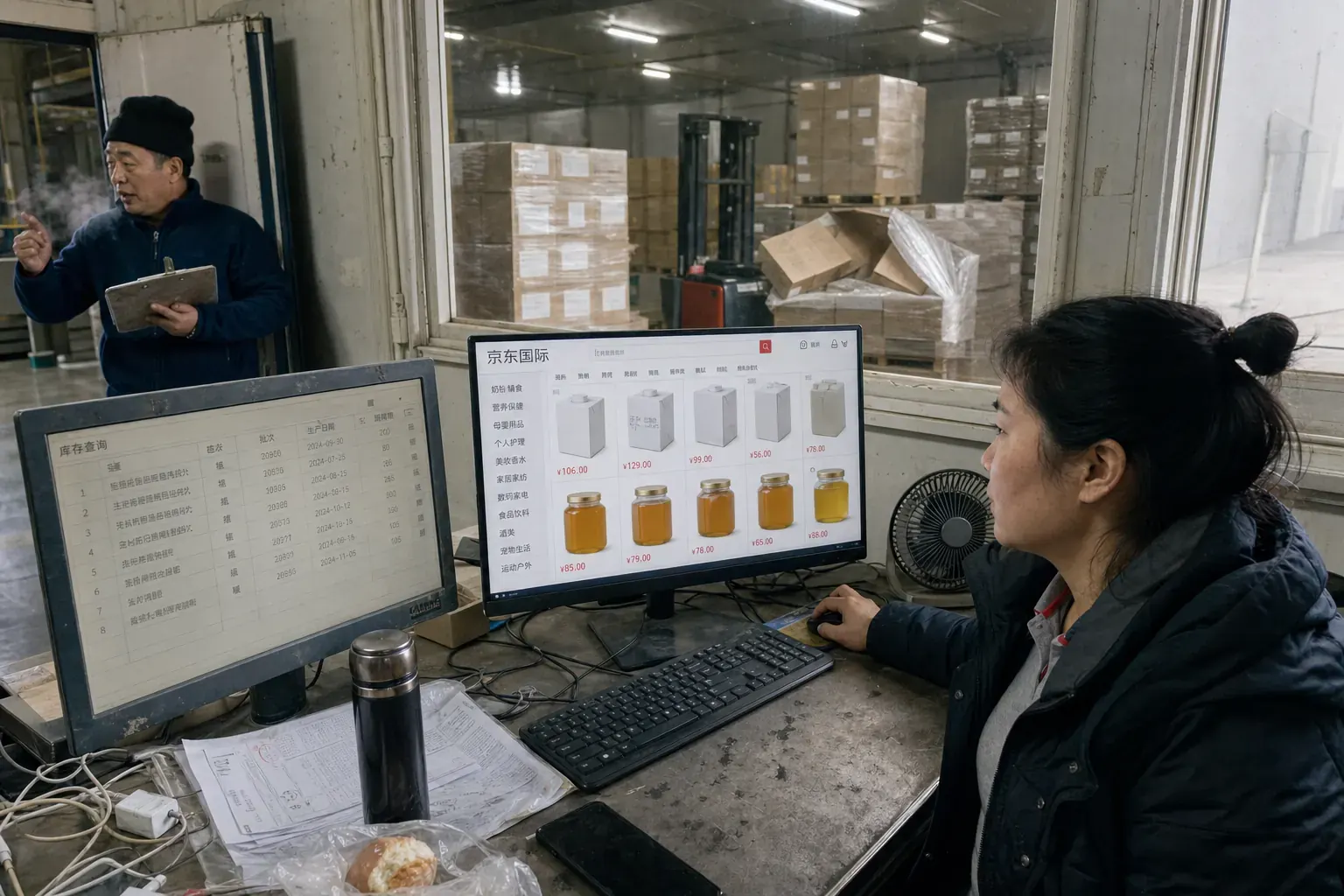
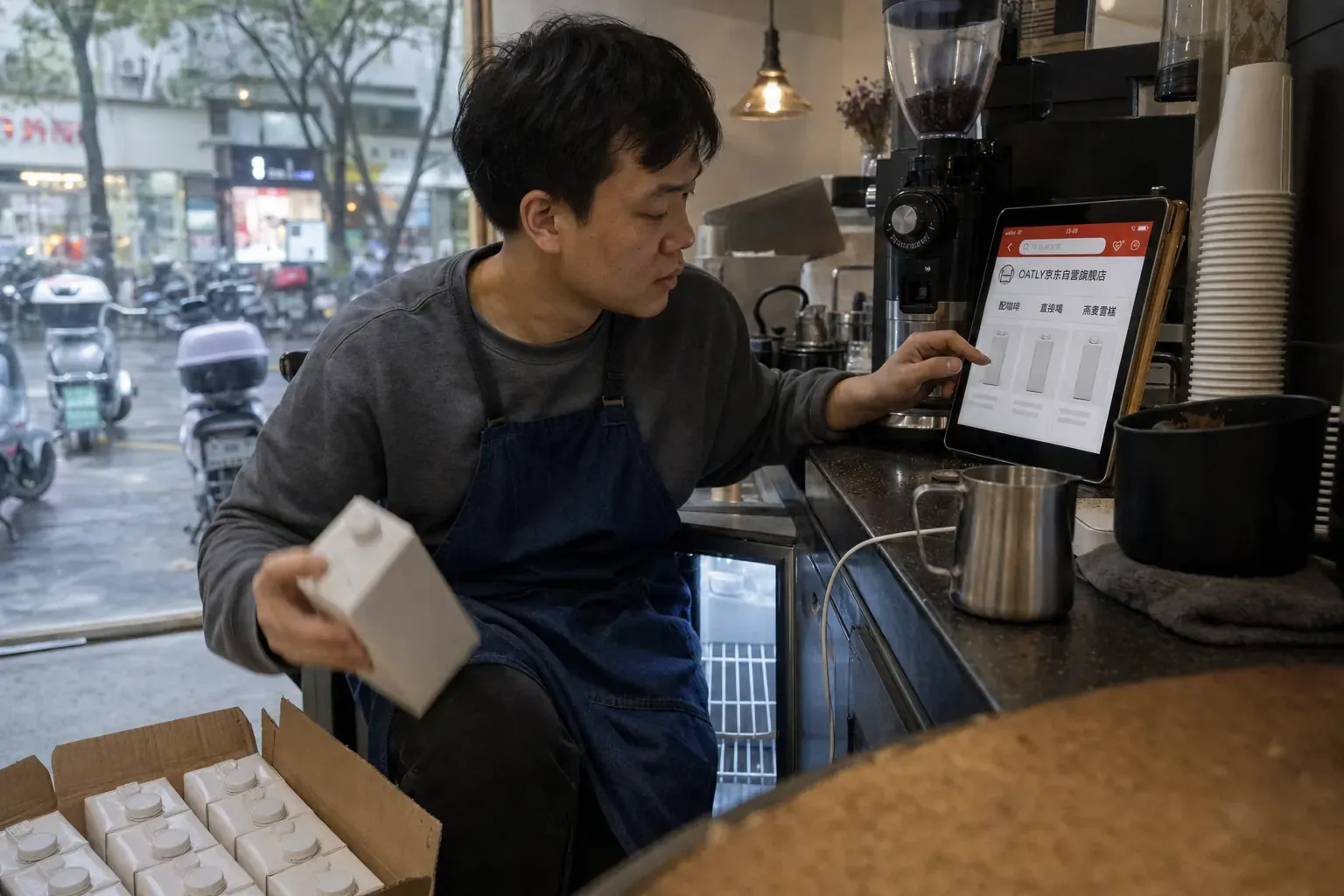
Oatly runs a JD self-operated flagship, the format where JD buys the stock and sells it itself. The menu follows how people drink the product: “for coffee” (配咖啡), “drink it straight” (直接喝), and oat ice cream. A flagship on Tmall, Alibaba’s main domestic marketplace, is live too.
The JD shop shows those menu routes; the public view gives no prices, review counts, or full product count. Source: JD (京东), storefront observation, October 2026. https://oalty.jd.com/
Greater China brought in $130.0 million in 2025, about 15% of group revenue, and earned $3.6 million in adjusted EBITDA, a profit measure that strips out one-off costs. Two years earlier it lost $57.5 million on the same measure.
Greater China revenue: $124.7 million (2023), $114.9 million (2024), $130.0 million (2025). Adjusted EBITDA: minus $57.5 million, minus $1.6 million, plus $3.6 million. Source: Oatly Group AB, annual report (Form 20-F) for 2025, March 2026. https://www.sec.gov/Archives/edgar/data/1843586/000184358626000004/otly-20251231.htm
Coffee shops and other foodservice accounts made up 54% of China revenue in the second quarter of 2026, down from 62% a year earlier. The segment posted an adjusted EBITDA loss of $1.5 million that quarter.
Q2 2026: Greater China revenue $30.1 million, about 54% foodservice, adjusted EBITDA loss of $1.5 million. Source: Oatly Group AB, second-quarter 2026 results, July 2026. https://www.sec.gov/Archives/edgar/data/1843586/000184358626000021/otly-ex99_1.htm
The sequence Oatly ran, with dates
The first attempt was the obvious one. In early 2018 Oatly put its cartons in Ole’, a premium supermarket chain. Shoppers asked if it was some kind of foreign soy milk. Even with a promoter in the aisle, the shelf sold two or three cartons a day.
So the team narrowed it down: one city (Shanghai), one channel (coffee), one product (the Barista Edition). Between March and June 2018 it got into several hundred cafes.
The Ole’ shelf sold two or three cartons a day; the cafe push then reached several hundred shops between March and June 2018. Source: CEIBS (中欧国际工商学院), case column, November 2022. https://cn.ceibs.edu/new-papers-columns/22366
| Date | What happened | Where it is recorded |
|---|---|---|
| Early 2018 | Ole’ supermarket launch | CEIBS |
| March to June 2018 | Several hundred Shanghai cafes | CEIBS |
| 2019 | Tmall brand awards; Asia revenue $10.2 million | Prospectus |
| End of 2020 | 8,200+ coffee and tea outlets, 4,700 of them Starbucks China | Prospectus |
| November 2021 | Ma’anshan plant opens, phase one sized for 150 million liters a year | Yicai |
| 2024 | Second China plant (Asia III) abandoned; Singapore plant closed | Form 20-F |
| July 2025 | Strategic review of Greater China announced | Q2 2025 report |
| June 2026 | Management buyout talks reported | 21st Century Business Herald |
Phase one of the Ma’anshan plant in Anhui opened on November 18, 2021, sized for 150 million liters a year at full output. Source: Yicai (第一财经), November 2021. https://www.yicai.com/news/101240506.html
Why coffee shops came first, and what that implied
A cafe fixed what the supermarket couldn’t. The barista explains the product and the customer tastes it in a latte. Nobody guesses what the carton is for.
By the end of 2020, 4,700 Starbucks China stores offered Oatly as their exclusive oat option. Asia revenue went from $10.2 million in 2019 to $53.7 million in 2020, and e-commerce on Tmall, JD, and other platforms made up 21% of China revenue that year.
Asia segment revenue: $10.2 million (2019), $53.7 million (2020). In 2020, e-commerce was 21% of revenue in China. Source: Oatly Group AB, prospectus (Form 424B4), May 2021. https://www.sec.gov/Archives/edgar/data/1843586/000119312521168012/d123209d424b4.htm
Our reading: the cafes did the marketing, and the online stores sold to people who had met the product over a counter. The catch is concentration. Big buyers fight on price, and when China’s coffee chains went into a price war, Oatly felt it.
The first-quarter 2026 decline came from foodservice, where a sharper coffee price war pushed customers to squeeze prices. Retail revenue grew 150% in 2025. Source: Beijing Business Today (北京商报), via Economic Observer (经济观察网), June 2026. http://www.eeo.com.cn/2026/0612/912748.shtml
If you sell into Chinese cafes, the distribution route you choose decides who absorbs that pressure: you, or a distributor standing between you and the chains.
What the China entry visibly cost
The filings give no launch budget. They do show what the segment lost or wrote off. It was called Asia in 2021 and Greater China later, so read the rows as a sequence, not one clean series.
| Item (US$) | Amount | Period |
|---|---|---|
| Asia segment EBITDA | minus 5.2 million | 2019 |
| Asia segment EBITDA | minus 2.1 million | 2020 |
| Greater China adjusted EBITDA | minus 57.5 million | 2023 |
| Asia III charges in Greater China | 25.1 million | 2024 |
| Greater China adjusted EBITDA | plus 3.6 million | 2025 |
| Strategic review costs | about 8.5 million | 2025 to mid-2026 |
Asia III impairment and related costs: $25.1 million in 2024. Strategic review costs: $7.5 million in 2025, $0.13 million in Q1 2026, $0.8 million in Q2 2026. Source: Oatly Group AB, Form 20-F for 2025 (March 2026) and Q1 and Q2 2026 results (April and July 2026). https://www.sec.gov/Archives/edgar/data/1843586/000184358626000004/otly-20251231.htm https://www.sec.gov/Archives/edgar/data/1843586/000184358626000015/otly-ex99_1.htm https://www.sec.gov/Archives/edgar/data/1843586/000184358626000021/otly-ex99_1.htm
The $8.5 million total is our sum. So is this: the Asia III charge alone is about seven times what the segment earned in adjusted EBITDA in 2025.
Where Oatly lost time and money
The costliest decisions in Oatly’s China story were about factories.
Ma’anshan’s first phase opened in late 2021 with room for 150 million liters a year. Oatly then started a second Chinese plant. In 2024 it stopped building, handed back that site’s land lease and took the $25.1 million charge. Its annual report now describes an asset-light model: existing plants and co-packers first, new buildings last.
Now look at sales. From July 2025 to June 2026, Greater China sold 116.8 million liters, our sum of four quarterly figures. Even if every liter came from Ma’anshan, its first phase wouldn’t be full.
Greater China sold volume by quarter, Q3 2025 to Q2 2026: 32.5, 32.5, 26.8, and 25.0 million liters. Source: Oatly Group AB, quarterly results, October 2025 to July 2026. https://www.sec.gov/Archives/edgar/data/1843586/000119312525254614/otly-ex99_1.htm https://www.sec.gov/Archives/edgar/data/1843586/000119312526045535/otly-ex99_1.htm https://www.sec.gov/Archives/edgar/data/1843586/000184358626000015/otly-ex99_1.htm https://www.sec.gov/Archives/edgar/data/1843586/000184358626000021/otly-ex99_1.htm
Then came the review, announced in July 2025, with a divestment of the China business among the options. In June 2026 Chinese press reported that local management was in substantive talks to buy it, aiming to close within 2026. Oatly says only that it expects to finish the review this year.
Oatly’s Q2 2025 report opened a review of Greater China, with options including a possible divestment. Source: Beijing Business Today (北京商报), via Sina Finance, July 2025. https://finance.sina.com.cn/jjxw/2025-07-25/doc-infhqxsq8960218.shtml
Greater China management was pursuing a buyout, targeting completion within 2026; negotiations remained uncertain. Source: 21st Century Business Herald (21世纪经济报道), June 2026. https://www.21jingji.com/article/20260609/herald/7ab5f69bad862cccb77de2c356360e47.html
What another drinks brand should copy, and what to skip
Hindsight is cheap with quarterly filings. Some of it still travels.
Copy the narrowing. One city, one channel, one product is a plan a small team can run. Pick the place where your product gets explained before it gets bought: for Oatly the cafe counter, for you maybe a bakery chain or a hotel breakfast buffet.
Copy the order, too. Online sales followed the cafes. Our view: a Tmall store opened before anyone knows the product has to buy every visit it gets.
Skip the second plant. Use a co-packer, or keep importing, until China volume fills the first line. To price a demand test with no local production, the Tmall Global setup and running cost calculator costs a cross-border store by category. Its figures are ours and generic, not Oatly’s.
Then plan for the price war before it arrives. If a few chains carry most of your China revenue, build retail early enough to take the weight. Oatly’s retail sales grew 150% in 2025, the same year its China foodservice sales started to slip.
By early 2026, Chinese press was blaming a coffee price war for the slide.
Questions about Oatly in China
When did Oatly enter China?
In 2018. Oatly’s 2021 prospectus dates its entry to that year, through the specialty coffee and tea channel. A CEIBS case study places a supermarket test at Ole’ in early 2018, before the cafe push that put Oatly into several hundred Shanghai coffee shops between March and June.
Is Oatly selling its China business?
It might. Oatly put Greater China under strategic review with its second-quarter 2025 results and expects to finish within 2026. Chinese press reported in June 2026 that local management was in talks to buy the unit. No deal had been announced in Oatly’s filings when we checked on October 28, 2026.
Does Oatly make its China products locally?
Yes, in part. Oatly leases a plant in Ma’anshan, Anhui province, that runs the whole process from oats to packed drinks. It opened in November 2021. A second Chinese plant, Asia III, was abandoned in 2024, the same year Oatly closed its plant in Singapore.
Updated October 28, 2026
Working on China? Let's grab a coffee.
Tell us where you are now and where you want to get to.