Lululemon entered China slowly. It set up a Shanghai company in 2013, then ran showrooms and community events for about three years. A Tmall flagship opened in November 2015, and the first three stores in December 2016. By fiscal 2025, China Mainland sold $1.75 billion and earned a 40% segment margin, the company’s most profitable region.
China Mainland net revenue was $1,754.8 million in 2025, up 28.9%, with segmented income from operations of $701.1 million, 40.0% of revenue. Source: lululemon athletica inc., annual report (Form 10-K) for fiscal 2025, March 2026. https://www.sec.gov/Archives/edgar/data/1397187/000139718726000020/lulu-20260201.htm
This teardown is for apparel and sportswear brands deciding how fast to go into China, and in what order. Lululemon helps because it’s listed in the US and reports China Mainland as its own segment. Few brands publish that.
Figures come from Lululemon’s SEC filings and dated Chinese reporting, checked on November 3, 2026. Where we draw a conclusion, we say so. Lululemon has no commercial tie to our group.
Where Lululemon stands in China today
China Mainland had 174 company-operated Lululemon stores on August 2, 2026, up from 99 at the start of 2023. Online, the brand sells through a WeChat store, its own site, lululemon.cn, and third-party marketplaces.
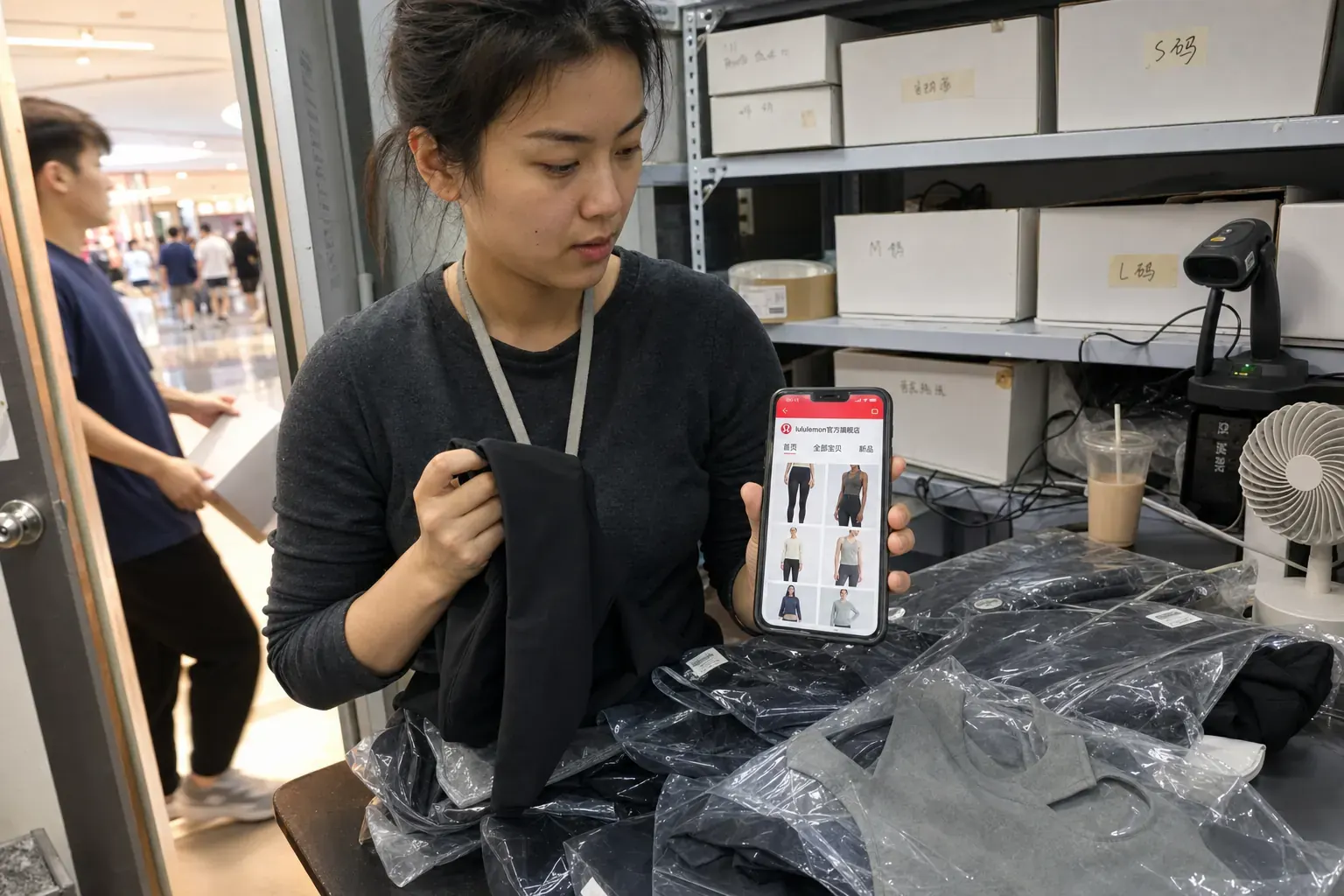
The Tmall flagship (lululemon官方旗舰店) is live. Its product pages sit behind the Taobao login, so we can’t give an honest count of products, prices or reviews. JD and Douyin flagships followed in 2022 and 2024.
174 company-operated stores in China Mainland at August 2, 2026. Second quarter China Mainland revenue $407.1 million, up 4%, down 2% in constant dollars; comparable sales down 2%, or 8% in constant dollars. Source: lululemon athletica inc., quarterly report (Form 10-Q), September 2026. https://www.sec.gov/Archives/edgar/data/1397187/000139718726000127/lulu-20260802.htm
China was 16% of group revenue in fiscal 2025. It’s also where the new stores go: the annual report filed in March says most 2026 openings will be there.
The sequence Lululemon ran, with dates
| Date | What happened | Where it is recorded |
|---|---|---|
| 2013 | Lululemon Trading (Shanghai) registered; first showroom at Xintiandi | PEdaily, via Winshang |
| Fiscal 2014 | First China showrooms in the annual filing | Form 10-K |
| September 2014 | Second Shanghai showroom | PEdaily, via Winshang |
| October 2015 | Beijing Sanlitun showroom | PEdaily, via Winshang |
| November 18, 2015 | Tmall flagship opens | Niaogebiji |
| December 2016 | Three stores open in Shanghai and Beijing | PEdaily; Form 10-K |
| 2018 | WeChat store launched; 22 stores across Greater China | Form 10-K |
| February 2020 | Every mainland store closed for a time | Form 10-K |
| July 19, 2022 | JD flagship opens | Beijing Daily |
| January 12, 2024 | Douyin flagship opens | Jiemian |
| August 2026 | 174 China Mainland stores | Form 10-Q |
Lululemon set up Lululemon Trading (Shanghai) in 2013 and opened its first showroom at Xintiandi. It opened three stores at once in mid-December 2016: Shanghai IFC in Pudong, Jing’an Kerry Centre and Beijing Sanlitun. Source: PEdaily (投资界), via Winshang (赢商网), September 2023. http://m.winshang.com/news716444.html
The dates don’t line up perfectly. Chinese press puts the first showroom in 2013. The annual filing for fiscal 2014 (February 2014 to January 2015) says that’s the year showrooms opened “for the first time in China.” And the filing for fiscal 2016 calls the December openings Lululemon’s “first stores in China.” Either way, the gap between arriving and selling from a real shop was about three years.
During fiscal 2014, Lululemon opened showrooms for the first time in China and said it would keep using a community-based approach to build brand awareness in new countries. In fiscal 2016 it opened 11 stores in Asia and Europe, including its first stores in China. Source: lululemon athletica inc., Form 10-K for fiscal 2014 (March 2015) and fiscal 2016 (March 2017). https://www.sec.gov/Archives/edgar/data/1397187/000139718715000016/lulu-20150201x10k.htm https://www.sec.gov/Archives/edgar/data/1397187/000139718717000008/lulu-20170129x10k.htm
Tmall before the stores, and what that implied
The Tmall store opened on November 18, 2015, roughly a year before any Lululemon store in China. New products went up about every two weeks, moving toward the same release calendar as Canada.
The Tmall flagship opened on November 18, 2015, with new products about every two weeks, gradually in step with Canada. From 2013 to 2016, Lululemon had no sales store in mainland China, only showrooms at Xintiandi, Shanghai Centre and Sanlitun. Source: Niaogebiji (鸟哥笔记), April 2024. https://www.niaogebiji.com/article-672827-1.html
Our reading: the showrooms and the events built demand in two cities, and Tmall sold to it nationwide with no rent to pay. The stores came about a year later. It’s a cheap way to start, and a slow one.
It also meant Lululemon ran its own China operation from day one, with its own Shanghai entity. No distributor sat in between. A smaller brand can run the same test as a cross-border store, without a Chinese company. On our generic apparel figures, a Tmall Global store asks for a 50,000 RMB deposit, a 60,000 RMB annual fee and a 5% commission; JD Worldwide asks for 35,500 RMB with no annual fee and 6%. Those are TheChinaPath calculator data, November 2026, not Lululemon’s costs. The Tmall Global setup and running cost calculator works through them by category.
What the China entry visibly cost
The filings give no launch budget, and Lululemon doesn’t report capital spending by segment. China revenue didn’t get its own line until the annual report for fiscal 2022. So the early years are a blank in the numbers.
What the recent filings do show is the cost of running China at scale, and what it returns.
| China Mainland (US$ million) | 2023 | 2024 | 2025 |
|---|---|---|---|
| Net revenue | 963.8 | 1,361.3 | 1,754.8 |
| Selling, general and admin | 230.6 | 328.9 | 417.5 |
| Segment income from operations | 337.3 | 509.9 | 701.1 |
| Segment margin | 35.0% | 37.5% | 40.0% |
| Stores at year end | 127 | 151 | 172 |
China Mainland segment figures for 2023 to 2025, and store counts at January 28, 2024, February 2, 2025 and February 1, 2026. Source: lululemon athletica inc., Form 10-K for fiscal 2023 (March 2024) and fiscal 2025 (March 2026). https://www.sec.gov/Archives/edgar/data/1397187/000139718724000010/lulu-20240128.htm https://www.sec.gov/Archives/edgar/data/1397187/000139718726000020/lulu-20260201.htm
Selling and admin costs in China rose 81% in two years. Revenue rose 82%. That’s our arithmetic. The cost base kept pace with sales, and the margin still widened.
For scale, the Americas segment earned 32.6% on its revenue in 2025 (again our calculation, same filing). China makes more on each dollar it sells.
Where Lululemon lost time, and what it cost
No filing puts a price on the slow start. What the filings do show is how long China stayed too small to report. Until December 2016 the brand had no sales store in the mainland. When China finally got its own revenue line, in the report filed in March 2023, the 2020 figure for Greater China (Hong Kong, Taiwan and Macau included) was $297.7 million. For the years before that, outsiders have no China number at all.
People’s Republic of China net revenue: $297.7 million (2020), $520.4 million (2021), $681.6 million (2022), including Hong Kong, Taiwan and Macau. Source: lululemon athletica inc., Form 10-K for fiscal 2022, March 2023. https://www.sec.gov/Archives/edgar/data/1397187/000139718723000012/lulu-20230129.htm
Then came February 2020. Lululemon closed every store in mainland China for a time. All but one had reopened when it filed its annual report in late March.
In February 2020, Lululemon temporarily closed all of its retail locations in mainland China; all but one had reopened at the time of filing. Source: lululemon athletica inc., Form 10-K for fiscal 2019, March 2020. https://www.sec.gov/Archives/edgar/data/1397187/000139718720000012/lulu-20200202x10k.htm
The marketplaces came late, too. JD opened in July 2022, almost seven years after Tmall. Douyin opened in January 2024.
Lululemon’s official flagship opened on JD on July 19, 2022. Source: Beijing Daily (京报网), July 2022. https://wap.bjd.com.cn/news/2022/07/19/10120103.shtml
Lululemon’s official Douyin flagship opened on January 12, 2024. Source: Jiemian (界面新闻), DT Finance, February 2024. https://www.jiemian.com/article/10838693.html
The sharper problem is current. In the second quarter of 2026, China comparable sales fell 8% in constant dollars, on lower conversion. Revenue still edged up because the store count did. In March, the company had guided to about 20% China growth for 2026. The first half came in at 16%, or 10% in constant dollars.
Lululemon expected China Mainland revenue to grow about 20% in fiscal 2026, with most of its 25 to 30 international store openings in China. Source: Xinhua (新华网), March 2026. https://www.news.cn/fashion/20260320/61536197af664dffa7cdda418023128f/c.html
Our view, not the company’s: if the same stores keep selling less, each new lease has to work harder to pay back.
What another sportswear brand should copy, and what to skip
Copy the order. Prove demand before you sign a big lease. Lululemon’s showrooms and Tmall store did that job for about a year before the first shop opened.
The control is worth copying too, if you can pay for it. With a brand-owned entity, pricing and customer data stay in-house. We think the 40% China margin is partly the return on that. Most brands can’t fund a Shanghai company on day one. A cross-border store tests the same demand question for far less, with no local entity.
Skip the long wait on the other marketplaces. Lululemon took almost seven years to add JD after Tmall, and eight to add Douyin. A brand starting now has no reason to treat the second platform as a later project.
Watch same-store sales more closely than the store count. Lululemon’s China revenue kept growing in 2026 while comparable sales fell.
For a sportswear brand with a smaller budget, the On Running teardown shows another route into China: Tmall first, then a mix of its own stores and dealer-run ones.
Questions about Lululemon in China
When did Lululemon enter China?
It registered Lululemon Trading (Shanghai) in 2013 and opened a showroom at Xintiandi, according to Chinese press. Its annual filing dates the first China showrooms to fiscal 2014. The Tmall flagship opened on November 18, 2015, and the first three full stores opened in Shanghai and Beijing in December 2016.
How big is China for Lululemon?
China Mainland brought in $1.75 billion in fiscal 2025, 16% of group revenue, and earned $701.1 million in segment operating income. The company had 174 stores there in August 2026. Growth slowed in the second quarter of 2026, when comparable sales fell 8% in constant dollars.
What is a Lululemon showroom?
Lululemon’s fiscal 2014 annual report describes showrooms as small locations with a limited range, opened when it enters a new market. In China, it ran three: two in Shanghai and one at Beijing Sanlitun, from 2013 until the first stores opened in December 2016.
Does Lululemon sell through a distributor in China?
Its filings name none. Lululemon runs company-operated stores in China, plus outlets and pop-ups, and sells online through its WeChat store and third-party marketplaces. Its Tmall, JD and Douyin stores are official flagships.
Plan the order of your China launch, store by store and platform by platform
Updated November 3, 2026
Working on China? Let's grab a coffee.
Tell us where you are now and where you want to get to.