A livestream agency, usually an MCN, sells a creator’s time and is paid from the commission on that creator’s sales. A Douyin Partner runs your shop and your own live room, with your ad account in the same budget. Brands that hire the first and expect the second pay slot fees and end up with no audience of their own.
Douyin is China’s short-video app, and it sells through live rooms, short videos and a storefront. When foreign brands weigh a Douyin livestream agency vs a DP (Douyin Partner), they are comparing two businesses that Douyin itself files in separate systems, with separate ways of getting paid.
There is a third kind in between: an agency that runs sessions in your own live room for an hourly fee.
Douyin livestream agency vs DP, side by side
The two main bills sit side by side in our Douyin cost calculator. At its defaults, RMB 2 million of first-year sales with creators moving 80% of it, a DP on a RMB 30,000 monthly retainer plus 5% costs RMB 460,000 a year, 23% of sales. Creator commission at 20% adds RMB 320,000, or 16% (TheChinaPath calculator data, October 2026). That’s about US$64,800 and US$45,100 at our planning rate of RMB 7.10 to the dollar. Every third-party figure below was checked on October 19, 2026.
| Question | Creator agency (MCN) | Live-room agency | Douyin Partner (DP) |
|---|---|---|---|
| What it runs | Creators’ own accounts and sessions | Hosts and sessions in your live room | Your shop, your live room, your ads, creator bookings |
| Douyin’s gate | 6 months old, RMB 500,000 capital, 3 creators bound | None of its own. Those listed in Douyin’s service market sit under brand livestream service, at the DP bar | Invitation only, 20 staff (12 on Douyin), RMB 100,000 deposit, RMB 3 million shipped sales a quarter |
| How it’s paid | Out of the commission you set (5% to 50%, up to 80% for named creators), plus slot fees from big hosts | Hourly or per session; one 2024 report cites quotes of RMB 500 and 2,000 an hour | Monthly retainer plus commission on sales; RMB 30,000 a month plus 5% in our calculator |
| What you keep when it leaves | The orders. The audience stays on the creator’s account | Followers and replays on your account. The hosts leave | The shop, account and ad history, if they’re in your company’s name |
| When to use it | A launch, a festival push, a price test | Hours or promotions your team can’t staff | Running Douyin as a channel, month after month |
Sources: Douyin MCN management code (September 15, 2026), operating service provider rules (October 16, 2026) and affiliate settlement rules (October 12, 2026); Beijing Business Today, May 20, 2024; TheChinaPath calculator data, October 2026.
What each one runs, in Douyin’s own rules
Douyin keeps creator agencies and store operators in separate systems.
MCNs sign up on Buyin (巨量百应), the back office creators use to pick products and track commission. The bar is low.
Douyin admits an MCN that has been in business at least six months, has registered capital of RMB 500,000 or more and binds at least three e-commerce creators. Source: Douyin E-commerce (抖音电商), Buyin MCN management code, revised June 2026. https://school.jinritemai.com/doudian/web/articlev0/114051
Store operators go through Douyin’s service market instead, and the bar is much higher.
Douyin admits operating service providers by invitation, after a site visit. A provider needs 20 or more staff, 12 of them on a Douyin team, an office of at least 100 square meters and a RMB 100,000 deposit. Brand providers must ship RMB 3 million of sales a quarter through the stores they serve (RMB 2 million in luxury cross-border). Source: Douyin E-commerce (抖音电商), operating service provider cooperation rules, October 2026. https://school.jinritemai.com/doudian/web/article/aJ2D2SbD5GWe
Inside that market Douyin lists full brand service and brand livestream service as separate categories, next to a revenue-share category.
Douyin’s service market splits brand operating providers into full brand service (品牌全案服务), brand livestream service (品牌直播服务) and revenue-share settlement (分成结算). Source: Douyin E-commerce (抖音电商), operating service provider management code, July 2026. https://school.jinritemai.com/doudian/web/articlev0/aJ5N3Pxir67C
In Douyin’s books an MCN is a talent business. Some are very good at moving stock through their creators. None of that work touches your shop.
Your own live room is another thing altogether. Douyin binds each shop to one Douyin account, the shop’s official account, and that’s where a store broadcast (the brand selling on its own account) runs.
Douyin binds every shop to a single Douyin account, which serves as the shop’s official account. Source: Douyin E-commerce (抖音电商), shop official account notice, September 2022. https://school.jinritemai.com/doudian/web/article/aHbHwLQPDWaZ
How each one gets paid
An MCN gets paid from the creator commission you set on each product, and only on orders that stick.
Commission is set at 5% to 50% on plans open to all creators and up to 80% on some plans for named creators. Commission is not settled on orders refunded within the after-sale period. Source: Douyin E-commerce (抖音电商), affiliate commission settlement rules, October 2026. https://school.jinritemai.com/doudian/web/articlev0/112620
Douyin takes its cut first. The agency’s comes out of what’s left.
Douyin deducts a technical service fee of 10% from the commission on the agency side. The MCN sets the split of the rest between itself and the creator in its own back office. Source: Douyin E-commerce (抖音电商), Buyin MCN management code, revised June 2026. https://school.jinritemai.com/doudian/web/articlev0/114051
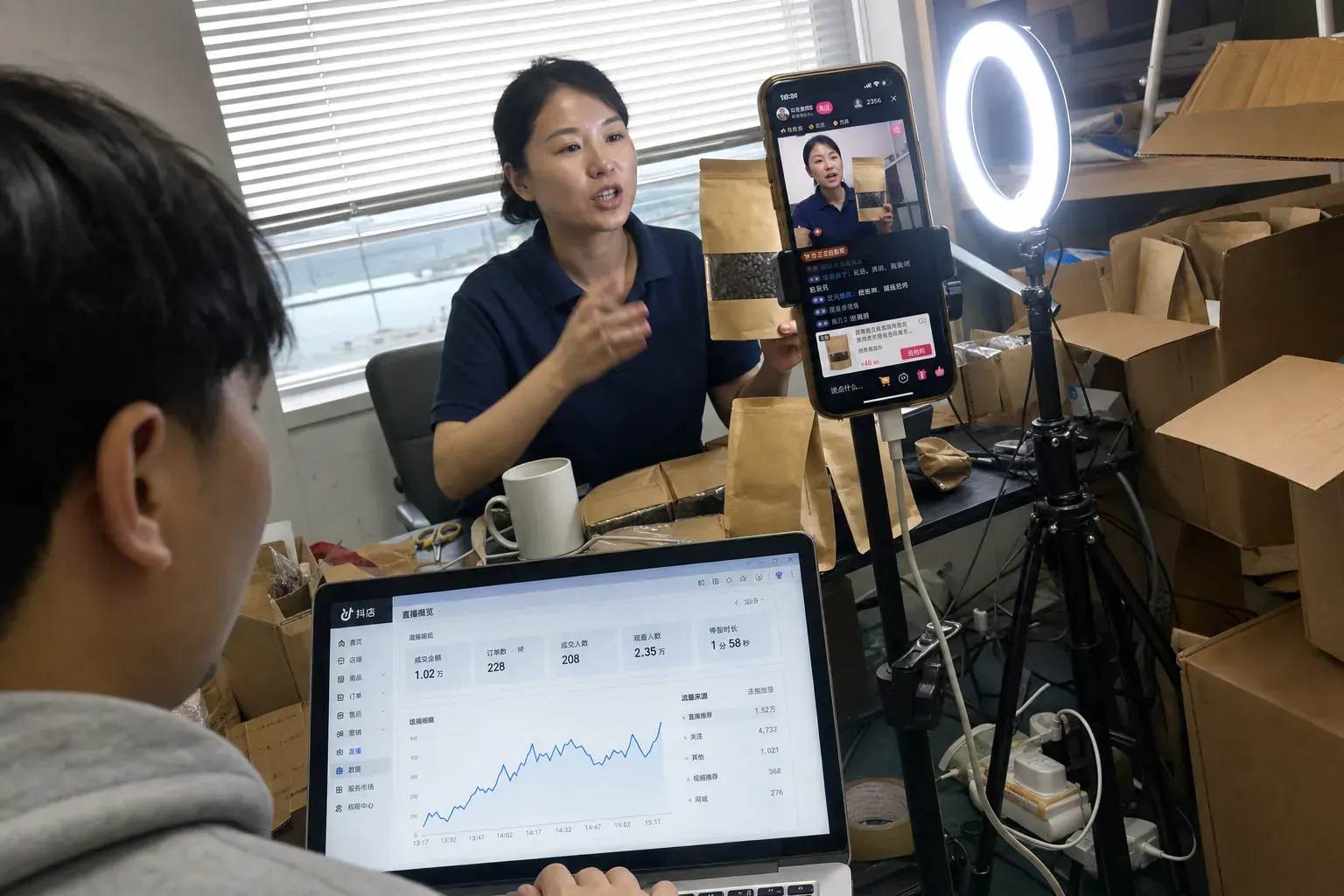
At the calculator’s defaults, creator commission works out to RMB 50 on a RMB 250 order. If those creators all sat with MCNs, Douyin would keep RMB 32,000 of the RMB 320,000 a year. The other RMB 288,000 goes to agencies and creators, split on terms the MCN sets and the brand doesn’t see. Big hosts charge a slot fee for airtime on top.
A live-room agency bills for time, and the quotes run wide.
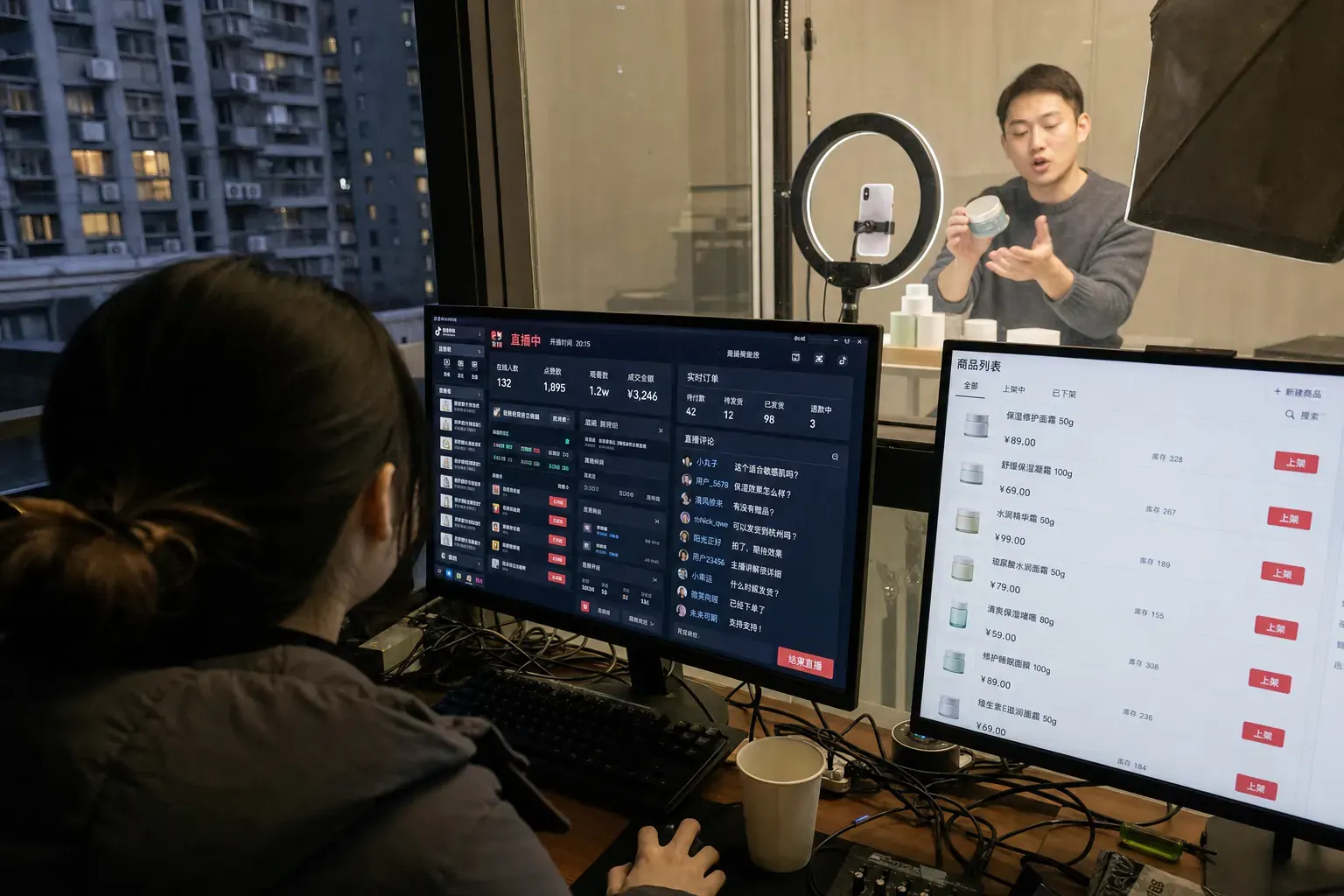
A host who had sold for major brands told Beijing Business Today that brands hand their own live rooms to outside agencies for big promotions. One agency quoted RMB 2,000 an hour and another RMB 500, and the brand moved sessions to the cheaper one. Source: Beijing Business Today (北京商报), on Beijing Daily’s site, May 20, 2024. https://xinwen.bjd.com.cn/content/s664b5f05e4b00fc26b9e0c15.html
That’s roughly US$70 and US$280 an hour. It’s also one host’s account from 2024 (it isn’t a rate card), so get three dated quotes for the same hours before you pick.
The DP charges a retainer plus a share of sales. Our calculator’s default is RMB 30,000 a month plus 5%. Ads and creator commission sit outside it, paid by you. What the live room itself costs to run, line by line, is in our piece on China livestream costs for brands.
Why the creator route keeps less
The invoices are only half of it. What’s left on your account afterward matters as much.
Creator sales cost more to win, RMB for RMB, than sales from a brand’s own room.
From mid-tier creators up, the creator cost ratio (slot fee, commission and ad spend over creator sales) is at least 35%. A brand’s own broadcasts typically run more than 10 points lower: one food merchant put its own room at 40% to 50% and creators above 50%. Source: Ebrun (亿邦动力), carried by Huxiu (虎嗅), July 16, 2025. https://m.huxiu.com/article/4584498.html
Brands’ own rooms now carry a big share of Douyin’s livestream sales.
During the 618 festival in 2025, half of the sales driven by Douyin livestreams came from brands’ own store broadcasts. Nearly 70% of merchants with more than RMB 10 million of livestream sales used store broadcasts. Source: 21st Century Business Herald (21世纪经济报道), January 30, 2026. https://www.21jingji.com/article/20260130/herald/50ea314a64d44c9664cf2c6a0132a9cc.html
Our calculator builds that shift into its second year. It moves creators from 80% to 60% of sales and lets sales with no ad or commission behind them grow from 5% to 20%. On its defaults, that’s RMB 600,000 of second-year sales against RMB 100,000 in the first (TheChinaPath calculator data, October 2026). Those are model assumptions, not results. They also assume someone is running your own room every day. A plan built only on MCN sessions doesn’t produce that line.
What to put in the contract
China’s livestream rules, in force since February 1, 2026, reach every one of these agencies.
Anyone who actually runs another party’s live room carries the live-room operator’s legal duties. A host agency that works with a live-room operator must sign a written agreement setting each side’s duties on host management, content, product quality checks and consumer protection. An agency that picks products must verify the seller’s licenses and certificates and keep the records for at least three years. Source: Cyberspace Administration of China (国家网信办), carrying SAMR and CAC Order No. 117, Livestream E-commerce Supervision Measures, articles 2, 43 and 45, published December 18, 2025. https://www.cac.gov.cn/2026-01/07/c_1769516655383334.htm
Build the contract around that. Then add a few lines of your own.
- For an MCN: the creators by name, the commission per product, any slot fee booked through Douyin’s cooperation order, and what happens to the fee if sales miss.
- For a live-room agency: the hours, the hosts, who writes the script, and confirmation that the room stays on your shop’s official account.
A DP contract needs one more line, on the scope of any revenue share. Douyin penalizes providers that promise a cut of “selected links” and then take a share of the whole shop. That rule helps only if the scope is on paper.
Keep the shop, the official account and the ad account in your company’s name whoever runs them. The details are in who owns your Tmall store, Douyin shop and customer data.
Running a DP and creators together
The calculator’s default plan is built that way: a DP on the shop and the room, with creators booked around it for launches and festivals. The DP usually books those creators. Ask it to report creator cost apart from its own fee, per creator and per kept order (an order the buyer doesn’t return).
Our guide to finding a Douyin Partner covers the checks to run before you sign. Compass holds the DPs we have watched run rooms in our categories, and our social commerce page lists the rest of the work a Douyin channel needs.
Paying creators per post to build awareness, rather than per sale, is a separate budget. TheRedScroll, the group’s China social media agency, handles that side.
Frequently asked questions
Is an MCN the same as a Douyin Partner?
No. Douyin registers them in different systems. An MCN signs creators on Buyin and is paid out of creator commission. A Douyin Partner is admitted to Douyin’s service market by invitation, with at least 20 staff and a RMB 100,000 deposit, and runs a brand’s shop, live room and ads for a retainer and a share of sales.
Can a livestream agency run my own live room?
Yes. Some agencies run sessions in a brand’s room for an hourly or per-session fee, and some brands bring them in for big promotions. Under China’s livestream rules, whoever actually runs your room takes on the operator’s duties too. Keep the account in your company’s name and the hours, hosts and scripts in the contract.
What does a Douyin Partner cost?
Usually a monthly retainer plus a commission on sales. The Douyin calculator on this site defaults to RMB 30,000 a month plus 5%, or RMB 460,000 a year on RMB 2 million of sales, 23% of the total. Ads on Qianchuan, Douyin’s ad platform, and creator commission are paid on top. At the calculator’s defaults those two come to RMB 440,000, close to the DP’s own fee.
Should a new brand start with creators or its own room?
Plan for both if the budget allows. Creators bring reach fast. Their audience, though, stays on their accounts. Your own room builds followers and sales on your shop’s account, and its costs run lower against sales: Ebrun reported own-room cost ratios at least 10 points below creator sessions.
Updated October 20, 2026
Working on China? Let's grab a coffee.
Tell us where you are now and where you want to get to.