A Hong Kong company is a clean overseas seller for cross-border ecommerce and a practical place to hold stock and sign contracts. It doesn’t replace a mainland importer for general trade, the duty-paid route into supermarkets and distributors. Use it for those three jobs, and hire the mainland partner for the fourth.
Brands ask about Hong Kong for good reasons. It’s next door to Shenzhen, its courts hear cases in English and it sits outside China’s customs territory. That last fact is the whole story. It’s why Hong Kong works as a seller and a warehouse, and why it stops at the border for anything sold duty-paid.
| Use | Works from Hong Kong? | What else you need |
|---|---|---|
| Cross-border seller (Tmall Global, Douyin Global) | Yes, the platforms accept a Hong Kong company | A mainland agent that registers with customs, a bank account outside the mainland, a trademark |
| Stock hub | Yes, no customs duty except on four goods | A bonded warehouse in the mainland for fast delivery, or direct mail at slower speed |
| Contracting party | Yes, Hong Kong law and arbitration reach mainland courts | An arbitration clause that names a Hong Kong institution |
| General trade importer | No | A mainland company filed with customs as the consignee, and for food a filed importer |
Platform rules, Hong Kong fees and customs rules in this piece were checked against their sources in November 2026.
A Hong Kong company as your cross-border seller
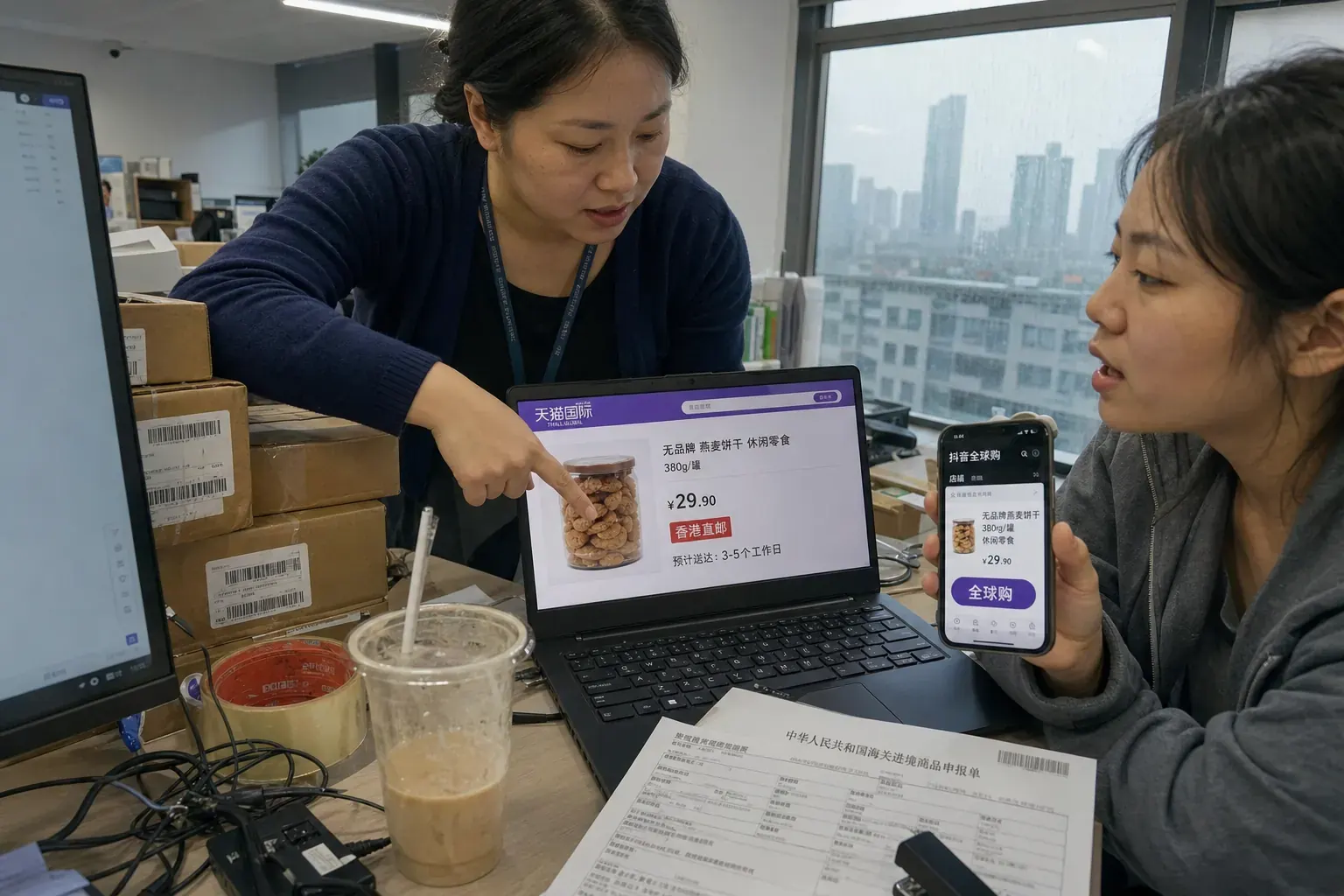
This is where Hong Kong does its best work. China’s cross-border retail rules want the seller to be a company registered outside the mainland that owns the goods. For this purpose Hong Kong counts as outside.
The cross-border retail import operator is an overseas-registered company that owns the goods. Goods move as bonded import (customs code 1210) or direct purchase (9610), and a mainland agent registers with customs and bears joint civil liability with the seller. Source: Ministry of Commerce (商务部) and five agencies, 商财发〔2018〕486号, November 2018. https://www.gov.cn/zhengce/zhengceku/2018-12/31/content_5437823.htm
The platforms say so in their own rules. Tmall Global, Alibaba’s cross-border marketplace, wants a company qualified outside mainland China with an overseas trademark.
The store’s opening entity must be a company in an overseas market or in Hong Kong, Macau or Taiwan, with qualifications outside mainland China and an overseas registered trademark. Source: Tmall Global (天猫国际), Merchant Acceptance Standards, in force March 2025. https://rule.tmall.hk/?type=detail&ruleId=11003210&cId=624#/rule/detail?ruleId=11003210&cId=624
Douyin, TikTok’s Chinese sister app, is more specific about its Douyin Global (抖音全球购) storefronts.
A Douyin Global seller must be registered overseas or in Hong Kong, Macau or Taiwan, and may not be a mainland company. It needs a mainland agent that carries joint liability and a corporate bank account outside the mainland. A Hong Kong company files both its Certificate of Incorporation and its Business Registration Certificate. Source: Douyin E-commerce (抖音电商), Douyin Global admission rules, page dated September 2026. https://school.jinritemai.com/doudian/web/article/108056
So a Hong Kong company can sign up as the seller, collect the platform’s payouts into its Hong Kong bank account and own the stock. What it can’t do is skip the mainland agent. Somebody inside China still registers with customs and shares the liability. On Tmall Global that’s usually the bonded warehouse operator or the Tmall Partner (TP) running the store. Our piece on the Tmall Global importer of record sets out who fills that role.
The shopper side doesn’t change either. Each buyer stays inside the cross-border quota.
Cross-border retail import purchases are capped at 5,000 RMB a transaction and 26,000 RMB a year per shopper. Source: Ministry of Commerce (商务部) policy database, 财关税〔2018〕49号, in force January 2019. https://policy.mofcom.gov.cn/claw/clawContent.shtml?id=65769
What the Hong Kong company costs, next to the store
The company is the cheap part. Hong Kong’s registries publish their fees.
Incorporating a local company with share capital costs HK$1,545 filed electronically, or HK$1,720 on paper, before the business registration fee. Source: Companies Registry (公司註冊處), Hong Kong SAR, FAQ on incorporation, revised June 2026. https://www.cr.gov.hk/tc/faq/local-company/incorporation.htm
A one-year business registration certificate starting between April 1, 2026 and March 31, 2027 costs HK$2,350: a HK$2,200 fee plus a HK$150 levy. Source: Inland Revenue Department (稅務局), Hong Kong SAR, business registration fee and levy table, 2026-27. https://www.ird.gov.hk/chi/pdf/brfee_table.pdf
That’s HK$3,895 in government fees for year one. Company secretary, registered address and audit come on top, priced by whoever provides them.
The store costs far more. TheChinaPath calculator data, November 2026: a Tmall Global store needs 80,000 RMB in deposit and annual fee before its first sale in 12 of the 20 categories our calculator carries, and 110,000 RMB in the other 8. Hold stock in a mainland bonded warehouse and the calculator’s defaults add a 100,000 RMB warehouse deposit and a 300,000 RMB tax prepayment. Those two are model defaults, not quoted market rates.
So the Hong Kong company rarely decides the budget. The store does.
Hong Kong as a stock hub
Hong Kong is a free port, and its customs service puts it plainly.
Imports and exports pay no customs tariff, and there are no tariff quotas or surcharges. Hong Kong has no VAT or general services tax. Only four classes of goods are dutiable: liquor, tobacco, hydrocarbon oil and methyl alcohol. Source: Customs and Excise Department (香港海關), Hong Kong SAR, cargo clearance, revised September 2022. https://www.customs.gov.hk/tc/service-enforcement-information/cargo-clearance/index.html
A brand can land a container in Hong Kong, pay no duty, and split it later: part to direct-mail orders, the rest to a mainland importer when it places an order. Chinese duty and VAT start only when goods cross into the mainland.
The catch is speed. Douyin’s own shipping rule shows the gap.
Bonded orders on Douyin Global must ship within 48 hours of payment. Overseas direct-mail orders must show the international pickup within 120 hours of payment. Source: Douyin E-commerce (抖音电商), Douyin Global shipping rules, revised April 2026. https://school.jinritemai.com/doudian/web/articlev0/107820
Bonded stock in Ningbo or Guangzhou reaches the shopper faster. It also ties up cash before the first order, as the calculator figures above show. A sensible order of play is to test a range on direct mail from Hong Kong, then move the lines that sell into bonded stock.
Hong Kong as the place you sign
Contracts are the quiet reason Hong Kong keeps coming up. Tmall Global itself picks it.
Tmall Global’s merchant service agreement is governed by Hong Kong law. Disputes go to arbitration in Hong Kong at the Hong Kong International Arbitration Centre, before three arbitrators, in English. Source: Tmall Global (天猫国际), merchant service agreement, last updated October 2022. https://terms.alicdn.com/legal-agreement/terms/suit_bu1_tmall/suit_bu1_tmall202111051504_43705.html
A Hong Kong seat also gives you reach into the mainland before the award. A 2019 arrangement between China’s top court and Hong Kong lets a party to a Hong Kong arbitration, run by a listed institution, ask a mainland court to freeze the other side’s assets while the case runs.
A party to an arbitration seated in Hong Kong and run by a listed institution may, before the award, ask the mainland intermediate court where the respondent lives or holds property for preservation of property, evidence or conduct. Source: Supreme People’s Court (最高人民法院), arrangement with the Hong Kong SAR on court-ordered interim measures in aid of arbitration, Arts. 1 to 3, signed April 2, 2019. https://www.court.gov.cn/shenpan/xiangqing/149552.html
By September 2025, Hong Kong arbitral institutions had handled 177 applications under the arrangement, across 48 mainland courts, and approved preservation covered assets worth more than 27.8 billion RMB. Source: Department of Justice (律政司), Hong Kong SAR, Secretary for Justice speech, November 12, 2025. https://www.doj.gov.hk/sc/community_engagement/speeches/20251112_sj1.html
For a distribution deal, that means your Hong Kong company can sell to a mainland importer under a Hong Kong-seated contract and still reach the importer’s assets if it stops paying. The route needs both a Hong Kong seat and a listed institution, so name both in the clause.
Where Hong Kong stops: general trade
General trade (一般贸易) is the route that puts goods on supermarket shelves, in convenience stores and in a distributor’s warehouse, with full duty and VAT paid at the border. Here the declaring party has to be a company registered in mainland China.
Customs files a consignee or declarant only if it holds market-entity status in China. A foreign company’s resident representative office in China gets a temporary filing for non-trade goods only. Source: General Administration of Customs (海关总署), Order No. 253, rules on customs declarant filing, in force January 2022. https://www.gov.cn/gongbao/content/2022/content_5671114.htm
A Hong Kong company is not a mainland market entity. It can sell to the importer and ship from Hong Kong stock. The importer declares the goods and pays the duty and VAT. From the border on, the mainland paperwork is its job.
Food adds a second layer.
Overseas exporters or their agents and food importers must file with the inspection authority, and imported prepackaged food needs a Chinese label that names the domestic agent. Source: Ministry of Commerce (商务部) policy database, Food Safety Law, Arts. 96 and 97, amended September 2025. https://policy.mofcom.gov.cn/claw/clawContent.shtml?id=104105
Your Hong Kong company can be the filed exporter. The mainland importer is still the one on the label. Setting up your own mainland company to fill that seat is possible, but it’s a far bigger project than a Hong Kong one, and the quicker start is an importer or distributor that already holds the filings.
Pairing the Hong Kong company with a mainland partner
The usual shape looks like this. The Hong Kong company holds the stock and signs the contracts. Cross-border sales run through it as the seller of record, with a mainland agent beside it. General trade runs through a mainland importer or distributor that buys from the Hong Kong company and carries the goods over the border.
The hard part is the second half. The importer has to reach the channels you want and hold the filings your category needs. Then it has to pay on time, and that’s the part references tell you more about than any filing. Our cross-border setup service handles the store side. For the general trade side, the guide to finding a distributor in China sets out the checks, and Compass lists importers and distributors we’ve met in person.
FAQ
Can a Hong Kong company sell on Tmall Global and Douyin Global?
Yes. Both platforms accept a company registered in Hong Kong as the store’s seller, and Douyin Global bars mainland companies from that role outright. You’ll still need a mainland agent that registers with customs and shares liability, plus a corporate bank account outside the mainland. Douyin asks a Hong Kong company for both its incorporation certificate and its business registration certificate.
Can my Hong Kong company import goods into China for general trade?
Not by itself. China customs only files a consignee that holds mainland market-entity status, and a Hong Kong company doesn’t. The usual answer is a mainland importer or distributor that buys from your Hong Kong company, declares the goods and pays duty and VAT. For food, that importer also has to be filed with the import inspection authority and named on the Chinese label.
Does keeping stock in Hong Kong save on Chinese duty?
No. Hong Kong charges no duty of its own except on liquor, tobacco, hydrocarbon oil and methyl alcohol, so stock waits there untaxed. Chinese duty and VAT apply when goods cross into the mainland, at cross-border retail rates for direct mail or at full general trade rates through an importer. Holding stock in Hong Kong only moves the tax bill to the day the goods cross.
What does a Hong Kong company cost to set up?
Government fees are HK$1,545 to incorporate online and HK$2,350 for a one-year business registration certificate from April 2026, so HK$3,895 in year one. Company secretary, office address, bank account and audit costs come on top and vary by provider. A Tmall Global store’s deposit and annual fee are a far larger line.
Updated November 7, 2026
Working on China? Let's grab a coffee.
Tell us where you are now and where you want to get to.