
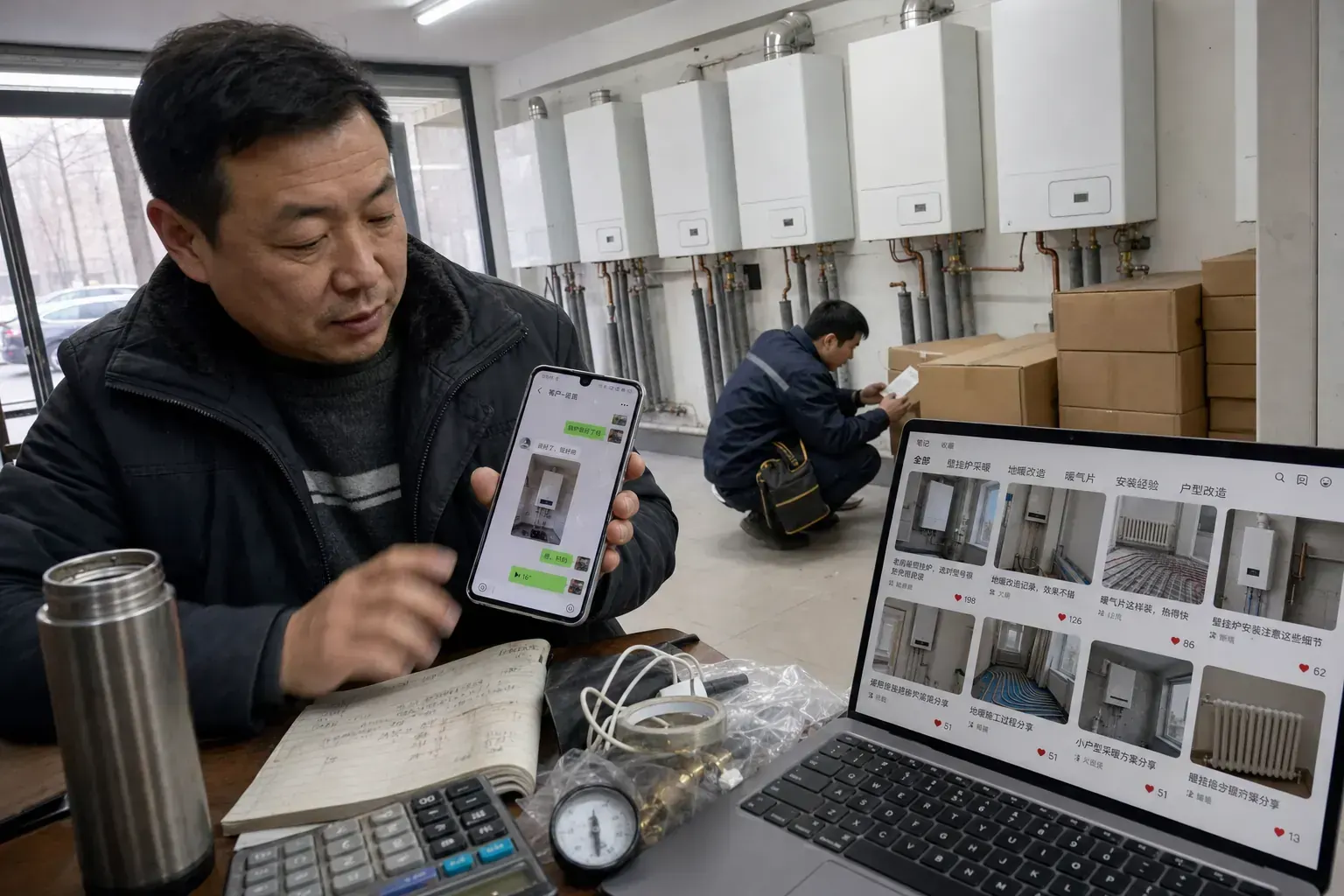
A boiler, a chiller or a heat pump can’t be sold into China through Tmall Global or any other cross-border store. Those products aren’t on the import list. HVAC brands reach Chinese buyers through design institutes and contractors on projects, and through distributors and installers in homes. For a gas boiler, the installer is in the room for every sale.
So the job is building a network on the ground, with online channels feeding it. Here’s what each channel reaches and costs, and who ends up owning the customer.
| Channel | Who it reaches | Cost to run (RMB) | Cost or value of a lead | Who owns the relationship |
|---|---|---|---|---|
| Design institutes and engineering firms | Projects, 71.6% of central AC in 2025 | Sales engineers’ time; no published fee | No published figure | The design institute and the engineering firm |
| Developers’ fitted housing | 61,000 new units in Q1 2025, 80% with central AC | Won by tender | Not applicable | The developer’s buyers |
| Distributors and dealers | Home renovation and retail, 28.4% of central AC | Carried in the dealer’s margin | No published figure | The dealer |
| Installers and service points | Every gas boiler sold to a home | Set up or contracted by the brand; no published rate | Not applicable | The installer |
| Douyin and Xiaohongshu (RedNote) | About 160 million home-interest RedNote users; Midea links 20,000+ stores to both apps | Ad budget set by the advertiser | Haier: about 2,830 RMB of retail sales per lead | The brand account, until a dealer takes over |
| The sales engineer’s and dealer’s contacts | US$99 one-off to verify an overseas account | No published figure | The salesperson | |
| Trade shows | 76,573 visitors at ISH China & CIHE 2026 | From 11,700 per show for a 9 sqm booth (2027 rate) | No published figure | The brand on the day, the dealer after |
Figures are cited below, channel by channel, and were checked against their sources in October 2026. Where a cell says no published figure, we found none we could stand behind.
How HVAC brands reach buyers in China, channel by channel
First, the money. It’s big, and it’s shrinking.
China’s central air-conditioning market was 138.68 billion RMB in 2025, down 4.1%. Domestic sales were 112.55 billion RMB, down 7.4%, and foreign brands held about 41% of them, a share that keeps falling. Source: Midea Group (美的集团), 2025 annual report, citing ChinaIOL (产业在线), March 2026. https://www.midea.com.cn/content/dam/mideacn-aem/%E6%8A%95%E8%B5%84%E8%80%85%E5%85%B3%E7%B3%BB/2025%E5%B9%B4%E5%BA%A6%E6%8A%A5%E5%91%8A.pdf.coredownload.inline.pdf
Heat pumps are a smaller market. Also down.
China’s domestic air-source heat pump market was 23.17 billion RMB in 2025, down 9.5%. Source: China Energy Conservation Association heat pump committee (中国节能协会热泵专业委员会) and ChinaIOL, 2025 heat pump yearbook, April 2026. https://pdf.dfcfw.com/pdf/H3_AP202605121822189843_1.pdf?1778573479000.pdf=
Most central air-conditioning money moves through projects. Hotels, offices, hospitals and housing estates buy on a specification, and the specification is written before any sales call.
Projects made up 71.6% of China’s central air-conditioning market in 2025, and home renovation and retail 28.4%. Source: Xinhuanghe (新黄河), citing iKEN (艾肯网), March 2026. https://news.qq.com/rain/a/20260313A00LJZ00
Who writes that specification? On commercial jobs, the design institute and the engineering company. One listed Chinese maker said so in its 2020 prospectus.
Shenling, a maker of specialized air-conditioning systems, said it usually wins customers through recommendations from design institutes and engineering companies, word of mouth and site visits. Source: Guangdong Shenling Environmental Systems (申菱环境), IPO prospectus, Shenzhen Stock Exchange, June 2020. http://reportdocs.static.szse.cn/UpFiles/rasinfodisc/RAS_00017300DC96A13FED3EC7EFFA3F9D3F.pdf
Housing used to be the other big project door. Developers fitted central air and boilers into finished flats and bought by tender. That door is closing fast, and foreign brands held most of the fittings.
New fitted-housing launches fell 42.1% to 61,000 units in the first quarter of 2025. Central air conditioning went into 80.0% of them, and foreign brands took 56.9% of those fittings. Source: AVC (奥维云网), via Tencent News, May 2025. https://news.qq.com/rain/a/20250512A079UU00
Boilers show the shift most clearly.
China sold 1.26 million wall-hung gas boilers at home in the first three quarters of 2025, down 6%. Retail sold 870,000, up 7%. Projects sold 390,000, down 26%. Source: China Household Electrical Appliances (中国家电网), citing ChinaIOL, November 2025. https://info.cheaa.com/2025/1120/651167.shtml
Wall-hung boiler sales were 1.05 million units in the first half of 2026, down 4.7%. Retail kept growing while the project channel kept shrinking. Source: China Household Electrical Appliances, citing ChinaIOL, August 2026. https://info.cheaa.com/2026/0807/657212.shtml
Retail, in this category, means a dealer and an installer. The big brands count their points of sale in the thousands, water-heater maker A. O. Smith among them.
A. O. Smith sells through about 8,700 points of sale in China, about 1,400 of which sell only its products. Source: A. O. Smith Corporation, annual report on Form 10-K, February 2026. https://www.sec.gov/Archives/edgar/data/91142/000009114226000008/aos-20251231.htm
That network is under strain right now. Prices fall, and fewer people walk in.
A price war has pushed central air-conditioning dealers’ gross margins into single digits, and home-renovation foot traffic has fallen off a cliff, a trade outlet reported. Source: Zhileng Shangqing (制冷商情), via Sohu, September 2026. https://www.sohu.com/a/1079482058_269726
Homeowners research online, and RedNote is one place many of them look.
About 160 million of Xiaohongshu’s more than 300 million monthly users show strong interest in home and renovation content. Source: Ebrun (亿邦动力), via Sina Finance, June 2025. https://finance.sina.cn/tech/2025-06-11/detail-inezsutf9242039.d.html
Midea, the market leader, has wired its own stores into those apps.
Midea has connected more than 20,000 of its stores to online traffic platforms including Meituan, Amap, Douyin and Xiaohongshu. Source: Midea Group, 2025 annual report, March 2026. https://www.midea.com.cn/content/dam/mideacn-aem/%E6%8A%95%E8%B5%84%E8%80%85%E5%85%B3%E7%B3%BB/2025%E5%B9%B4%E5%BA%A6%E6%8A%A5%E5%91%8A.pdf.coredownload.inline.pdf
The creator posts that feed RedNote and Douyin are a content job. That work sits with TheRedScroll, the group’s China social media agency.
WeChat is where a lead gets worked. Sales engineers and dealers keep their customers in their own contact lists, which matters the day a dealer leaves.
An overseas entity pays a one-off review fee of US$99 for each WeChat verification application. Source: WeChat Open Community (微信开放社区), June 2025. https://developers.weixin.qq.com/community/develop/article/doc/000e64388c0f107faf739efcd66813
At a trade show, the distributors and design engineers come to you. One hall, three days.
ISH China & CIHE drew 76,573 visitors from 81 countries and regions to Beijing on March 31 to April 2, 2026. Source: Messe Frankfurt, closing report, April 2026. https://ishc-cihe.hk.messefrankfurt.com/beijing/en/press/press-releases/2026/ISHC26-FR.html
The 2027 show charges 1,300 RMB a square meter for a standard booth, from 9 square meters, and 1,200 RMB for bare space, from 36 square meters, tax included. Source: CIEC GL events (中展智奥), co-organizer booth sales page, May 2025. https://www.bj-ish-cihe.com/sdm/2987219/2/nd-7838263/218438.html
Why there’s no cross-border route for a boiler, a chiller or a heat pump
China’s cross-border retail import list names everything a shopper can buy from abroad through Tmall Global, JD Worldwide or a Douyin cross-border store. Central heating boilers (tariff heading 8403) aren’t on it, and neither are heat pumps or chillers.
The cross-border retail import list carries small room air conditioners of up to 4,000 kilocalories an hour and instantaneous gas water heaters. It carries no line for central heating boilers or heat pumps, and the 2022 update added none. Source: Ministry of Finance (财政部) and 12 other departments, Announcement 2019 No. 96, December 2019. https://gss.mof.gov.cn/gzdt/zhengcefabu/201912/t20191227_3451448.htm
There’s a price cap, too.
Cross-border retail imports are capped at 5,000 RMB a transaction and 26,000 RMB a year per buyer. Source: Ministry of Commerce (商务部) policy database, document 财关税〔2018〕49号, November 2018. https://policy.mofcom.gov.cn/claw/clawContent.shtml?id=65769
A wall-hung gas boiler, the unit sold for homes, sits under that boiler heading. So it comes in through general trade and meets an inspector at the border.
Wall-hung gas boilers are declared under HS code 8403101000. They are goods subject to mandatory inspection, need China Compulsory Certification (CCC), and must have a Chinese energy label before import. Source: China Customs (中国海关) magazine, General Administration of Customs, December 2023. http://chinacustoms.gmcmonline.com/202312/c/19081.shtml
CCC for gas appliances has been enforced since 2020.
Household gas appliances entered CCC certification on October 1, 2019. From October 1, 2020, they could not be sold or imported without it. Source: State Administration for Market Regulation (市场监管总局), Announcement 2019 No. 34, July 2019. https://www.gov.cn/zhengce/zhengceku/2019-11/07/content_5449758.htm
Larger commercial boilers are special equipment. For those, the factory abroad needs its own Chinese license.
Overseas makers of boilers and other pressure equipment need a Chinese manufacturing license, from June 1, 2022. Source: State Administration for Market Regulation, Announcement 2021 No. 41, via China Quality News (中国质量新闻网), December 2021. https://www.cqn.com.cn/zj/content/2021-12/02/content_8759263.htm
Gas rules put the installer in the chain.
Makers and sellers of gas appliances must set up, or contract, after-sales service points staffed by installers and repairers who have passed an assessment. Source: State Council (国务院), Urban Gas Management Regulations, article 32, revised February 2016. https://www.samr.gov.cn/zw/zfxxgk/fdzdgknr/bgt/art/2023/art_335c4cbf82244ad1be861b5d21260bc2.html
What a qualified HVAC lead costs, and how long a sale takes
A cost per qualified HVAC lead in China isn’t published anywhere we could verify. The figures that circulate come from agencies selling lead services. We don’t repeat them.
One honest benchmark exists, and it runs the other way. It’s what a lead was worth to a large Chinese appliance maker that reports one.
Haier’s digital marketing produced 526,400 sales leads from January to June 2025, which converted into 1.49 billion RMB of retail sales. Source: Haier Smart Home (海尔智家), 2025 interim report, August 2025. https://smart-home.haier.com/media/x3deorng/600690-2025%E4%B8%AD%E6%8A%A5.pdf
That’s about 2,830 RMB of retail sales per lead in the first half of 2025, on our arithmetic. A new foreign brand should expect far less. Haier’s leads land on a store network that already exists.
The cycle has two speeds. A home buyer renovating a flat decides inside the renovation, and the installer is in the room. A project starts with the design institute’s drawings and ends at a tender. We found no published length for that cycle. Plan the cash for a sale that can outlast one heating season.
The verdict: sign the network before you buy the reach
Get specified first, then get installed.
For commercial systems that means Chinese technical documents a design engineer can drop into a drawing set, and someone who visits the institutes in person, more than once (one visit gets you a business card). For homes it means distributors who stock the product and installers who are trained, and paid, to fit it.
Online reach comes after the network exists. Midea’s app traffic lands in 20,000 of its own stores. A RedNote search that ends at a dealer who doesn’t carry your boiler is wasted money. Our distribution team builds the distributor side. The work is project-based and quoted after the first call.
What our Viessmann work shows, and what it doesn’t
We built and ran Viessmann’s Tmall and JD stores, two storefronts run by one team across six workstreams, from product pages to customer service (published case figures). Both are domestic stores. That’s the online route this category has.
The stores did best when they sent work to the installers and distributors who already carried the brand. The case page publishes no revenue or lead figure, so none appears here.
Where to start
Map the distributors and installers in your first two or three provinces before anything else. Ask each one which brands it fits today, and what it would take to add yours. Compass, our partner directory, is where we start that shortlist.
FAQ
Can a foreign HVAC brand sell boilers on Tmall Global?
No. Central heating boilers and heat pumps aren’t on China’s cross-border retail import list, and a system priced above 5,000 RMB would also hit the per-order cap. The brand imports through general trade, with CCC where it applies, then sells through dealers or a domestic Tmall or JD store, as Viessmann does.
Who decides which HVAC brand gets installed?
On commercial projects, the design institute and the engineering company write the specification, and contractors buy to it. In homes, the dealer and the installer steer it. Gas boilers have to be fitted by assessed installers under the Urban Gas Management Regulations.
Is the market still worth entering?
Yes, if you build for the retail side. Domestic central air-conditioning sales were 112.55 billion RMB in 2025, down 7.4%, and the foreign share keeps falling. Retail boiler sales still grew in 2025 and early 2026, so dealer and installer coverage counts for more than a developer contract.
Talk to us about building your distributor and installer network in China.
Updated October 30, 2026
Working on China? Let's grab a coffee.
Tell us where you are now and where you want to get to.
